
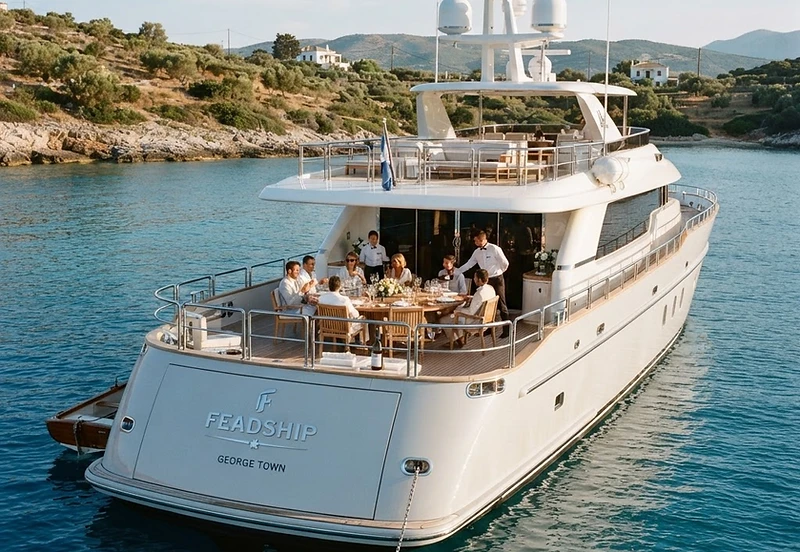
When a vessel of significant stature slips into the protected waters of an anchorage—perhaps tucked behind the limestone cliffs of the Ionian or waiting in the cobalt shadows of a quiet Cycladic bay—the interior focus of the yacht undergoes a subtle, necessary shift. The deck space, previously the realm of navigation, salt-spray exposure, and the sheer kinetic energy of open-water cruising, yields to the interior sanctuary. At the heart of this transition lies the formal dining saloon, a room designed not merely for sustenance but as a stage for the deliberate slowing of time. Unlike the open-air aft deck, where the wind governs the conversation, the saloon functions as a controlled environment. Here, the exterior world is framed behind floor-to-ceiling glass, rendered mute and manageable, a moving portrait of the sea that serves only to heighten the stillness within.
The Geometry of the Table
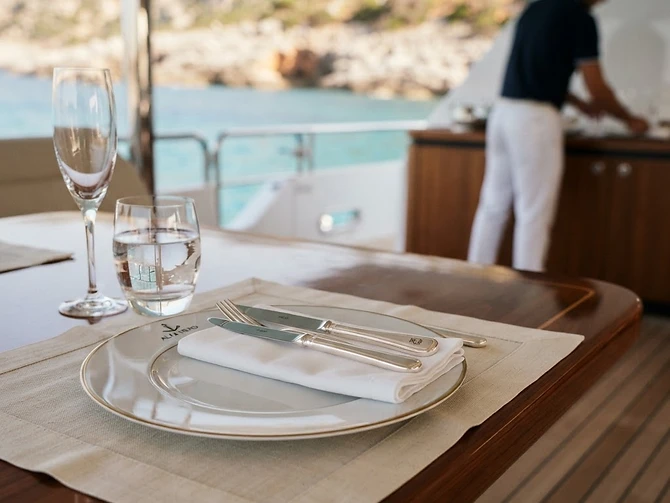
In these high-ceilinged spaces, furniture is rarely a matter of convenience; it is a structural commitment. Bespoke dining tables, often meticulously anchored through the deckhead and the sole to dampen the harmonic vibration of the engines, represent a triumph of maritime engineering disguised as high design. One might find veneers of rare macassar ebony or high-gloss polished sycamore, their edges softened by inlays of brushed titanium. The objective is absolute stability. As the tide shifts and the vessel finds its natural swing at anchor, the dining saloon remains a steadfast coordinate against the chaos of the deep. I recall a dinner aboard a 60-meter Feadship anchored off the coast of Milos; as the vessel swayed gently against the current, the service ware—weighted silver chargers and fine lead-crystal stems—never once shuddered. Everything is curated to respect the movement of the sea, even as the room itself seems to exist in a state of defiance against it.
To dine on board is to accept a quiet, luxurious paradox: one is simultaneously in motion and held in a state of absolute, manufactured poise.
The Art of Ambient Transition
Lighting within the saloon acts as the primary orchestrator of the evening ritual. As the sun dips below the horizon and the sky bleeds from gold into a bruised violet, the focus of the space tightens. Hidden linear LED arrays and discrete pin-spotting wash the tabletop in a warm, low-kelvin directed glow, leaving the peripheral bulkheads in shadow. This high-contrast arrangement minimizes unwanted reflections in the glass, effectively turning the windows into obsidian mirrors that amplify the sense of enclosure. The architecture retreats to allow the meal, the conversation, and the sea to become the sole occupants of the space. It is a mastery of subtraction, where every unnecessary element is pared away to highlight the quiet gravity of the evening. Sitting there, with the faint hum of the generator providing a near-subliminal pulse, one feels the true utility of the space: it is where the yacht ceases to be a machine and becomes a private, drifting estate.
The Final Anchoring
As the evening deepens, the transition from the vitality of the day to the quietude of the saloon marks the true end of the voyage for the day. There is a profound, almost psychological distinction between eating on deck, exposed to the raw salt-air elements, and retreating to the interior cabin for a final course. The saloon serves as the ship's cerebral center, a space where the vast, unscripted uncertainty of the open ocean is replaced by the curated, intentional rhythm of life aboard. It is a place of finality, where the day’s adventures are recounted over a simple, perfectly executed meal, before the anchor light flickers to life and the vessel settles into its long, quiet slumber.






