
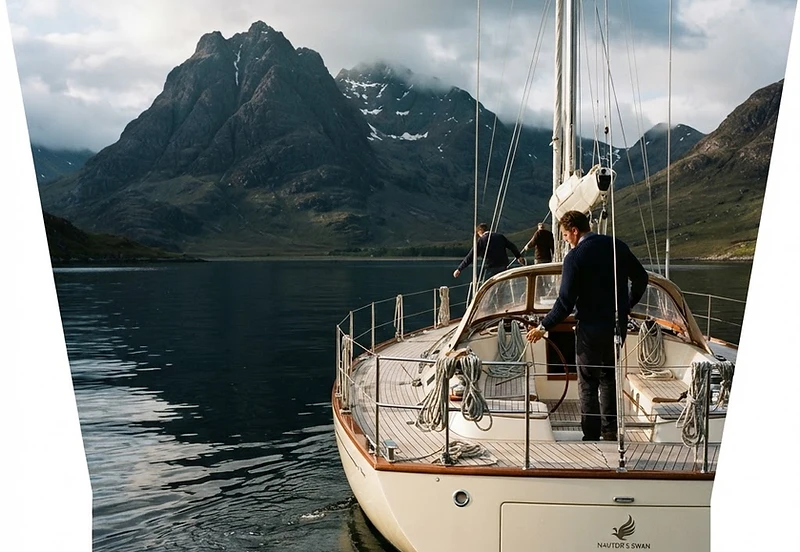
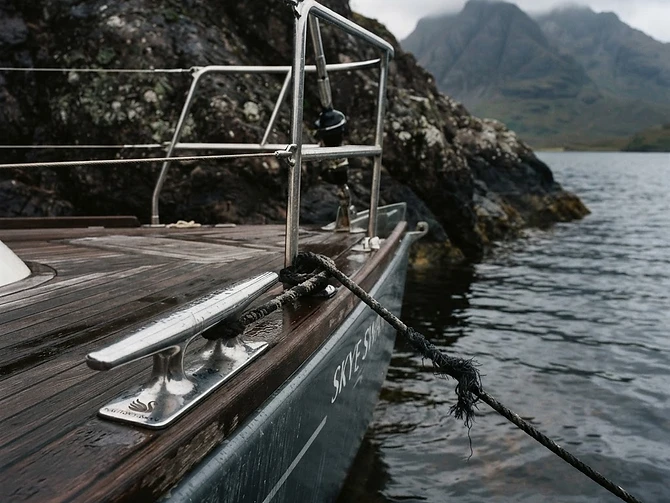
The water in Loch Scavaig, tucked beneath the jagged, ancient ramparts of the Cuillin range on the Isle of Skye, is never truly still. Even at anchor, the Atlantic pulse finds its way into the bay, turning the sea a deep, ink-stained brown from the peat runoff of the surrounding moors. Sitting on the lowered swim platform of a Nautor’s Swan, the transition from the boat’s teak decking to the biting temperature of the Inner Hebrides is a visceral calibration of the senses. One moment you are sheltered within the engineered precision of a Finnish-built hull, and the next, you are suspended just inches above the abyss, the silence broken only by the distant, mournful cry of a golden eagle circling the crags.
The Architecture of the Waterline
For all the sophisticated naval architecture that defines a modern performance cruiser, the swim platform remains its most honest interface. On a vessel of this pedigree, the engineering is nearly invisible, hidden within the hydraulic architecture that folds the stern into a terrace. At anchor off Elgol, we watched as the crew deployed the transom, revealing a seamless extension of the cockpit. It acts as a staging ground—a place to stow the cold-water swimming gear, a site for a final check of the charts, and a morning vantage point to monitor the erratic Highland weather. There is a specific, grounded dignity in being this close to the waterline while the wind kicks up whitecaps against the black basalt cliffs, the hydraulic hum of the transom door being the only mechanical sound in an otherwise primordial silence.
Standing there, one realizes that the yacht is a paradox. Its hull is designed to deflect the sea, to maintain a dry, climate-controlled domesticity while the wind howls at 30 knots through the rigging. Yet, by dropping the swim platform, the boundary is breached. We brought the boat into the loch not merely to hide from the swell, but to engage with the sheer verticality of the Cuillins. The deck becomes a threshold, the transition point between the world of human invention and the untamed, volcanic chaos of the Scottish landscape.
Rituals and the Resilience of Wood and Steel
As the mist rolled off the Sgùrr na Strì, we retreated to the cockpit, the cold still clinging to our skin. The transition from the sea to the saloon was buffered by the warmth of a freshly brewed coffee, its steam rising to meet the gray dampness of the air. We sat beneath the bimini, watching the tide slowly uncover the treacherous, weed-slicked rocks that line the shore. There is no urgency in the Hebrides, only the rhythm of the tide and the shifting light. The yacht, though a marvel of modern construction and carbon-fiber mastery, felt like a temporary visitor in a cathedral of stone, held in place by a single anchor and the patience of those aboard. Every creak of the hull against the fenders is a reminder of our fragility in such a place.
By noon, the clouds parted, casting a sharp, metallic light across the loch. Preparing the tender for a trip to the shore, we stepped off the platform once more, the sea now reflecting the sudden clarity of the sky. We rowed toward the pebble beach where the stillness was profound, the only movement being the occasional ripple caused by a seal surfacing to watch our progress. It is this duality—the high-performance rig and the wild, untamed water—that defines a summer in Scotland. We are never just sailing; we are occupying a moving room, constantly adjusting our position against the ancient geography of the islands, finding comfort in the tension between the sanctuary of the hull and the vast, cold reach of the Atlantic.
As we prepared to weigh anchor and depart for the open sea, the light began to turn a bruised purple, signaling the coming change in weather. The Nautor’s Swan responded with agility to the first gusts, its lines tight, its compass true. Leaving the shelter of the loch, the yacht seemed to sigh as it met the open swell, shifting from a stationary observer to a vessel in its element. We left the Cuillins to their solitude, carrying with us the quiet, shivering memory of the water’s edge.






