
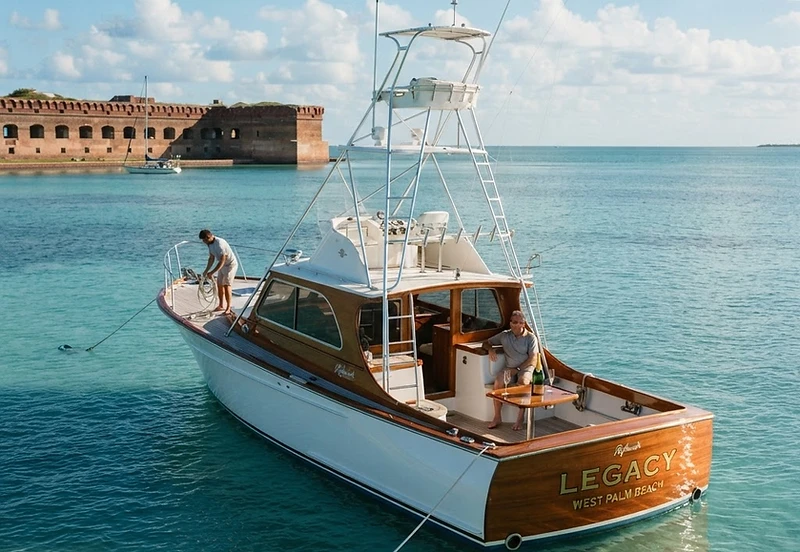
The air in the Dry Tortugas possesses a singular, clarifying quality. It strips away the ambient noise of modern navigation, leaving only the sharp, metallic tang of brine and the low-frequency hum of a hull carving through limestone-fed shallows. Moored off the derelict ramparts of Garden Key, the 1964 Rybovich, Legacy, sits as a masterclass in varnished teak and aluminum grace. To witness her swing at anchor, pivoting slowly against the tidal pull, is to observe a vessel that feels less like a manufactured object and more like an organic extension of the Florida current itself. Her signature tumblehome—that subtle, inward-curving geometry of the hull—reflects the kaleidoscope of turquoise water with an honesty that modern carbon-fiber composites often surrender in favor of brute interior volume.
The Geometry of Heritage
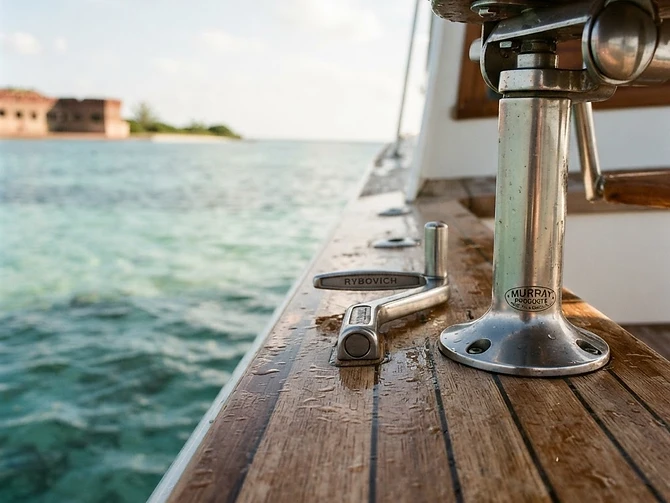
Restoring a Rybovich is an exercise in profound archaeological patience. Working with the original lines drafted by the Rybovich family in their West Palm Beach yard requires a deep reverence for the golden ratio of mid-century sportfishing architecture. Standing on the aft deck, one feels the structural integrity of the cold-molded hull, a form engineered to move with the Gulf Stream rather than merely fighting against the swell. The stainless-steel hardware, polished to a mirror finish, catches the harsh afternoon sun with a blinding brilliance, serving as a reminder that in the 1960s, utility was inseparable from aesthetic intent. Beneath my bare feet, the teak floorboards, meticulously sourced and laid, retain the lingering warmth of a day spent navigating the shallow banks, a testament to the tactile, inimitable pleasure of a boat built by human hands rather than programmed cutters.
The Ritual of the Anchorage
As the sun began to dip toward the horizon, painting the sky in violent, bruised shades of violet and burnt orange, the ritual of the evening took hold. We sat in the cockpit, the silence of the Tortugas broken only by the rhythmic lapping of water against the waterline. There is a specific kind of luxury found in isolation; here, seventy miles west of Key West, the trappings of the mainland feel like a distant dream. I recall the sound of a cocktail shaker muffled by the wind, the scent of sea salt mixing with the faint, sweet smell of fresh varnish—a fragrance that seems to define the very soul of a classic Rybovich. We watched the last light play off the heavy masonry of Fort Jefferson, feeling the weight of the nineteenth century pressing against the modernity of our own transit. In the Tortugas, urgency is a foreign concept; time is kept only by the shifting tide and the patient rotation of the planets.
A Steady Wake
By dawn, the wind had shifted to the east, prompting the familiar dance of preparation. Watching the engines of such a classic vessel wake to life is an intimate experience; they do not roar with the frantic, forced energy of modern performance boats, but rather heave with a deep, percussive breath that resonates through the floorboards. As we weighed anchor and cleared the narrow channel, leaving the sanctuary of the park, I looked back at the wake we had traced across the sandbars. To restore a 1960s classic is not merely an act of technical maintenance or a display of fiscal indulgence; it is a vital effort to ensure that a certain standard of movement—and a deliberate, measured way of interacting with the sea—persists in an era of disposable transience. On the bridge, with the heavy wooden helm steady under my hands, the Atlantic felt wide, deep, and beautifully, profoundly ordered.






