
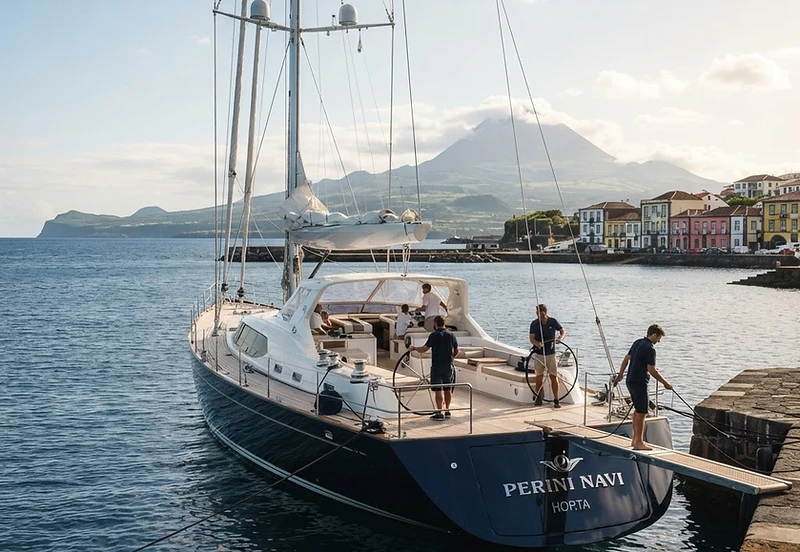
The morning light in Horta, Faial, arrives with a particular, sharp clarity that only exists in the middle of the Atlantic. Standing on the aft deck of the Perini Navi ketch as she rests at anchor in the marina, the scent of sea salt is momentarily overtaken by the earthy, crushed-stone aroma of the volcanic slopes that define the Azores. Provisioning for a week of cruising these islands is an exercise in managing the profound instability of the mid-Atlantic; there is no room for error when you are balancing the structural demands of a sailing yacht against the delicate, temperamental nature of the wine you intend to pour once the sails are furled.
The Logistics of the Mid-Atlantic Cellar
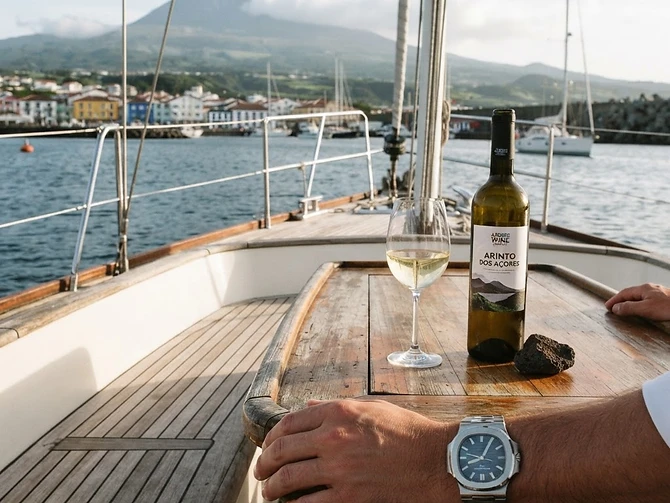
Our cellar master, a man whose movements are as deliberate as the ticking of a Patek Philippe Nautilus on his wrist, spent the previous afternoon coordinating with local suppliers in Pico. Transporting cases of Azores Wine Company whites is not a matter of mere utility; it is a choreography of temperature and vibration. On a vessel of this displacement, the engine room's heat and the rhythmic shudder of the hull in a following sea are the natural enemies of a young Verdelho. We store the crates in a climate-controlled locker positioned near the center of gravity, beneath the master stateroom's deck, where the pitch and roll are dampened by the sheer weight of the steel hull.
There is a specific ritual to the decanting process here. As the sun begins its slow descent toward the horizon, the steward sets the table with heavy, hand-blown crystal. We pull a 2018 Arinto dos Açores, a wine that tastes, quite literally, of the salty air and black basaltic soil that forms the rugged coastline of the archipelago. Drinking it on deck, with the silhouette of Pico Mountain looming across the channel, one realizes that the wine is not just a complement to the evening; it is a translation of the very geography we have spent the day traversing.
The Discipline of the Watch
Life aboard is governed by the persistent, rhythmic demand of the tide and the shift. Checking the GMT hand on my watch, I note we are precisely three hours behind the vineyards of the mainland. It is a necessary friction—a reminder that while we exist in a mobile, autonomous architecture, we are inextricably tethered to the slow, stubborn pace of the earth. When the anchor finally bites into the volcanic sand of a secluded bay near Fajã Grande, the transition from the kinetic energy of the sails to the stillness of the mooring is almost tactile. We open a bottle of Curral Atlantis, the wine's salinity mirroring the spray that still coats the yacht's teak, and listen to the water lapping against the hull—a sound that, in this remote corner of the Atlantic, remains the ultimate arbiter of time.
As night falls, the constellation of lights from the shore reflects against the dark, churning water of the channel. The yacht, a masterpiece of naval engineering, stands firm, a quiet sentinel in the vastness. We have our provisions, our passage, and the singular, grounding taste of the land we are passing through. It is enough.






