
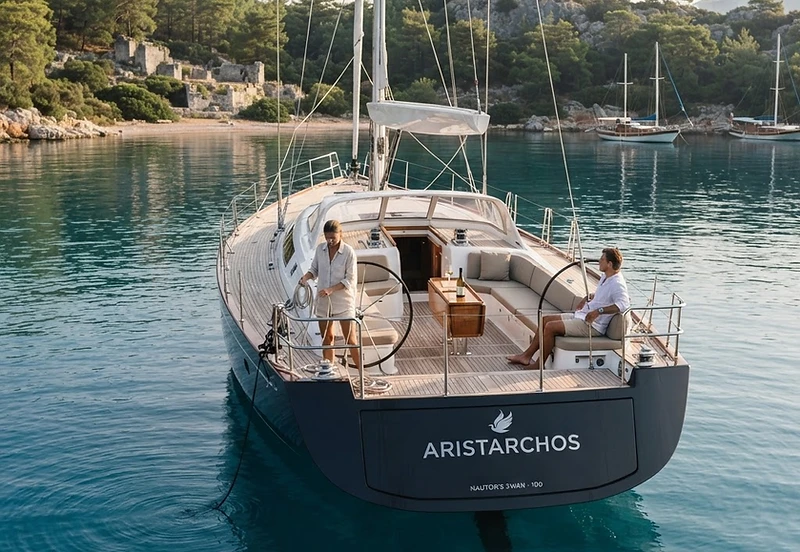
The anchor chain of the Nautor's Swan 100, S/Y Aristarchos, rattled briefly against the hawsepipe before falling silent into the stillness of the Gulf of Gökovā. We were positioned off the western reach of Sedir Island, where the water transitions from the deep, melancholic indigo of the open Aegean to a translucent, near-fluorescent turquoise. By 07:00, the sun had already begun to warm the teak decking, casting long, sharp shadows from the mast onto the white cushions of the aft cockpit. This was not a harbor for haste; the proximity to the ancient limestone ruins of Cedrae meant that our approach required the precision of a seasoned navigator, threading the keel through sandbars that have shifted with the currents for centuries. The air was cool, carrying the faint, sharp scent of cedar smoke from the distant charcoal fires of the mainland villages, a grounding, earthy counterpoint to the salt spray that had crusted the lifelines during our overnight reach from Bodrum.
The Gastronomy of the Open Reach
Our chef had spent the previous evening at the Göcek market, returning with local cibes, wild artichokes, and a haul of sea bass caught off the Datça Peninsula. Dining at anchor is an exercise in managing the horizon; as the tender returned from a reconnaissance mission toward the shore, we laid a heavy linen cloth across the table. For a midday meal, the crew served a cold-pressed olive oil from a boutique estate near Milas, its peppery finish cutting through the richness of charcoal-grilled octopus. The texture of the octopus—tender, with just enough char to suggest the wood-fired origins of the marinade—was elevated by the simplicity of the preparation. We savored the meal as the yacht gently veered, the current pulling against the stern, while the distant call of a cicada echoed across the water from the pine forests of the island, a rhythmic, shimmering sound that defined the Turkish summer heat.
The Architecture of Silence
On deck, time is measured less by the conventional rhythm of the day and more by the swinging of the boom and the subtle shift in the light as it catches the white quartz sands of Cleopatra Beach. There is a specific sobriety required of a life lived aboard a vessel like the Aristarchos; one must respect the limitations of a self-contained environment. Every movement, from the hoisting of a sail to the plating of a lunch, is a choreographed response to the wind and the depth sounder. I spent the morning perched on the gunwale, watching the interplay of light on the seabed; the bottom topography here is deceptive, revealing shallow shelves of rock and sand that look like spilled silk through the clear, shallow water. As the boat gently pivoted on her chain, bringing the pine-clad hills of the Turkish mainland into view, the world felt entirely contained within our own rub-strake, a singular, drifting architecture anchored in a sea of myth.
As evening approached, the sky bruised into a deep violet, and the water grew still, reflecting the first pale stars. We packed the linen, secured the deck, and prepared to weigh anchor, the quiet hum of the engine a small intrusion upon the absolute silence of the bay. Sailing the Gulf of Gökovā is a reminder that luxury is not merely the possession of space, but the intentionality of being in it, a quiet communion between the hull and the sea that persists long after the anchor is brought home.






