
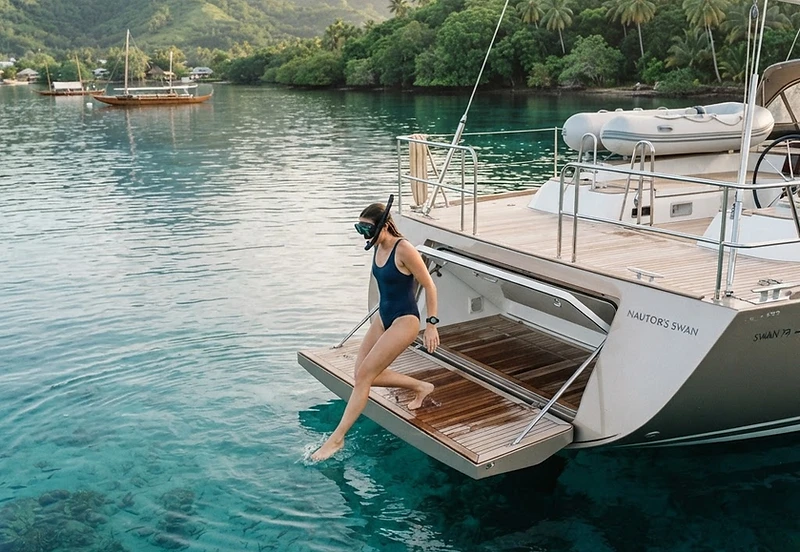
The Yasawa Islands are not a destination one arrives at; they are a slow surrender to the geography of the South Pacific. Anchored in the protected embrace of a private cove near the Blue Lagoon, the Nautor's Swan 78, her teak decks silvered by the persistent humidity, sits motionless. There is no engine noise, no frantic VHF chatter—only the rhythmic, soft slap of the Pacific against her hull, a sound that serves as the quiet metronome of our stay. The heat has not yet begun to press against the rugged coastline, leaving the air thin and expectant, smelling faintly of dampened volcanic earth, sea salt, and the sweet, heavy scent of frangipani drifting from the shore.
The Descent into Indigo
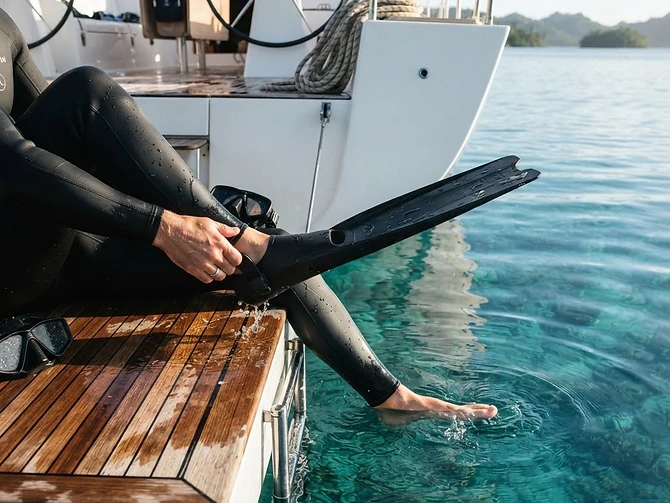
Stepping onto the fold-down transom, I find the water is not merely warm; it is tactile. It feels more like silk than liquid, wrapping around the limbs as one slides from the carbon-fiber swim platform. Beneath the surface, the clarity is startling—the seabed, a mosaic of white coral sand, creates a luminosity that reflects upward, illuminating the underside of the yacht in shimmering turquoise ribbons. Schools of small, darting reef fish move in perfect synchronicity, ignoring the intrusion. Looking back at the waterline, the vessel's architecture feels at once immense and entirely at home; she is a machine built for ocean-crossing efficiency, yet in this context, she is the only structure that truly matters, a white needle threaded through the eye of an island chain.
Swimming here, away from the hum of civilization, the scale of the landscape becomes clear. The islands rise from the seabed like jagged, green teeth, and the yacht acts as a silent observer to this ancient theater. There is an absolute lack of pretense in the water; one is stripped of the world, left only with the physical sensation of the current pulling gently against the mooring lines.
Calibration at the Surface
Upon climbing back aboard, the ritual of the morning transition begins. The salt dries into a fine, crystalline veil on the skin, and there is a profound, meditative symmetry in being at sea. I dry off on the aft deck, watching the light shift from a pale, bruised violet to a hard, brilliant gold as the sun crests the jagged ridges of the nearby hills. For a few minutes, the world is reduced to nothing more than the tension of the lines and the distant, low boom of the surf breaking against the outer barrier reef—a steady, percussive reminder of the vast, open ocean that lies just beyond the protection of the lagoon.
Before the steward arrives with the morning's first service, there is a moment of total stillness. I lean against the pushpit, watching the mist evaporate from the distant volcanic peaks. As the aroma of freshly pressed coffee—sourced from a small, estate-grown batch from the highlands of Viti Levu—drifts across the cockpit, the day’s navigation begins to take shape in the mind. The charts are checked, the wind lines monitored, and the vessel begins to wake. We discuss the run to the next anchorage, perhaps near Sawa-i-Lau, but the immediacy of the morning swim remains the anchor of the day, a private baptism in the deep, clear silence of the Fiji islands.
Cruising these waters requires a certain humility; one must defer to the tide and the shifting light. As the crew readies the deck for the day’s short passage, I find myself lingering near the stern, reluctant to leave the stillness of this cove. To sail the Yasawas is to understand that the destination is not a port, but the vessel herself, and the quiet, crystalline hours spent hovering between the hull and the reef.






