
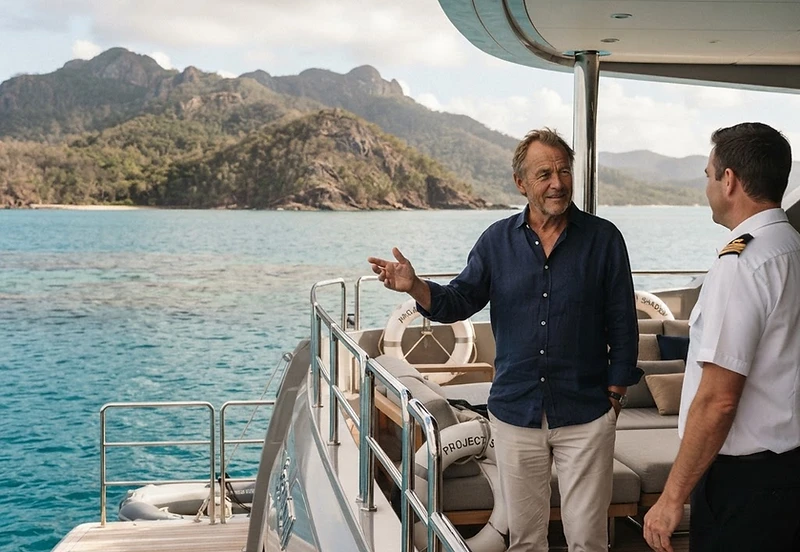
The morning light in the Whitsundays possesses a particular, crystalline quality, filtering through the humidity to turn the Coral Sea into a vast, aquamarine basin. Standing on the aft deck of a custom 70-metre vessel, I watched as Espen Øino traced the curve of the superstructure with his hand. We were anchored in the lee of Hook Island, the silence of the anchorage broken only by the rhythmic lap of water against the swim platform and the distant, singular cry of a sea eagle. It is here, far from the drafting tables of Monaco, that the true dialogue between naval architecture and the natural world becomes audible.
The Geometry of the Floating Pavilion
To view a superyacht as merely a boat is to ignore the structural ambition of its exterior. Øino speaks of his projects not as nautical vessels, but as floating pavilions—structures that must reconcile the rigid requirements of hydrodynamics with the fluid grace of modern residential architecture. He points to the way the deck lines extend the interior living spaces outward, blurring the boundary between the climate-controlled saloon and the open air of the Pacific. It is an architectural logic reminiscent of the great mid-century villas; the goal is to create a seamless transition where one does not simply stand on a yacht, but exists within its volume.
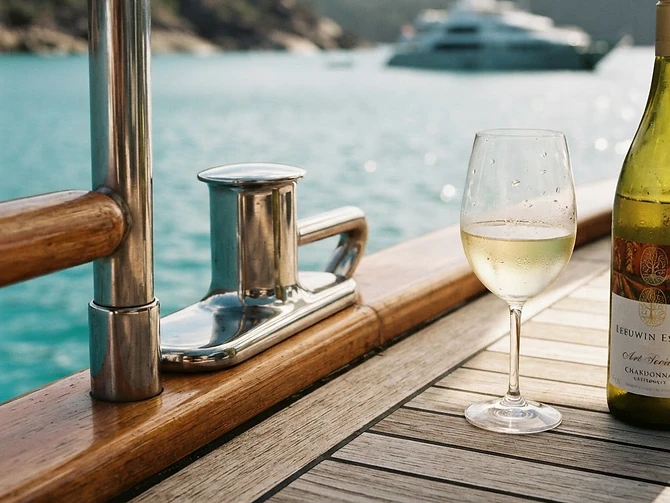
As we stood there, a tender approached from the direction of Hamilton Island, carrying a chilled bottle of Leeuwin Estate Art Series Chardonnay. The wine, a product of Western Australia’s cool-climate viticulture, offered a crisp, citrus-forward counterpoint to the tropical heat. It served as a reminder that life aboard is defined by such deliberate pairings. Just as the wine is calibrated to the environment of the table, the yacht’s exterior—its rake, its tumblehome, and the proportion of glass to steel—is calibrated to the environment of the sea. The vessel does not fight the horizon; it acknowledges it.
Refining the Silhouette
There is a deliberate restraint in the design process that mimics the precision of a high-complication watch. Øino notes that every line on the exterior serves a purpose, whether it is to break the wind or to frame a view of the Whitsunday passage. He gestures toward the silhouette of a passing catamaran, noting how the structural integrity of the hulls allows for a lightness of form. It is a lesson in minimalism: the most successful designs are those where no further element can be removed without compromising the vessel’s identity. The aesthetic is one of clean, uninterrupted surfaces that catch the Southern Cross as it rises, turning the steel skin into a mirror for the stars.
We remained on deck until the sun began to dip behind the headlands of Nara Inlet, casting long, bruised-purple shadows across the water. The yacht, designed to be an extension of the coast, sat perfectly in its element. It was a moment of profound stasis, a reminder that the best architecture—be it on a cliffside in the Mediterranean or anchored in the heart of the Great Barrier Reef—is that which feels as though it has simply grown out of the environment it inhabits.






