
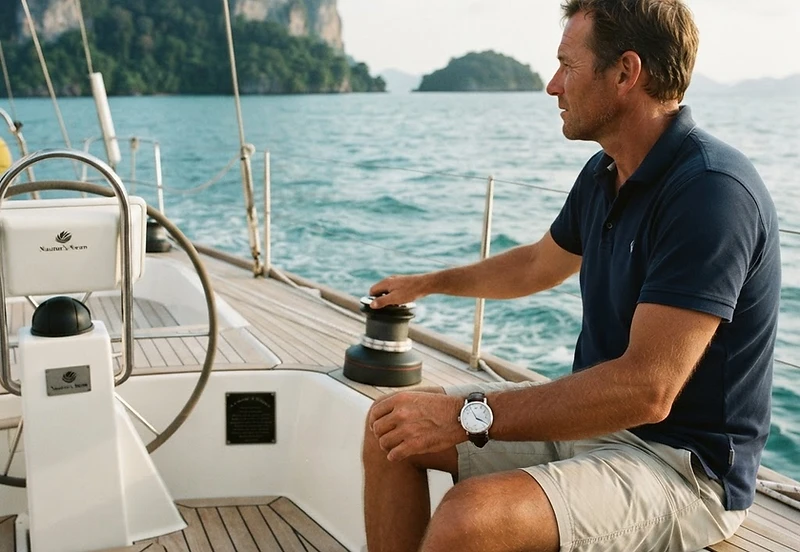
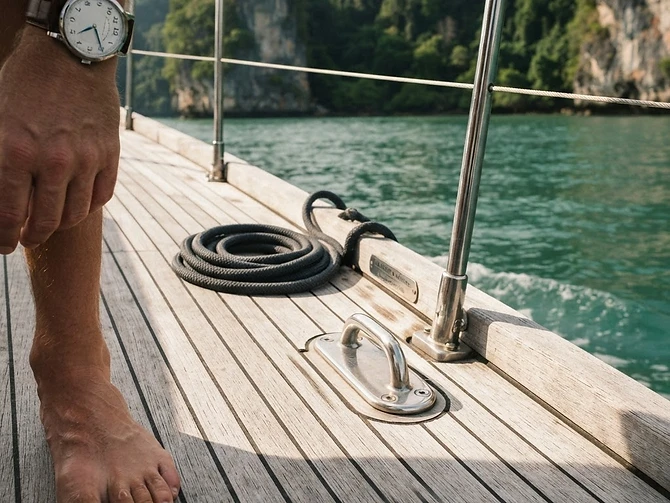
The morning light over the Andaman Sea does not break so much as it arrives in a soft, humid diffusion, turning the limestone karsts that guard the approach to Kuah into jagged silhouettes of charcoal and jade. Aboard the Swan 65, there is a distinct, rhythmic cadence to the start of the day. The teak decks, still holding the dampness of the tropical night, cool underfoot, and the scent of rain-washed jungle drifts across the water, meeting the sharp, clean salinity of the open strait. We are positioned five miles off the coast of Pulau Langkawi, drifting in the light, variable draft that precedes the inevitable afternoon squalls. Here, the ocean does not merely reflect the sky; it absorbs the drama of the islands, creating an environment where the transition from sea to land is blurred by mist and memory.
The Geometry of the Hunt
Seeking the migratory paths of cetaceans in these waters requires the patience of a seasoned helmsman and the quiet grace of a vessel built to harmonize with the wind. Nautor’s Swan has always understood this fundamental relationship between hull and habitat, and at the helm, the feedback from the rudder is intimate—a conversation between the composite keel and the currents of the strait. We track the surface tension with intent, looking for the tell-tale disruption of water that signals a breach or a lingering blow. The sea is a vast, glassy expanse of oil-slick water, and in this environment, one finds a profound tension between the chaotic, unpredictable biology of the whale and the steady, reliable purpose of a well-rigged yacht. To watch the horizon while scanning the deep cobalt of the channel is to acknowledge the duality of a life lived at sea: we are entirely at the mercy of the elements, yet we exist within a vessel that offers us a position of refined, watchful privilege.
The Soundings of the Straits
By midday, the heat settles heavy and resonant over the aft deck. We weigh anchor near the fringes of the Kilim Karst Geoforest Park, where the geology of the coast seems to push directly into the seabed, creating deep-water channels that invite the giants of the deep to pass. The stillness is absolute until a rhythmic, wet exhalation breaks the silence—a sharp puff of mist caught in the sun before the grey, slick dorsal fin of a Bryde’s whale cuts the water. It is a fleeting, haunting encounter that renders the surrounding geography irrelevant. We kill the engines, letting the boat luff, and listen to the water slap softly against the hull. The crew moves with a practiced, almost silent fluidity, clearing the decks and preparing a light lunch of chilled pomelo salad and fresh, lime-cured snapper. This is the quiet luxury inherent in a well-managed vessel: the ability to pause time in the presence of something wild. There is no urgency to chase; the yacht is not merely a vehicle, but a sanctuary from which to observe the transit of these giants as they move through their own, ancient architecture.
A Ritual of Return
As we turn back toward the sheltered, protected waters of Rebak Island Marina, the sun dips behind the western headlands, turning the sky a bruised, vibrant purple. The day’s passage is logged not by knots covered or distance gained, but by the weight of the encounter. Life aboard becomes a series of calibrated rituals, each transition smoothed by the knowledge that the vessel is as much a part of this marine landscape as the reefs and the limestone shadows themselves. We stow the lines and retreat to the cockpit, the air cooling as the stars emerge over the Andaman horizon, reflecting in the wake we leave behind—a silver thread in an infinite, dark sea.






