
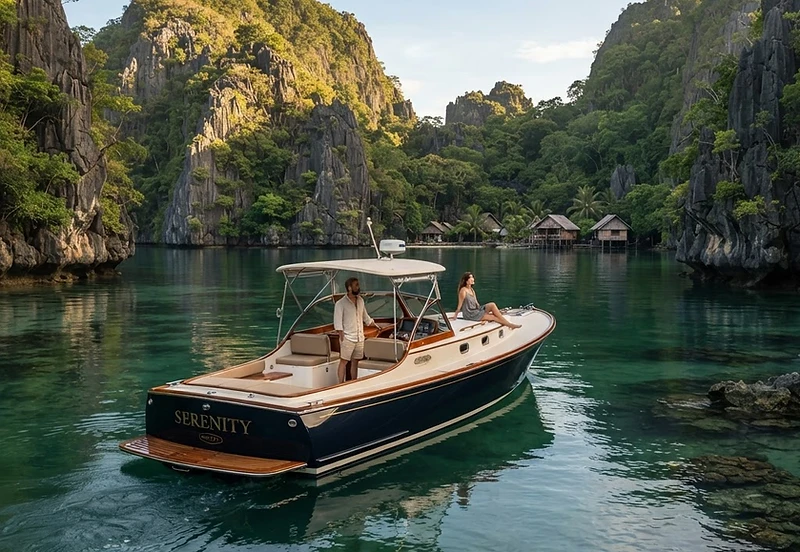
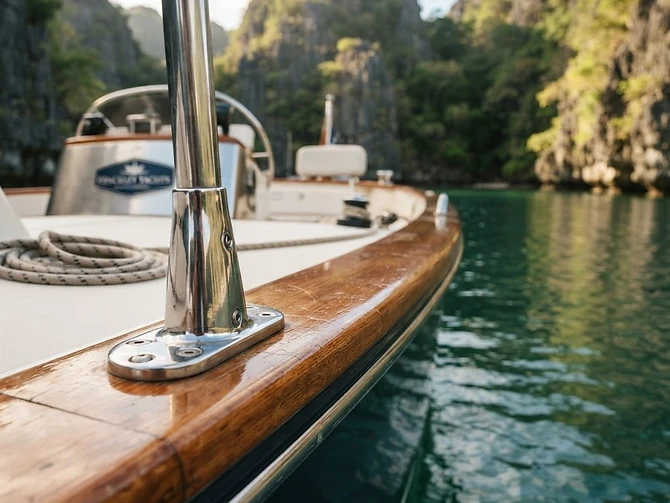
The morning light in Palawan is rarely subtle; it arrives with a sudden, golden intensity that turns the Sulu Sea into a sheet of hammered silver. We slipped the lines at El Nido’s Miniloc Island resort, stepping aboard a Hinckley Picnic Boat. There is an unmistakable tactile honesty to a Hinckley; the weight of the varnish on the teak coaming and the reassuring hum of the jet drive are sensory reminders that you are in a vessel built for purpose rather than mere parade. As we cleared the jagged karst pillars, the air turned sharp with the scent of brine and damp limestone, a bracing contrast to the tropical heat already beginning to shimmer off the water.
The Geometry of the Lagoon
Steering through the narrow, treacherous entrance to an unnamed anchorage near Matinloc Island, the architecture of the archipelago reveals itself in stark, vertical relief. Massive limestone cliffs rise abruptly from the turquoise water, their weathered surfaces folded like ancient drapery and perforated by hidden, emerald-hued grottos. This is a natural cathedral, a place where the scale of the landscape demands an immediate reduction in speed. We throttled back, the jet drive allowing us to venture into shallows where a traditional propeller would have long since bitten the coral. The boat carved a silent, disappearing wake toward a sliver of white sand that seemed to exist only for the duration of the high tide. Here, the boundary between the vessel and the environment is porous; you do not merely watch the landscape—you drift into its fold, enveloped by the stillness that only remote cruising can provide.
Midday Calibration
Once anchored, the ritual of the lunch service took precedence over the urge to explore further. We secured the fenders, the soft thud against the hull echoing briefly against the limestone walls, and prepared a simple, deliberate meal. We served fresh lapu-lapu, lightly grilled over a charcoal brazier with shards of ginger and the bright, searing acidity of local calamansi. The citrus cut through the salt-heavy air, a culinary necessity in the heat. There is a particular luxury in being entirely self-contained, watching the small, complex currents dance around the rudder while the world outside shifted with the slow, inexorable rise of the tide.
We spent the early afternoon drifting between the swim platform and the cool, shadowed interior of the nearby sea caves. The water here is so clear that the reflection of the Hinckley’s white fiberglass hull appears to hover in the air, detached from the seabed. There is no urgency in these waters, only the steady, rhythmic pulse of the ocean against the rock. Occasionally, a sea eagle would circle overhead, its cry the only sound competing with the soft lap of waves against our gunwales. It is a rare privilege to find a corner of the world that feels so profoundly indifferent to the march of modern industry.
As the shadows of the karst began to stretch across the cove, we gathered our things for the passage back. The afternoon wind was picking up, whispering through the rigging of a passing paraw in the distance, reminding us that these waters do not remain still for long. Stepping back onto the Hinckley and engaging the throttles, the transition from the silence of the shore back to the familiar, mechanical grace of the cockpit felt like moving between two distinct states of existence—one anchored in ancient stone, the other defined by the fluid, restless beauty of the tide.






