
The Soft Transition of the Horizon
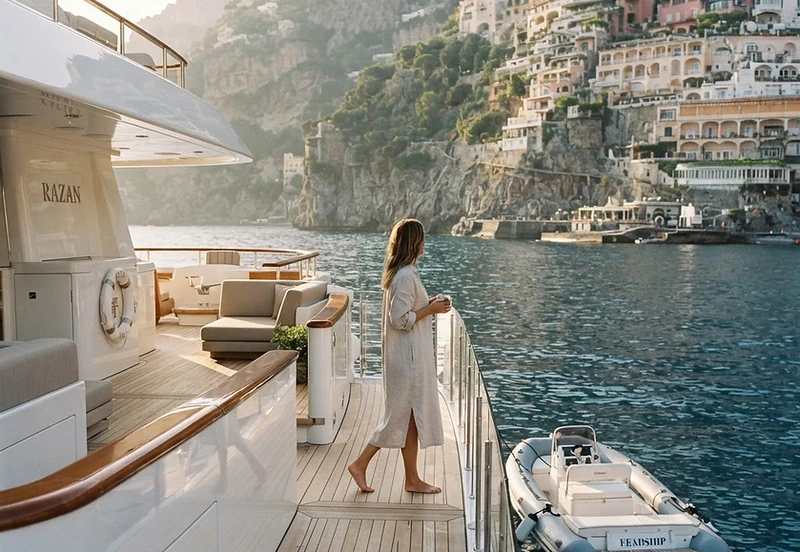
The first light of day in the Tyrrhenian Sea does not announce itself; it merely resolves the charcoal silhouettes of the Lattari Mountains into shades of ochre and burnt umber. From the owner’s suite of a 55-metre Feadship currently holding station off the coast of Positano, the world arrives in whispers. There is a distinct, low-frequency hum of the stabilizers working against the rhythmic pulse of the swell, a vibration so familiar it feels like a secondary heartbeat. To wake at sea is to surrender one’s internal clock to the movement of the hull, to the gentle pitch that reminds you exactly where you are in the world. As the automated blinds draw back with a hushed mechanical sigh, the bedroom vanishes, replaced by the sheer verticality of the Amalfi coastline, where the village of Positano clings to the rock like a cluster of sun-bleached barnacles. In these early hours, the sea is glass, holding the reflection of the mountains with a clarity that defies the coming heat of the Italian summer.
Architectural Echoes on the Shoreline
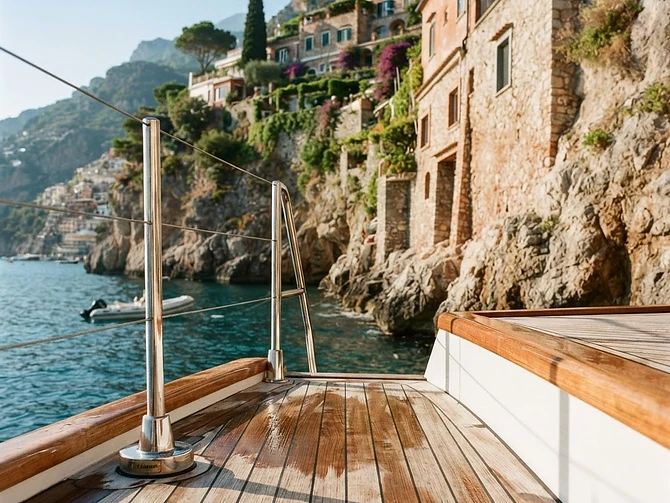
Below the yacht’s white, sweeping sheer line, the water reflects the stark, modernist lines of Villa Treville, an estate that bridges the gap between the wild, unruly sea and the calculated order of local Italian design. Its architecture—a masterful interplay of hand-hewn stone, lime-washed masonry, and soaring, arched openings—mirrors the interior logic of the yacht itself. Both structures act as instruments for viewing the horizon. Just as the yacht is meticulously designed to frame the bay through floor-to-ceiling glass that retracts into the bulkhead, the villa uses stone loggias and terraced gardens to capture the shifting light of the Tyrrhenian, grounding the ephemeral nature of the cruise in the ancient, unmoving geography of the cliffside. Watching a local fisherman guide his small, weather-beaten wooden gozzo toward the villa’s private stone jetty, one realizes that this stretch of coast is not merely a destination of leisure; it is a complex, engineered threshold where humanity has spent centuries mediating its relationship with the tides. The stone of the house and the composite hull of the yacht sit in a quiet conversation, both testament to a desire to exist at the absolute limit of the earth.
The Ritual of the First Coffee
On the main deck aft, the air carries the sharp, clean scent of salt, wet stone, and the faint, citrus-sharp sweetness of the lemon groves clinging to the ravines above. The steward arrives with a single ceramic cup of espresso, the steam dissipating rapidly into the cooling morning air, curling into the wake of the tender. There is no urgency here, only the necessity of checking the spring lines and observing the slight wind shift against the distant, hazy profile of Capri. The transition from the warmth of the cabin’s cashmere-lined interior to the open, salt-sprayed reality of the deck is the essential, recurring ritual of the cruising life. It is a moment of total presence, where the boundary between the architecture of the boat and the architecture of the land dissolves entirely, leaving only the metallic, rhythmic clink of the anchor chain occasionally adjusting its tension against the seabed. As the sun finally clears the crags of the Punta Campanella, casting long, golden shadows across the deck, the yacht, the villa, and the water become a singular, coherent landscape of morning, held together by nothing more than the tide and the patient wait for the day to turn.






