
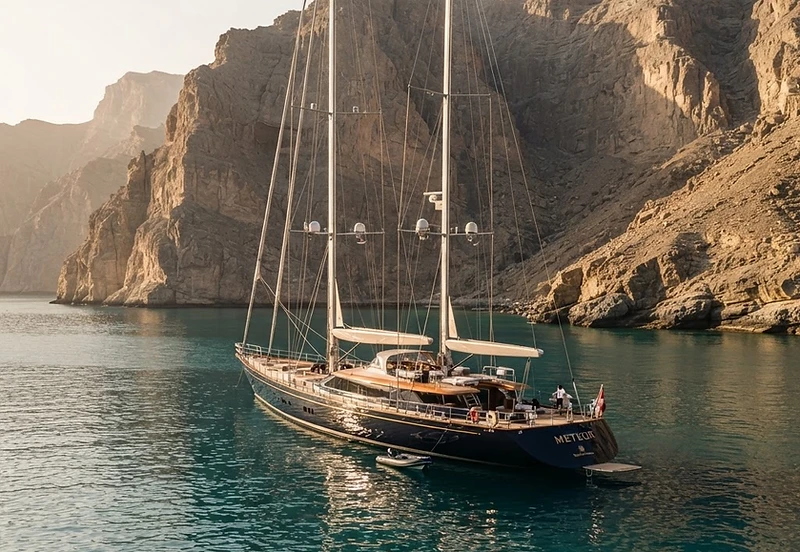
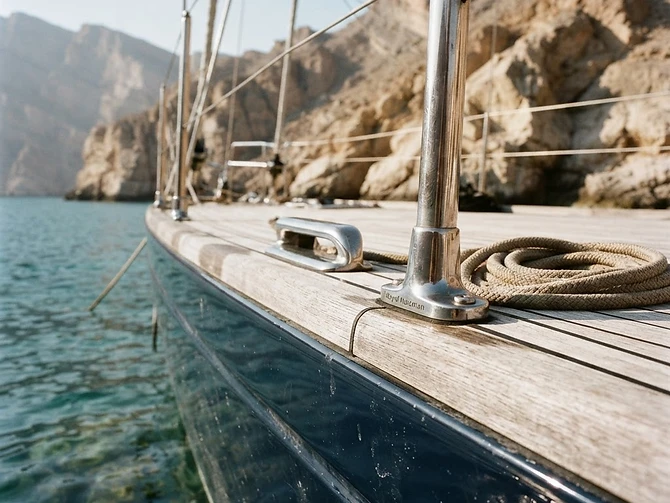
The Musandam Peninsula is a place where geology dominates every conversation. Here, the Hajar Mountains do not merely meet the sea; they fracture into it, creating the dramatic, jagged fjords known as khors. We were anchored in a deeply secluded inlet near Kumzar, the profound silence of the landscape broken only by the rhythmic, percussive slap of water against the hull of Meteor, a stunning 52-meter schooner by Royal Huisman. From the warm teak deck, the scale of the world is entirely disorienting: the granite cliffs rise hundreds of feet, dwarfing the mast and rendering the vessel a mere sliver of white against the ancient, ocher rock. There is a specific kind of humility that descends upon one when moored in the shadow of such vertical immensity.
The Geometry of the Anchorage
High above the waterline, carved into the cliff face like an extension of the crag itself, sits a private retreat that echoes the brutalist sensibility of local stone-craft. It is a structure of sharp, deliberate angles and deep, cooling shadows, designed to visually vanish into the surrounding geology. Looking up from the tender as we returned from a morning reconnaissance, the villa and the yacht felt like two halves of a singular architectural intent—one anchored by limestone foundations, the other by the gravitational weight of her keel. I watched the steward emerge onto the aft deck, his movements measured and precise, to prepare the morning service. The light here is crystalline, sharp enough to cut, reflecting off the water to illuminate the undersides of the cliffs in a way that makes the rock look almost translucent.
The Weight of the Wind
In this labyrinth of stone, the standard, frantic rhythm of the civilized day simply dissolves. One relies on the internal logic of the ship to track the passing hours, as the sun vanishes behind the towering peaks several hours before it actually sets on the horizon. My companion, a veteran sailor of these Middle Eastern waters, remarked that in the Musandam, time is not measured in minutes but in the unpredictable duration of the katabatic winds that roar down from the plateaus.
The mountain breathes, and we must listen,he noted, gesturing toward a slight shift in the water’s surface tension. We spent the afternoon preparing for the evening thermal; securing the deck cushions and checking the swing of the anchor became a ritualistic dance, a necessary deference to the power of the corridor of the Strait of Hormuz.
As the light deepened to a bruised, electric violet, the distinction between the villa’s terrace and the yacht’s teak deck felt purely academic. Both were simply platforms for witnessing the vast, terrifying stillness of the Strait. We dined on local Omani lobster, served chilled with nothing more than a squeeze of Omani lime and a pinch of coarse sea salt, the flavors clean and defiant against the heat. Beneath us, the current hummed a low, constant vibration, a reminder that even in this fortress of stone, everything is in motion. We are, at all times, merely guests of the tide, drifting between the architectural permanence of the shore and the fluid grace of the yacht, both bound by the same unrelenting, beautiful horizon. As night fell, the stars appeared in a density I have never seen elsewhere, pinpricks of cold light reflected perfectly in the mirrored, motionless water of the khor.






