
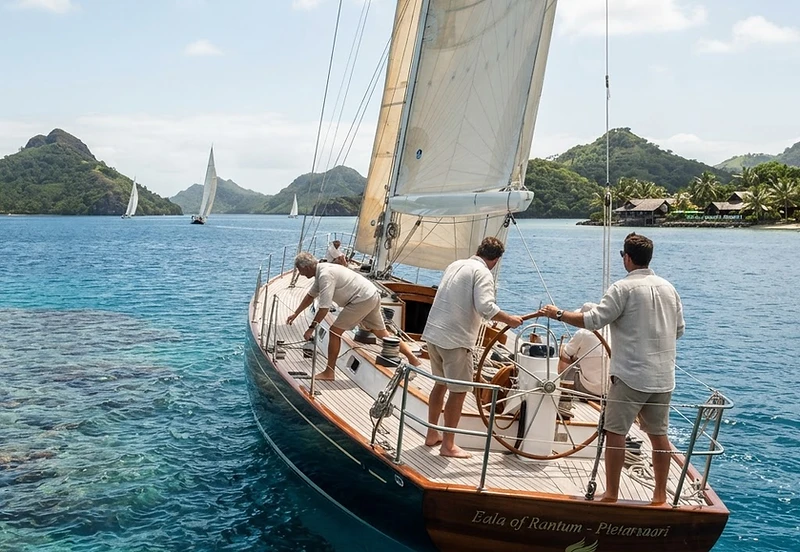
The morning light in the Yasawa Islands does not merely arrive; it refracts through the translucent shallows of Nanuya Lailai, turning the seabed into a tapestry of shifting cyan and cobalt. We are anchored in the shadow of volcanic peaks on a 1930s gaff-rigged cutter, our vessel straining rhythmically against the mooring line as the tide begins its slow retreat. The air is thick with the scent of brine, crushed coral, and the damp, earth-rich perfume of the nearby shoreline, where the jungle meets the salt. Here, in this remote archipelago, one feels the true weight of distance—the Yasawas are a world apart from the frantic pace of the modern cruising circuit, a place where time is measured not in hours, but in the swing of the boom and the tightening of a halyard.
The Kinetic Symphony of the Fleet
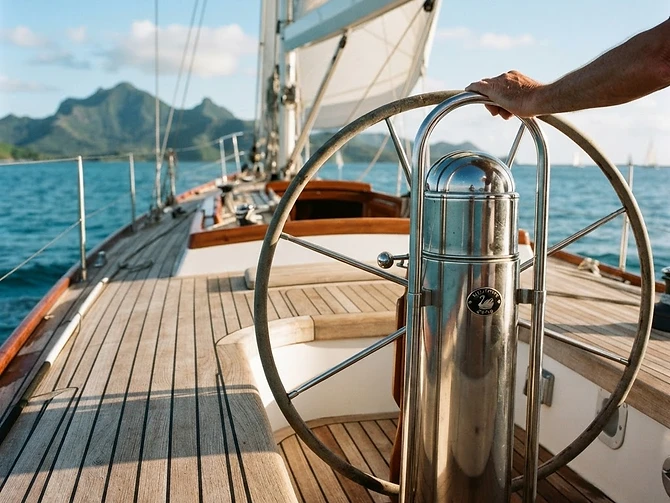
As the fleet prepares for the day’s passage, the deck of a restored 45-foot Nautor’s Swan moored nearby becomes a workshop of frantic, beautiful efficiency. There is a distinct, low hum of activity that contrasts with the absolute stillness of the horizon—the sharp clatter of snatch blocks, the rhythmic grinding of winches, and the soft, repetitive slap of sailcloth against the mast. My attention is drawn to the helmsman, whose focus is entirely locked on the horizon. He moves with the practiced economy of a sailor who has spent more nights at sea than on land. The race committee boat, stationed near the entrance to the Blue Lagoon, signals the warning flare, and suddenly, the lagoon is transformed. The orchestration of white canvas begins as the yachts heel over, their hulls slicing through the turquoise water with a grace that belies their age. The sound of linen catching the steady trade winds replaces the stillness of the anchorage, a deep, resonant thrum that vibrates through the very soles of one's feet.
Anchorage and the Art of Stillness
By late afternoon, the fleet has dispersed into the hidden coves of the Yasawa chain, seeking shelter as the wind shifts toward the south. We make our way ashore via the tender to the white sands near the Blue Lagoon Resort, where the evening ritual is as predictable as it is necessary. We sit on a weathered driftwood bench, watching as the classic yachts swing on their anchors, their masts silhouetted against a sky bruised with violet and gold. The conversation naturally turns to the structural integrity of these wooden hulls—the way a teak deck swells and sighs under the tropical sun, and the constant, silent war between salt-rot and varnish. We discuss the merits of a well-maintained keel versus the blistering speed of modern carbon rigs, yet we always return to the same conclusion: there is a soul to a classic vessel that no modern material can replicate. It is a dialogue between craftsmanship and the unforgiving majesty of the tide.
As the sun finally dips below the Western Pacific, the cooling air carries the scent of woodsmoke from a distant village fire. The only sound remaining is the gentle, rhythmic lap of water against our hull—a sound that has persisted for centuries, indifferent to our maps, our itineraries, or the arbitrary nature of our arrivals. We leave the deck lights dimmed, preferring the clarity of the southern stars, the true navigators of this vast, saline theatre, as we prepare for the long, open-water crossing that awaits us at dawn.






