
The humidity of the Dampier Strait is a tactile weight, a living membrane that separates the polished teak of our Royal Huisman ketch from the limestone karst spires erupting from the crystalline blue depths. As we swung at anchor off the coast of Waigeo, the rhythm of the vessel became defined not by the clock, but by the gentle, rolling swell of the Pacific meeting the Indonesian archipelago. Provisioning for a week in such a remote expanse is an exercise in profound anticipation; the cellar is not merely a supply, but a stabilizing architectural feature of the ship, a silent, cooling partner to the hull’s steel stability. Here, the boundary between the wild, untamed currents of Raja Ampat and the civilized refinement of life aboard is maintained by the subtle, steady hum of the climate-controlled lockers.
The Logistics of the Living Hold
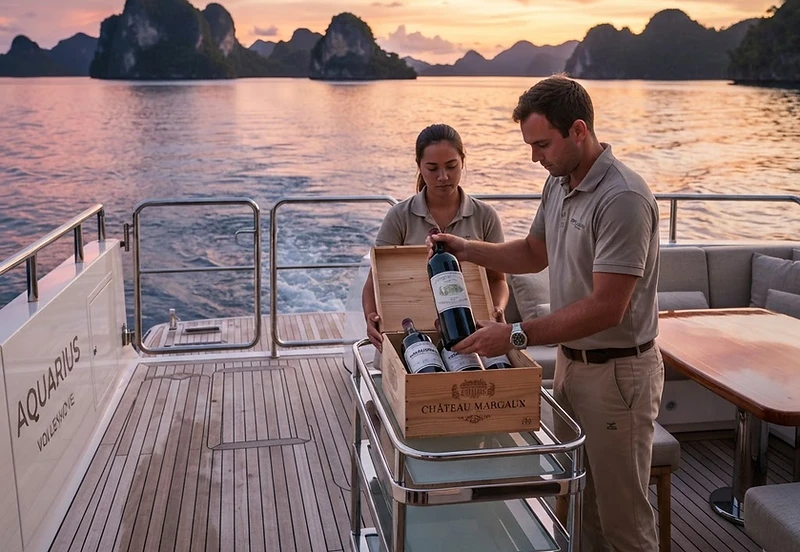
Before casting off from the bustling port of Sorong, the loading of the ship’s hold was a delicate operation, requiring the precision of a master engineer. We stood on the quay as crates were transferred by tender, their contents shielded from the relentless tropical salt-spray by specialized thermal casings. On a vessel of this pedigree, the galley and the refrigerated storage function as a marvel of spatial efficiency, mirroring the clever architecture of a high-end villa where every bulkhead serves a dual purpose. Our sommelier treated the collection with the same reverence one might reserve for sensitive navigational charts, acknowledging that the bottle pressure fluctuates with the sharp barometric shifts of these latitudes. It is a quiet, hidden labor—the act of ensuring that the terroir of a distant continent remains pristine while surrounded by the saline, humid breath of the equator.
Sundown and the Pour
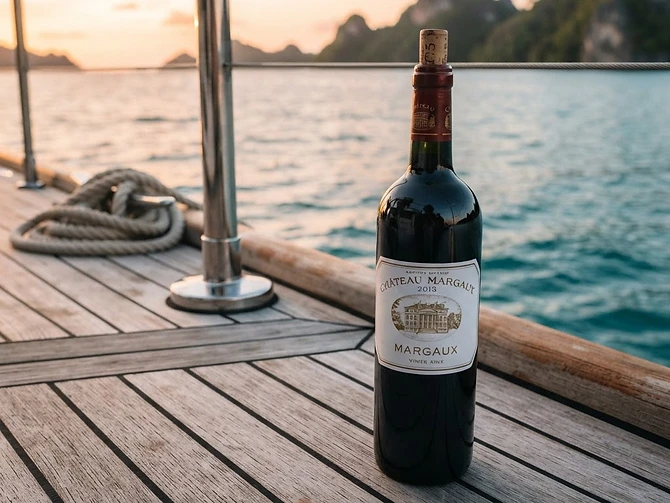
By late afternoon, as the shadows of the jungle stretched like ink across the water, the day’s exertion—a morning spent navigating the shallow coral heads near the Misool chain—gave way to the evening ritual. We gathered on the aft deck, a space that feels less like a boat deck and more like an elevated, open-air pavilion. A 2014 Château Margaux was decanted, allowed to breathe in the salt-heavy air, opening with a structural complexity that provided a startling, elegant contrast to the rugged geography of the volcanic spires surrounding us. As the wine touched the glass, I traced the horizon where the sky surrendered its violet hue to the deep navy of the coming night. The only sounds were the soft clink of crystal, the rhythmic lap of water against the hull, and the distant, haunting call of a bird from the Waigeo canopy. We drank slowly, watching the first sparks of bioluminescence begin to stir in the wake of the tender returning from a final reconnaissance dive.
The Vineyard at Sea
There is a profound, quiet elegance to enjoying a vintage of such pedigree in a place as raw and prehistoric as the Dampier Strait. It acts as a bridge between the refinement of our European origins and the wild, volcanic reality of the Indonesian islands. As the ketch strained gently against her anchor chain, the wine offered a narrative structure—a history of terrestrial soil brought into the vast silence of a maritime night. It is not about the excess of luxury, but about the continuity of culture and the insistence on grace. Carrying the spirit of a historic estate to the edge of a coral shelf, we discovered that even in the most remote waters on earth, the ritual of the pour remains the true anchor of the voyage.
As the moon rose, casting a silver path across the strait, the vessel felt entirely contained, a world unto itself. We had reached the edge of the map, yet we remained grounded by the familiar, complex notes of the grape and the steady, reassuring presence of the ship. There is no clearer definition of adventure than this: to be utterly lost in the beauty of the wild, while remaining completely at home.






