
The passage from Highborne Cay to the northern reaches of the Exuma Cays Land and Sea Park is a masterclass in reading the water. From the flybridge of the Royal Huisman ketch, the transition from deep cobalt to the shallow, translucent greens of the sandbanks is rhythmic, a dance of keel against the limestone floor. As we approached the protected anchorage at Warderick Wells, the wind dropped to a faint whisper, leaving the hull to settle into a near-perfect silence. There is a specific tension in the rigging when the boat finally bites into the sand, a feeling that the world has paused specifically for the descent of the sun. The water here is not merely a medium; it is a lens, revealing the intricate, shifting geography of the seafloor with such clarity that one feels as though the vessel is hovering in mid-air.
The Geometry of the Midnight Watch
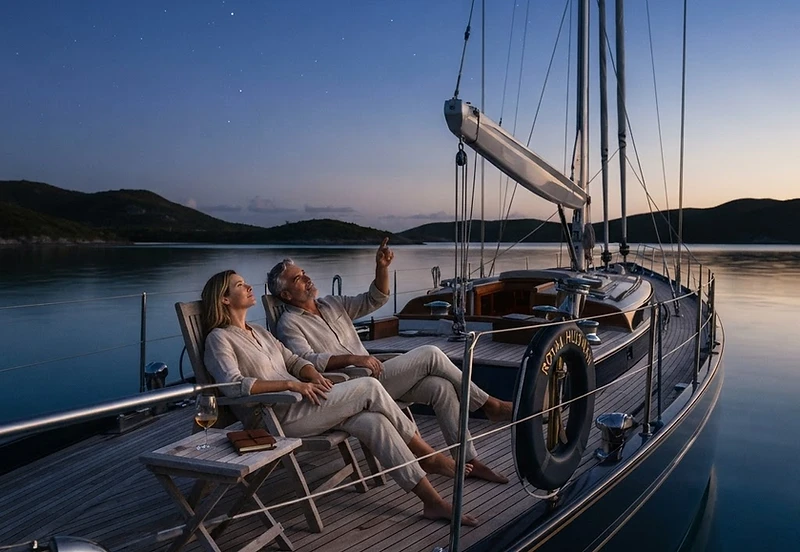
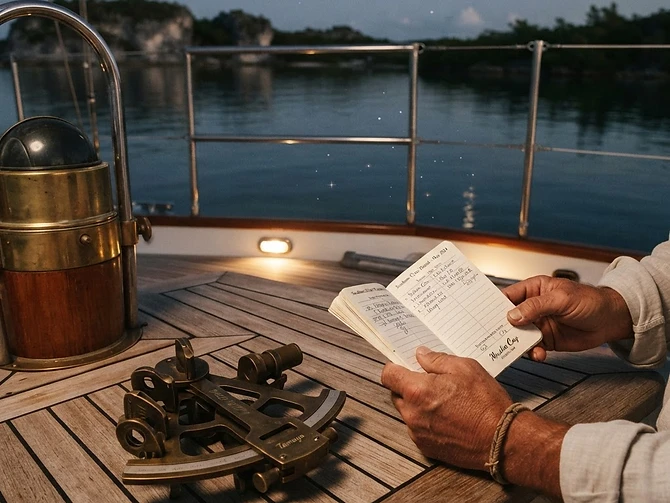
As evening solidified into night, the deck became a platform for something far beyond coastal navigation. I took the watch, checking the tension on the anchor rode while the ship swung lazily in the tidal current. The silence of Warderick Wells is profound—an absence of engines and mainland hum that allows the natural world to assert its own rhythms. Without the light pollution of the settlements, the stars felt heavy, pressing down on the masthead as if we were anchored in the center of a celestial planetarium. The mast traced a slow, hypnotic arc against the constellations, a reminder that even at rest, we are in constant motion relative to the cosmos.
The Architecture of the Edge
We retreated to the cockpit, where the evening air hung thick and humid, perfumed by the distant, earthy scent of mangroves. We spoke of the architecture of our surroundings—how the limestone ridges of the Cays, worn smooth by eons of wave action, echoed the cantilevered design of the villa we had visited earlier that week on Musha Cay. Both were built with an eye toward the horizon, designed to make the boundary between land and water feel like an afterthought. In this setting, the distinction between the man-made grace of a ketch and the raw geology of the Bahamas blurred. We found ourselves discussing the sheer audacity of construction in such an exposed environment, realizing that whether on a deck or on a cliffside, true luxury is merely the ability to remain undisturbed by the elements.
To watch the stars from the deck of a sailing yacht is to acknowledge the scale of the sea; you are a moving point in a vast, indifferent grid.
By midnight, the Southern Cross had pivoted into view, a geometric anchor point in the southern sky. It provided a stark orientation that the GPS simply could not replicate; it was a connection to the ancient mariners who had navigated these same shallow channels with nothing but wood, wind, and intuition. The Southern Cross hung low over the dark silhouette of the mangroves, casting a faint, ghostly illumination across the teak decking. It was a moment of absolute stillness, punctuated only by the occasional lap of water against the hull—a sound that, once heard in the deep solitude of the Exumas, becomes the standard against which all other peace is measured.
We woke to a light swell and the sharp, invigorating aroma of roasting coffee, the anchor chain rattling softly against the fairlead as the tide shifted. The morning light transformed the anchorage back into a vibrant, shifting landscape of sapphire and white sand. It was time to pull the hook and move south toward Staniel Cay, leaving the celestial geometry behind for the practical demands of the charts, yet carrying the quiet gravity of the night into the day ahead.






