
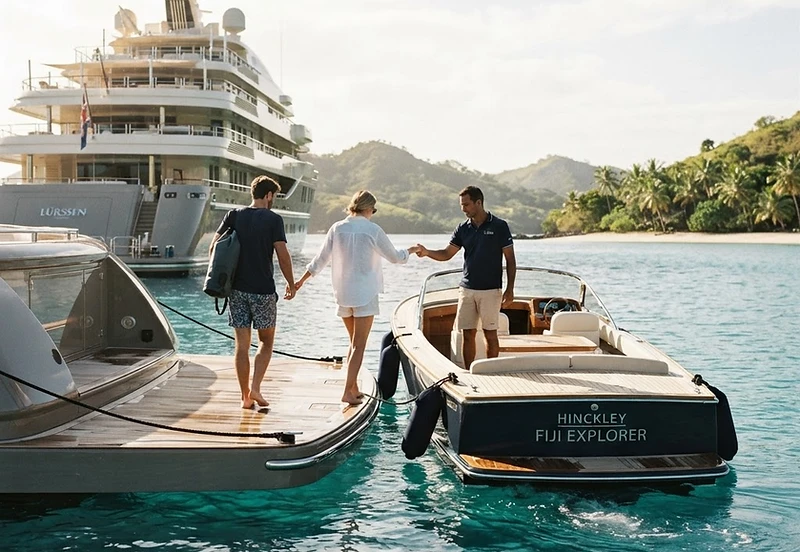
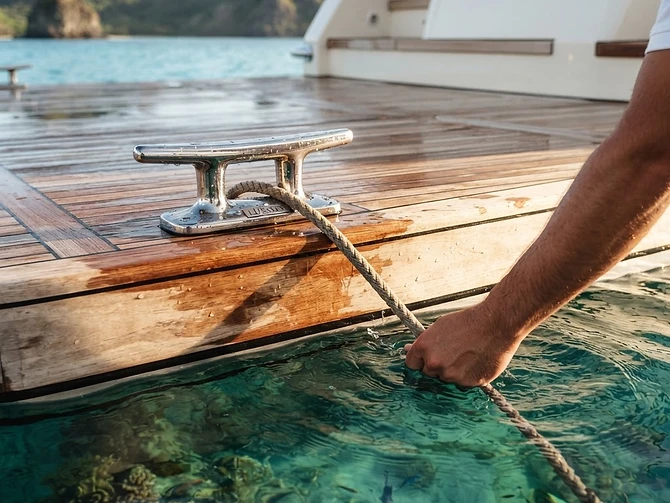
The Lürssen rests silently in the lee of Sawa-i-Lau, her steel hull holding the heat of the South Pacific afternoon while the shadow of the limestone karsts stretches long across the turquoise shallows. There is a specific rhythm to the transition from the polished teak of the mothership to the spray-drenched console of the custom Hinckley tender. As the engines catch, the sudden hum is a reminder that we are untethered, crossing from the controlled climate of the vessel into the raw, humid breath of the Yasawa chain. The air here carries the scent of salt spray mingled with the earthy sweetness of crushed frangipani, a perfume that clings to the skin even after we clear the wake.
The Architecture of the Anchorage
Steering through the reef passages requires a sharp eye, tracking the gradient from deep indigo to the pale, translucent jade that signals shallow coral. The Hinckley handles with an elegant, almost intuitive precision, carving through the surface as we make for the secluded docks of the Blue Lagoon. The architecture of the shoreline here is not built of stone or steel but of volcanic rock draped in verdant palm, a structure shaped by millennia of trade winds. Pulling into the rickety pier, the transition is tactile; the rough, weathered wood of the jetty contrasts with the refined engineering of the tender’s hull, grounding us in the island’s ancient geology. One notices the subtle shift in sound: the low-frequency thrum of the yacht’s generators is replaced by the relentless, rhythmic percussion of the Pacific swell against the fringing reef.
The Art of the Off-Ship Excursion
Stepping onto the pier, the heat is absolute, a heavy blanket that demands a slower pace. We wander toward the shade of the palms, where the local flora seems to vibrate against the deep blue sky. There is a profound sense of isolation here, a rare commodity in modern navigation. We are the only visitors for miles, our presence felt only by the occasional local fisherman steering his skiff with a practiced, singular oar. Exploring the limestone caves nearby, the air turns cool and damp, a stark contrast to the sun-baked decks we departed an hour ago. We find ourselves tracing the cool, smooth walls of the grotto, listening to the drip of freshwater—a reminder of the subterranean life blood of these islands. It is in these moments, far from the reach of satellite connectivity, that the true purpose of the vessel becomes clear; it is not merely a mode of transport, but a self-contained sanctuary that grants us access to the world’s most guarded corners.
Rituals of the Evening Tide
As the sun begins its slow descent, painting the clouds in shades of bruised plum and burning gold, we retreat to a small, open-air lodge. Dinner is an exercise in restraint—fresh-caught walu seasoned with lime and chili, served as the Southern Cross begins its slow rotation above the canopy. We pace the evening with a glass of crisp, chilled dry white, its clean mineral notes cutting through the tropical heat with a familiarity that bridges the distance between the world we left behind and this humid cove. As we push off from the dock, the silence of the outboard motor as we drift away is absolute, leaving behind the warmth of the coast for the starlit serenity of the Lürssen waiting in the dark.
Returning to the anchorage, the lights of the yacht appear as a constellation on the water. Climbing the boarding ladder is a familiar ritual, a shedding of the shore’s humidity for the conditioned, cedar-scented quiet of the master cabin. We have traded the grit of the islands for the curated peace of the open sea, yet the taste of the coast lingers—a reminder that the most rewarding part of the yachting life is the ease with which one can slip between two worlds.






