
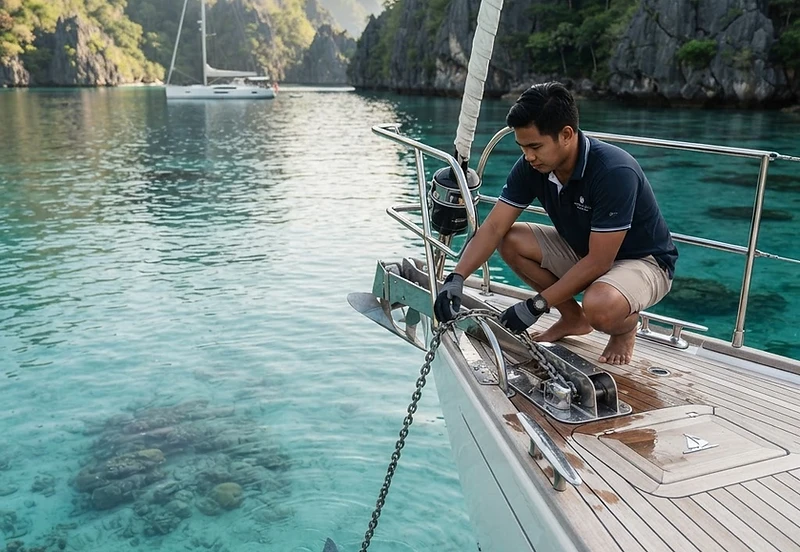
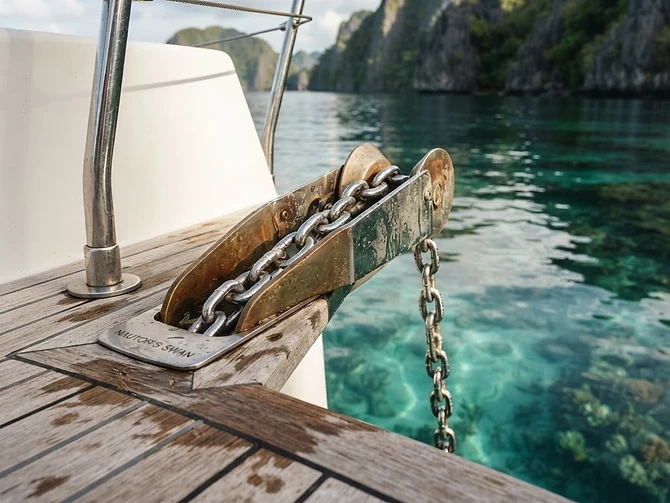
The morning off Coron was not marked by the roar of an engine, but by the rhythmic clink of the anchor chain against the bow roller of our Nautor's Swan. We were tucked into a shallow alcove, the water so translucent it seemed our vessel was floating on air rather than salt. Beneath us, a tapestry of brain coral and staghorn formations created an architectural complexity that rivals any man-made facade in Manila. To drop an anchor here without consequence is a discipline, a quiet dialogue between the ship's bridge and the seabed that demands the precision of a master mariner.
The Weight of Stewardship
In the Palawan archipelago, where the limestone karsts rise like cathedral spires from the turquoise expanse, the traditional practice of dropping heavy iron into the reef is an ecological failure. The reality of cruising in such a delicate ecosystem requires a departure from the convenience of simply hitting the ‘drop’ button at the first sign of a calm bay. We utilize the yacht's dynamic positioning system where the depth and bottom topography permit, keeping us hovered above the blue while protecting the vibrant benthic life below. Yet, when the current intensifies and a secure hold becomes an absolute necessity, we seek out the sandy halos that exist between the coral heads. There is a profound elegance in this restraint. It is a slow, methodical search—a process of scouting with the tender to ensure our anchor lands on a patch of barren sediment, isolated from the living coral. This is not merely environmental caution; it is the fundamental etiquette of the modern explorer, recognizing that the beauty we seek to inhabit is also what we must preserve.
Refined Rituals at Sea
Once the sonar confirms we are anchored securely in the sand, the tension of navigation dissipates, and the rhythm of life aboard shifts to the aft deck. The heat of the Philippine sun, thick and honeyed, is tempered by the shade of the bimini and a chilled glass of fresh calamansi juice, its sharp, citrus acidity finding a perfect match in the sea-salt-dusted prawns prepared by the galley. There is no urgency here. Living well at sea is the ultimate architectural exercise: a floating home that must adapt to its surroundings while providing a sanctuary for its guests. I recall a moment just after noon, watching the light fracture through the water’s surface, illuminating the movement of a school of fusiliers darting beneath the swim platform. It was a silent, graceful dance that made the imposing luxury of our vessel feel humble by comparison. As the shadows lengthen across the karst cliffs, the anchor watch becomes a meditative act, ensuring our presence is but a fleeting, respectful moment in the long, ancient history of these reefs.
We remain tethered to the seabed by a sliver of galvanized steel, a connection that demands absolute awareness of the shifting tides. To love the ocean in this modern era is to acknowledge its fragility, ensuring that the only mark we leave upon the Sulu Sea is the soft, transient wake of our departure. By the time the horizon swallows the sun, the tide has already smoothed away the ripple of our passage, leaving the reef as silent and pristine as it was before we arrived.






