
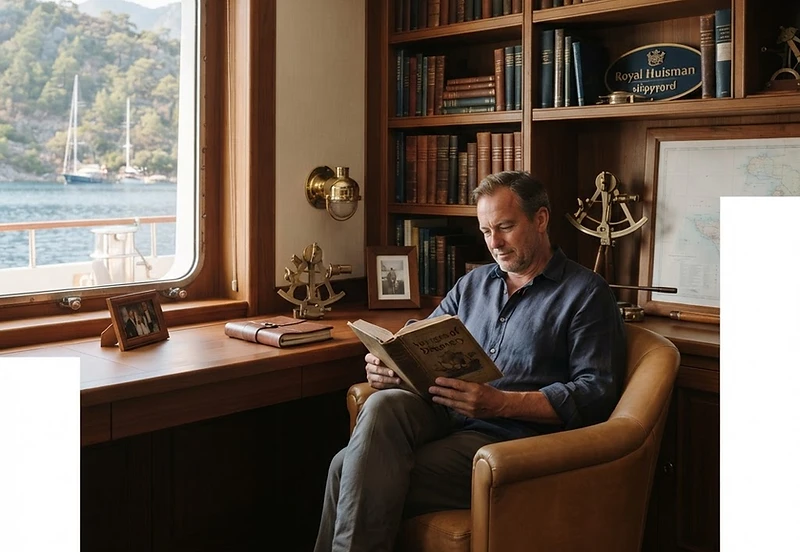
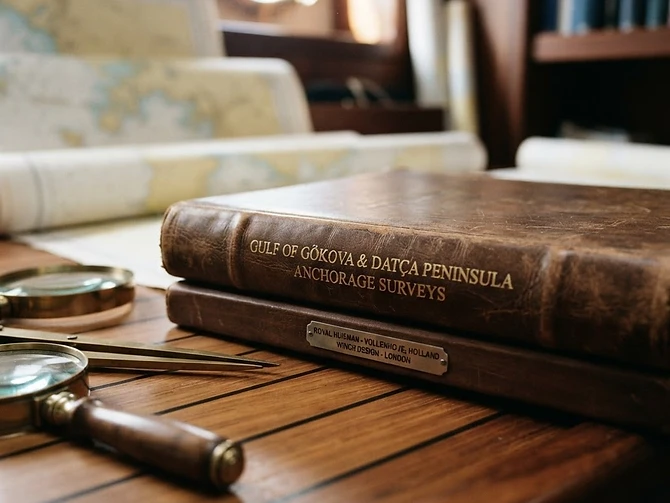
The Gulf of Gökova does not yield its secrets to those in a hurry. From the bridge of our 50-meter Royal Huisman, the coastline appears as a layered wash of ochre limestone and deep, resinous pine. We dropped anchor in the crystalline basin of Okluk Bay, the water so still it seemed to hold the hull in a liquid frame. While the guests gathered on the aft deck, I retreated to the owner’s study, a quiet volume of teak and leather that sits at the vessel's heart, shielded from the sun-drenched chaos of the Aegean summer.
The Architecture of Seclusion
Designed with the restraint typical of a studio like Winch Design, the space functions less as a cabin and more as an extension of the ship’s naval architecture. The cabinetry is milled from matte-finished walnut, integrated flush against the hull’s curvature to maximize the limited footprint. There are no loose items here; everything is secured for the passage, from the gimbaled lamps to the customized desk inlays. Within these walls, the yacht ceases to be a vessel of transit and becomes a stationary observatory. The air here smells faintly of cedarwood oil and the cooling salt mist that filters through the air-conditioning vents, a persistent reminder that despite the cabin’s terrestrial comfort, we are suspended over the depths.
Standing by the porthole, I watched the tender return from a nearby cove near Sedir Island. The turquoise shallows there are legendary, yet from the cool interior of the study, the landscape feels curated, framed by the circular glass. The transition from the blinding exterior glare to this dim, focused sanctuary is one of the true luxuries of life aboard. It is a deliberate recalibration of the senses, allowing for the kind of intellectual clarity that only occurs when the horizon line is fixed and the daily concerns of land-based life are obscured by thirty miles of blue water.
A Library for the Latitude
In the silence of the library, the sea is an auditory backdrop rather than a visual distraction. One hears the faint, rhythmic slap of water against the waterline—a sound that anchors the mind more effectively than any shore-side silence. I pulled a volume of maritime history from the shelf, its spine softened by years of humidity and salt. There is a profound honesty in reading at sea; without the insistent flicker of digital signals, the focus narrows to the rhythm of the tide and the turning of a page. A cup of Turkish coffee, brought down from the galley, left a ring of dark, bitter grounds on the mahogany surface, a small human mark in a space defined by its geometric perfection.
As the afternoon light began to sharpen against the limestone headlands of the Datça Peninsula, the yacht swung gently on her chain. The study is a rare, contemplative pocket within the nomadic machinery of yachting, a place where the movement of the stars feels fundamentally aligned with the structure of the ship. We are currently charting a course for the Knidos ruins, yet for this hour, the only progress being measured is the depth of one’s own thought. It is not an escape from the sea, but a way to inhabit it more deeply, mapping the miles behind us while the anchor holds fast in the silt of the Turkish coast.
The sun eventually dipped behind the silhouette of the mountains, casting long, bruised shadows across the bay. The anchor chain gave a final, resonant shudder as the current shifted, a subtle vibration that traveled through the deck plates and into the floor of the study. It is a reminder that we are merely guests of the geography, riding the pulses of the tide. When I finally emerged to join the others on deck, the evening air was cool, smelling of crushed pine needles and the distant, cooling stone of the ancient world.






