
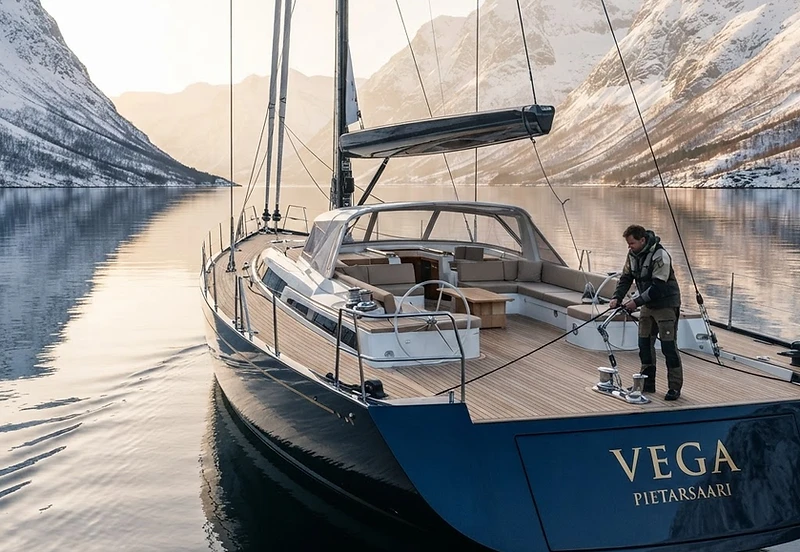
The Nautor’s Swan 78 slipped into the narrow channel between the granite cliffs of the Helgeland coast with a silence that felt almost liturgical. There is a distinct, cold friction to sailing the Norwegian Sea in late July; the wind carries the scent of ancient snow and brine, a bracing contrast to the soft, Mediterranean airs we usually chase. Aboard, the rhythm was dictated not by the schedule of a port, but by the relentless, pale persistence of the midnight sun, which turned our teak decks into glowing platforms of bleached honey. Here, the North Sea is not merely a body of water to be traversed; it is a profound, icy mirror reflecting the jagged, vertiginous edges of Norway’s coastal majesty.
Precision at the Arctic Threshold
Navigating these latitudes demands a departure from the casual ease of lower latitudes. The Helgeland archipelago, with its thousands of islands, islets, and skerries, requires a vigilant hand at the helm and a deep respect for the shifting currents that funnel through the mountain passes. We found ourselves moving with a heightened awareness, our passage defined by the changing light that never truly dimmed, merely shifted from the brilliance of noon to a long, melancholic gloaming that lasted for hours. The yacht, a masterpiece of Scandinavian craftsmanship, handled the unpredictable gusts rolling off the Svartisen glacier with the quiet confidence of a vessel built for the North. It was during a particularly sharp gust that I noticed the captain’s subtle adjustment to the helm, a minute, rhythmic correction that spoke of a deep familiarity with these demanding waters.
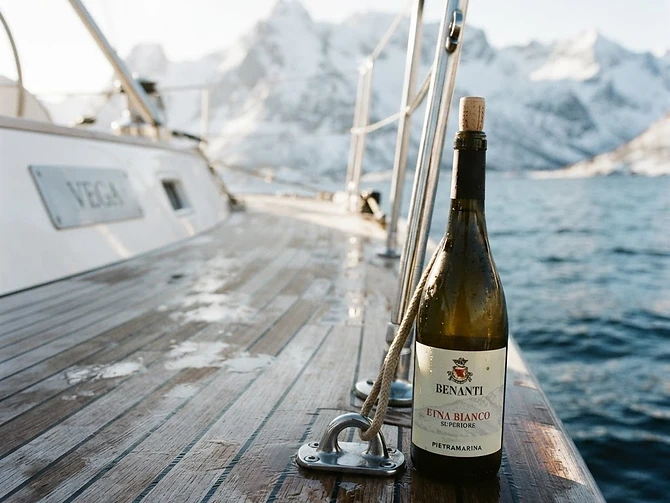
As the primary steward on this voyage, I found that the maritime environment here necessitates a different kind of rigor. We were carrying a selection of crisp, mineral-forward whites, specifically chosen for their saline backbone, which mirrors the mineral-heavy air of these fjords. Monitoring the temperature of these bottles required more than a standard cellar; it necessitated an intuitive understanding of the yacht’s thermal stability. I spent my afternoons navigating the internal cooling systems, ensuring that each bottle moved from the dark, climate-controlled recesses of the lazarette to the glass at the exact moment the ambient air temperature hit that perfect threshold of cool, northern crispness.
The Architecture of the Anchorage
We eventually dropped the hook off the island of Vega, where the coastline is a serrated edge of raw granite and hardy scrub, a UNESCO site of profound quietude. Looking toward the shore, the traditional rorbuer—stilted fishermen’s cabins—offered a lesson in vernacular architecture. These structures, perched precariously on stone plinths over the rising tide, are the ultimate expression of living in concert with the sea. As we sat on the aft deck, the juxtaposition was striking: the hyper-engineered, carbon-fiber sophistication of our Swan against the brutalist, weathered endurance of the 19th-century timber architecture on the bank. The wind died down as the sun lingered at the horizon, leaving the water as still as polished slate.
I poured a glass for our guests, noting how the taut acidity of the wine cut through the richness of the local tørrfisk, served simply with cultured butter and coarse sea salt. The taste was a revelation—the marriage of volcanic wine and the austere, salt-cured bounty of the Arctic sea. There is a singular beauty to the Helgeland drift. It is not the lush, sensory overload of the tropics, but a landscape of subtraction. Every sound, from the soft clink of a lead crystal glass against the stainless steel rail to the distant, haunting cry of a sea eagle, is amplified by the sheer, looming scale of the mountains. In these waters, luxury is redefined as the privilege of space, of silence, and of a vintage that remains perfectly chilled by the very sea that carries you toward the next horizon.
As the midnight sun finally brushed the tops of the granite peaks, casting long, bruised shadows across the deck, the reality of the voyage settled in. We were not merely passing through; we were participants in an ancient dialogue between vessel and elements. To sail Helgeland is to accept the bracing reality of the North—a place where comfort is found not in excess, but in the deliberate selection of moments that defy the vast, indifferent beauty of the Arctic.






