
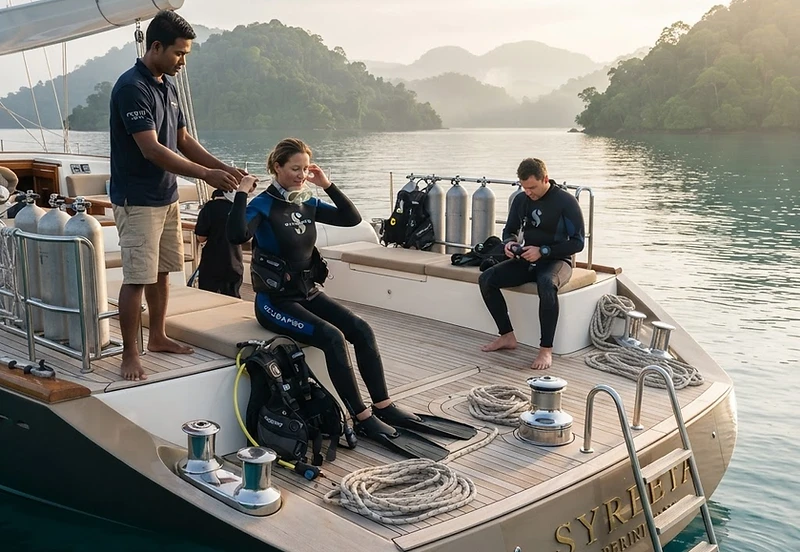
The Andaman Sea in the Mergui Archipelago possesses a particular, glass-like stillness that makes the scale of a vessel like our 50-meter Perini Navi seem both intrusive and perfectly aligned. We were anchored in the lee of Lampi Island, where the dense mangrove fringes meet the emerald water with a crispness that defies the humidity. Standing on the aft deck, the teak beneath my feet was still cool from the overnight air, a tactile reminder of the ship's meticulous maintenance before our arrival in these remote waters. The silence here is not empty; it is a heavy, velvet presence, broken only by the rhythmic clicking of the cooling engine and the occasional, distant call of a hornbill echoing from the dense, uncharted forest canopy.
The Geometry of the Descent
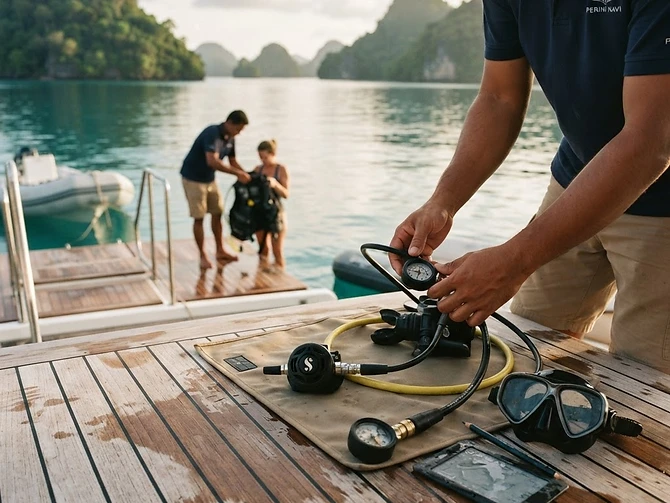
The dive briefing was not a lecture, but a choreography. Our captain and the lead dive guide leaned over the aft deck table—a slab of polished mahogany that served as the focal point of our morning ritual. They traced the underwater topography of the Lampi reef on a laminated chart, their fingers hovering over the limestone drop-offs that characterize this hidden corner of the world. Precision is the language of the sea; the guide traced a path through the currents, noting the specific depth where the water temperature typically drops, a thin, invisible line that demarcates the reef’s vibrant life from the deeper, darker abyss beyond. It is in these moments, amidst the humming of the generators and the gentle lap of the tide against the hull, that the true nature of a long-range charter reveals itself: a curated surrender to the environment, mediated by the engineering marvel beneath us.
Rituals of the Surface Interval
Life aboard during a charter is defined by these small, meditative transitions. As the gear was checked—regulators tested, masks cleared, fins laid out with geometric precision—the stewardesses circulated with trays of chilled coconut water and small porcelain bowls of fresh, local pomelo segments. The contrast between the rugged, untamed exterior of the archipelago and the refined, anticipatory calm of the aft deck creates a tension that is unique to the yachting experience.
There is a distinct dignity to being the only vessel for thirty miles in every direction, a sensation that turns the aft deck into a sanctuary of high-functioning peace.We were not merely visitors; we were observers of a private, aquatic threshold, balanced between the luxury of our surroundings and the raw, prehistoric majesty of the Lampi Marine National Park.
The Transition Beneath the Surface
As the final tank was secured to the rack, the captain gave a sharp, affirmative nod. There was no rush, only the deliberate, rhythmic cadence of a crew that understands the necessity of preparation. We moved from the shaded, climate-controlled comfort of the deck to the vibrant, blinding heat of the mid-morning sun, feeling the weight of the cylinders ease as we reached the swim platform. We slid into the water, leaving the stillness of the deck for the muffled, shifting light of the reef, carrying the quiet, shared discipline of the morning with us into the depths. Below the surface, the yacht’s hull loomed like a great, white cathedral, its anchor chain descending into the gloom like a tether to the civilized world we had momentarily abandoned.
Returning to the deck an hour later, the transition back to the surface felt like re-entering a different era. The sun had shifted, casting long, sharp shadows across the deck, and the crew was already transitioning into the midday service, folding towels and refreshing the linens with a grace that made the morning's intense exertion seem like a dream.






