
The Anatomy of the Descent
The Gerlache Strait is less a body of water and more a cathedral of ice, where the sheer verticality of the peaks mirrors the depths beneath our keel. We are anchored in the lee of Enterprise Island, the steel hull of our 45-metre expedition vessel shivering slightly as a distant glacier calves into the basin. The water here is not merely cold; it is a profound, numbing presence, holding a clarity that makes the bathymetry seem within reach. To dive here, seeking the agile leopard seals that patrol these frigid corridors, is to accept that you are no longer the navigator of your surroundings, but a guest in a realm governed by buoyancy and absolute stillness.
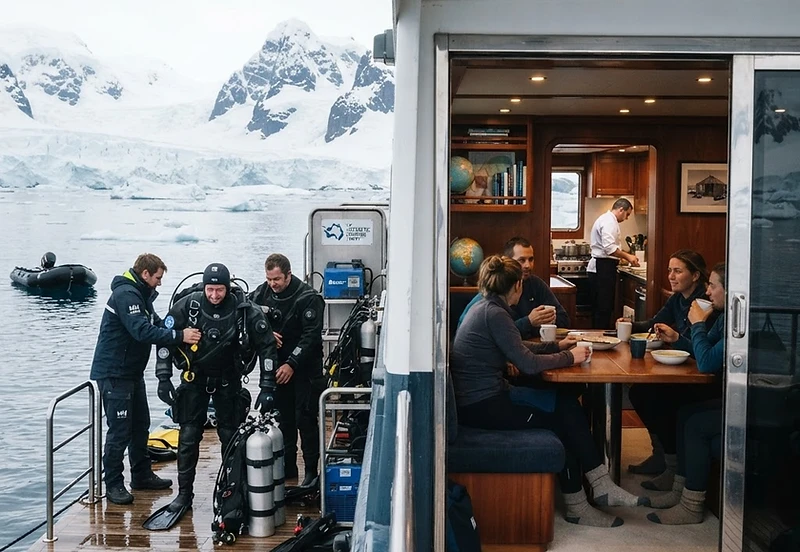
Preparing for an encounter with the local marine life requires a ritualistic attention to detail that mirrors the maintenance of the yacht itself. As we suit up on the aft deck, the familiar scent of salt-crusted neoprene mingles with the faint, metallic tang of the ship’s stabilizers. There is no bravado among the dive team; only the rhythmic hum of the compressors and the shared knowledge that in these waters, every movement must be deliberate. We slip from the swim platform, the surface tension yielding with a sharp, percussive break, and then—the descent into the cobalt void.
The Culinary Pulse of the Peninsula
Returning to the warmth of the aft saloon after a dive is a transformation of the senses. The galley, masterfully managed by our chef, serves as the heart of our expeditionary life. Following the bite of the Antarctic current, the table becomes a sanctuary. Tonight, the menu anchors us to the region’s sparse but vital offerings. We dine on toothfish—the Patagonian icefish—sourced through careful coordination with small-scale regional suppliers who understand the delicate balance of these southern fisheries. The fish is served with a reduction of local kelp and a dusting of hand-harvested sea salt, a dish that tastes of the very strait we spent the morning exploring.
This is not luxury defined by excess, but by provenance. The ingredients are treated with a reverence that matches the landscape. We finish the evening with a glass of crisp, mineral-forward white wine, paired with native cloudberries that provide a sharp, fleeting sweetness against the lingering chill of the dive. There is a quiet, shared intelligence in the room; we speak of the drift, the thermoclines, and the extraordinary privilege of witnessing a landscape that remains indifferent to our presence. The conversation inevitably turns to the morrow—the wind speed, the pack ice, and the next anchorage near the historic station at Port Lockroy.
As the southern sun lingers, refusing to set, I find myself standing on the bridge wing. The vessel, a marvel of naval architecture, feels like a sturdy, wood-trimmed anchor in the infinite white. I watch the icebergs ghost past, their blue cores glowing like trapped light. There is no horizon, only the seamless union of glacial ice and steel hull. We are explorers, yes, but tonight we are simply commuters, resting in the long, silver shadow of the mountains, waiting for the tide to turn.






