
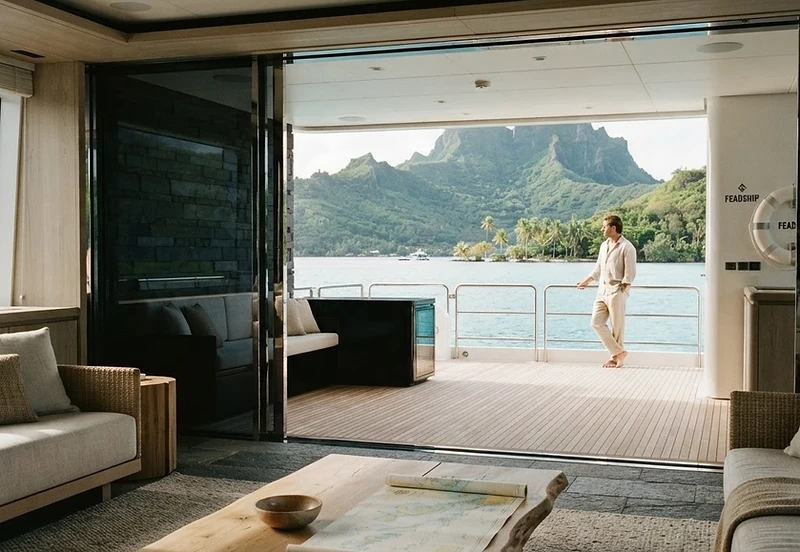
The morning light in the Fa’ahia lagoon has a specific, bruised quality, filtering through the palms of Taha’a before striking the warm, honey-toned teak of the 70-meter Feadship Sea-Glass. We are anchored in the deep, protective shadow of Mount Ohiri, the air thick with the heavy, sweet scent of crushed frangipani and the faint, unmistakable briny tang of the nearby reef. Life aboard a vessel of this pedigree is defined by the tension between the vastness of the Pacific and the deliberate, curated intimacy of the design. Inside the main saloon, the world shifts entirely. Interior designer Rémi Tessier has composed a space that feels less like a traditional yacht interior and more like a sublime extension of the island’s own geology, bridging the gap between marine architecture and the rugged topography of French Polynesia.
The Basaltic Interior and Architectural Rhythm
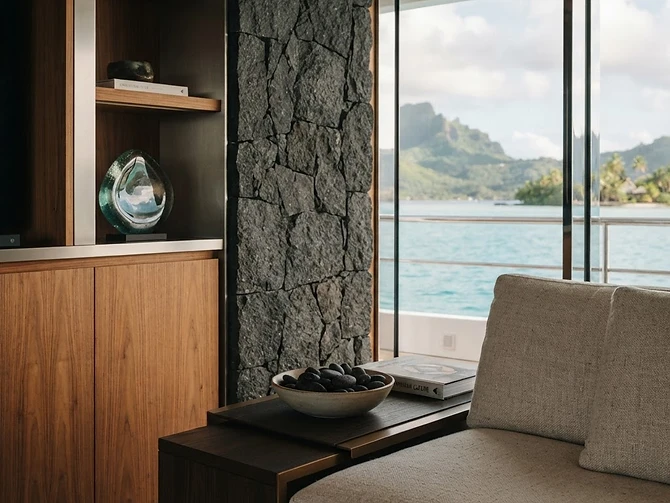
Tessier’s work on Sea-Glass purposefully eschews the expected tropes of yacht design—the overused nautical brass, the predictable navy upholstery, and the frantic high-gloss finishes—in favor of a quiet, architectural rhythm that respects its environment. The bulkheads are clad in sand-blasted oak, their grain carefully oriented to echo the vertical striations of the basalt pillars one sees while hiking the ridges of Moorea or Tahiti. There is an intentional weight to the furniture that grounds the visitor; heavy linen sofas in subtle, muted tones of volcanic ash sit against low, wide coffee tables carved from monolithic stone. As the yacht swings slowly and rhythmically on her chain, the horizon lines outside the floor-to-ceiling glass shift, aligning with the horizontal datum lines of the saloon’s custom joinery. It is an exercise in restraint where every surface invites the palm of the hand, demanding a tactile connection to the materials.
Living at the Threshold of the Pacific
One is struck by the deliberate lack of hierarchy between the interior deck and the exterior, a philosophy borrowed from the airy, permeable layout of a traditional Polynesian villa. Standing in the saloon, holding a glass of cool, clear coconut water—the fruit sourced just hours earlier from the bustling stalls of the Vaitape market—one feels the structure functioning as a house afloat rather than a mere transit vessel. The boundaries between the cabin and the lagoon are merely suggestions, mediated by the soft, diffused light that Tessier forces to bounce off matte, light-absorbing surfaces. I watched a crew member move with near-silent grace, adjusting a motorized blind to shield a delicate, hand-stitched leather chair from the harsh mid-day glare; it was a gesture of stewardship as careful and protective as one might witness in a private coastal residence in the Hamptons or the Cote d'Azur.
Later, as the sun dips behind the jagged, impossible silhouette of Bora Bora, the saloon undergoes a profound transformation. The lighting design, tucked away in recessed channels, begins to mimic the flicker of soft firelight against the basalt-toned walls. It is a space designed specifically for the return from the water, where the salt of the Pacific remains on the skin, yet the mind finds a cool, structural clarity. Sea-Glass does not merely float upon the Society Islands; through Tessier’s hand, it acknowledges the landscape, mirroring the island’s enduring, stone-hewn stillness against the restless, sapphire depth of the sea. In this quiet refuge, the vessel ceases to be a machine and becomes, quite simply, home.






