
The Architecture of the Mooring
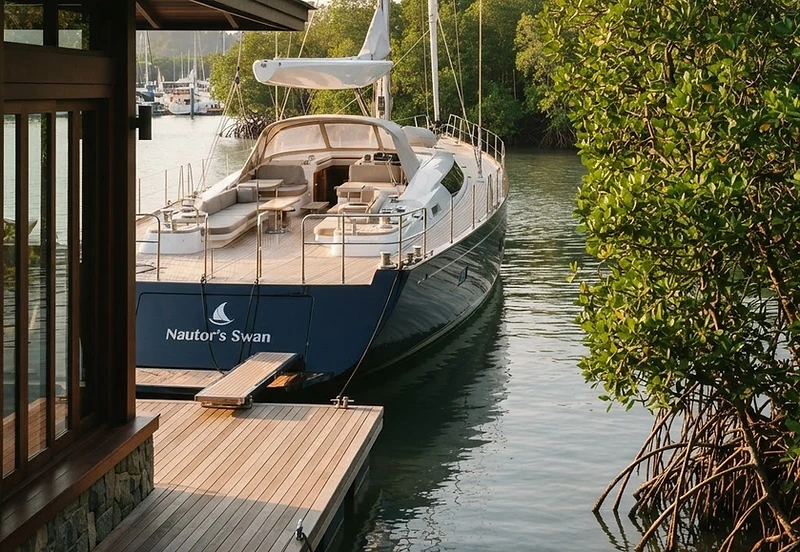
The humidity of the Andaman Sea hangs heavy over Rebak Island by five in the morning, a thick, sweet air that tastes faintly of salt and crushed ferns. Across the calm, silt-heavy waters of the marina basin, the 45-meter Nautor’s Swan sits perfectly still, her white hull glowing with a ghostly, pre-dawn luminescence. Watching her from the shoreline, the distinction between the yacht’s refined naval architecture and the structure of the private pavilion beside it begins to dissolve. This pavilion, constructed of reclaimed teak and local Langkawi limestone, features deep, cantilevered eaves that mimic the precise sweep of the yacht's flybridge. It was designed by architects who understood that the vessel is not merely a transient guest at the dock, but the primary orientation point for the entire landscape. Every line of the structure serves to frame the yacht, treating her presence as a permanent anchor for the eye, regardless of whether she is tethered or currently chasing the horizon.
Reflections in the Mangrove Channel
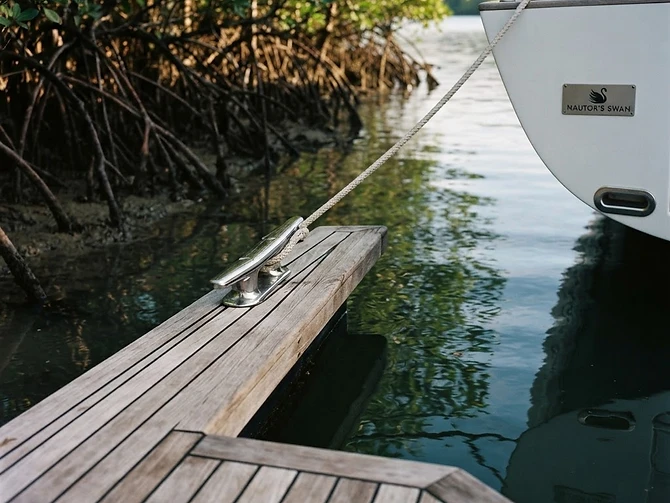
As the sun begins to bleed through the dense canopy of the surrounding mangroves, the water in the slip becomes a perfect, dark mirror, absorbing the first light. I watched the deck crew of the Swan meticulously rinsing the saltwater from the stainless steel stanchions, their movements choreographed with the quiet, practiced intensity that is unique to life aboard. There is a specific cadence to these tasks—the rhythmic hiss of the hose, the soft thud of a chamois against teak, and the muffled commands whispered across the deck. From the pavilion’s interior, kept intentionally minimal to prioritize the vista of the soaring mast, the yacht feels less like a separate entity and more like an expansive extension of the living space. "The boat dictates the geometry of the room," the owner remarked, stepping out onto the veranda to observe the tide shift against the stern. Here, the pavilion acts as a land-based sanctuary, a place where the stillness of the harbour is felt just as acutely as it is on the water. The selection of materials—weather-beaten teak decking that flows seamlessly from the quay into the pavilion floor—ensures that the transition from vessel to shore is not a disruption of the journey, but a graceful, continuous movement.
The Quietude of the West Coast
Beyond the marina, the vast expanse of the Malaysian west coast offers a different, more primal rhythm. There is a profound sense of isolation here, a solitude one struggles to locate in the crowded, buzzy anchorages of the Mediterranean or the Caribbean. When the trade winds pick up and the coastal palms begin to rustle, the pavilion becomes an acoustic buffer, shielding the serenity of the yacht’s morning ritual from the outside world. The sound of a tender engine idling near the quay provides the only punctuation to an otherwise silent morning—a low, guttural thrum that serves as a reminder of the voyage ahead. It is a rare luxury to find a berth that respects the nautical environment so thoroughly, refusing to impose itself upon the sea, but rather waiting patiently for the next crossing. As the crew finishes their checks and preps the galley, the pavilion remains a stone-and-timber reflection of the sea-going life, holding the space with stoic loyalty until the next return.
As the Swan eventually slips her lines and glides silently toward the open, shimmering blue of the Andaman, the quay feels suddenly diminished, returning to its quiet role as a witness to the tides. The relationship between the structure and the vessel remains, a dialogue of form that lingers long after the wake has smoothed over the harbor floor and the horizon has claimed its prize. In this hidden corner of Langkawi, the land does not just host the ship; it pays homage to the very act of sailing.






