
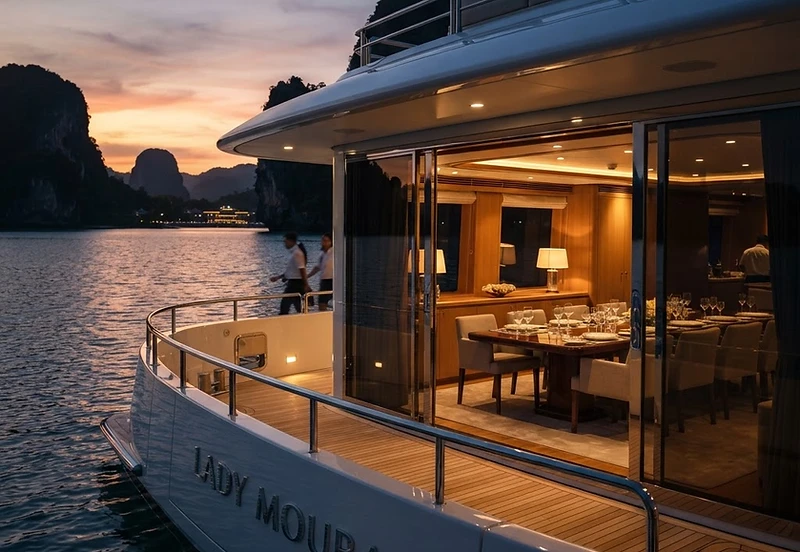
The Lady Moura—not the leviathan of fame, but a distinct vessel of understated grace—swung gently on her hook in the sheltered lee of Pulau Dayang Bunting. Outside, the limestone karst formations of the Langkawi archipelago turned from brilliant ochre to a deep, bruising purple as the sun dipped toward the horizon. Here, in the Andaman, the humidity clings to the salt-slicked decks until the very moment of dusk, when a cool breath of air off the mountains settles over the water. We had spent the afternoon navigating the narrow channels between the islands, the depth sounder reading a constant, comforting rhythm, before settling into this quiet anchorage near the Royal Langkawi Yacht Club’s outer reaches. There is a specific stillness here, a quality of light that seems to refract differently against the vertical cliffs, turning the sea into a sheet of hammered silver.
The Architecture of the Interior
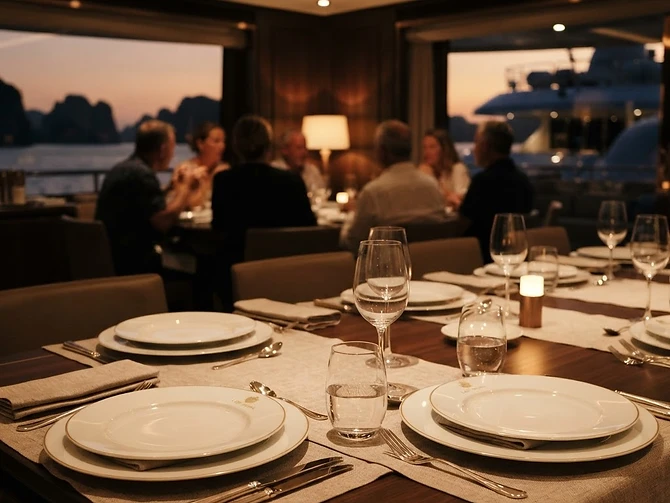
Stepping into the formal dining saloon is to leave the raw, humid theatre of the sea and enter a space defined by the deliberate, grounded geometry of maritime architecture. The room is a masterclass in spatial efficiency, designed by the studio of Bannenberg & Rowell, where the walls are paneled in bleached teak that mimics the surrounding islands' rugged facades. This is a house afloat; the saloon acts as the primary social anchor, a structural core around which the rest of the vessel’s utility revolves. The table, a sprawling expanse of polished macassar ebony, is currently set for twelve, the silverware catching the soft, recessed glow of the overhead LED arrays that have replaced the flickering lamps of older eras. The joinery is so precise that even when the vessel catches a swell, there is no groan of timber, only the rhythmic, reassuring pulse of the sea against the hull.
The Ritual of the Twelve
Watching the steward prepare for the evening service is an exercise in symmetry. Each place setting is a study in precise architectural alignment: the heavy crystal glasses spaced to the millimeter, the linen napkins folded into crisp, sharp-edged triangles that echo the silhouette of the jagged cliffs outside. I overheard the chief steward remark that the motion of the boat is a variable the setting must account for—the hidden magnetic clips beneath the tablecloths, the specific weighting of the flatware—ensuring that the formal arrangement remains static even as the vessel breathes with the tide. As we sit down to a dinner of locally sourced red snapper and ginger-infused greens, the room feels like a solid, permanent villa, momentarily tethered to the shifting currents of the Malaysian coast. There is a profound elegance in this illusion; the yacht is not merely a mode of transport, but a bespoke structural home, built to hold its own against the vastness of the Andaman.
Reflections on the Andaman Tide
As the conversation wanes and the plates are cleared, the anchor chain rumbles somewhere beneath the deck, a reminder of the proximity of the seabed. It is a grounding sound, a reminder that we are guests of this geography. We finish the evening on the aft deck, looking back at the dark, looming shadows of the islands which appear almost monolithic in the moonlight. The dining saloon remains lit behind us, a golden, structured beacon floating in the middle of the quiet, black water. In that moment, the boundary between the artificial luxury of the interior and the primal, limestone-hewn wilderness outside feels remarkably thin, yet perfectly balanced. We are, quite literally, anchored in a state of suspended animation, waiting for the tide to dictate our next passage towards the open reaches of the Andaman Sea.
The evening concludes with the soft hum of the generator and the distant, lonely call of a sea bird circling the karst peaks. It is this transition—from the structured elegance of the dining table to the vast, unscripted freedom of the night—that defines the true luxury of the yachting life, proving that the most stable foundations are often those that float.






