
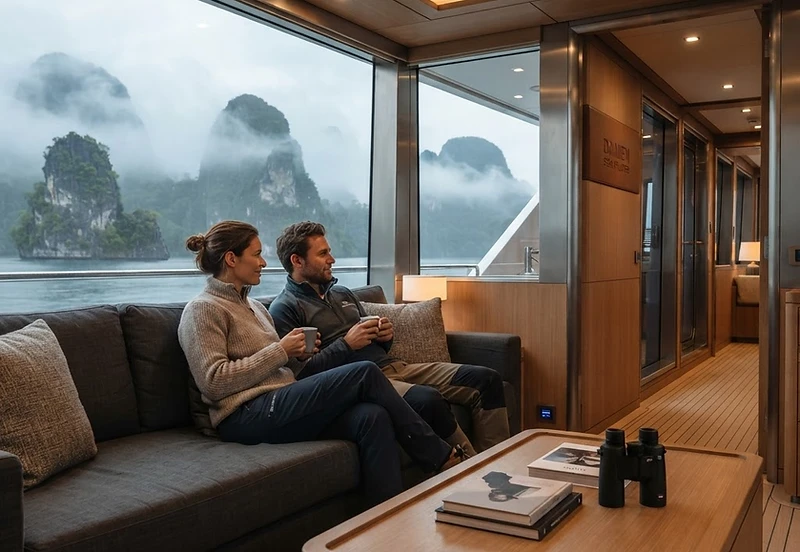
The humidity of the Wayag anchorage usually clings to every surface, heavy and perfumed with damp limestone and decaying mangroves, but inside the main salon of this Damen SeaXplorer, the atmosphere is distinct—conditioned, crisp, and smelling faintly of the waxed walnut paneling that defines the interior’s core. We were anchored deep in the shadows of the limestone islets, the sea a flat, ink-black mirror reflecting the jagged, silent horizon. Beyond the triple-glazed glass, the tropical night was absolute and suffocating, but within this floating fortress, the environment felt less like a nautical vessel and more like a high-altitude mountain villa, seamlessly shifted from the Alps to the equator.
The Architecture of the Interior Threshold
The layout of the yacht acts as a series of thermal and structural baffles, a design language crafted for the extremes. The designers, Azure Yacht Design, have articulated the space to prioritize the transition from the harsh, unpredictable exterior conditions to the interior sanctuary. Unlike the airy, minimalist decks of a Mediterranean coastal cruiser, designed for the predictable sunshine of the Côte d'Azur, this space is built with heavy, tactile materiality. The joinery is robust, finished with a matte sheen that absorbs the interior lighting rather than reflecting it, creating an intimacy that feels intentional rather than expansive.
The structure reads as an extension of the vessel’s naval architecture; the steel bulkheads are acknowledged rather than hidden, providing a skeletal grounding that reminds one of the vessel’s true purpose—to survive the crushing pressure of pack ice or the oceanic swell of a deep-water passage with equal, detached indifference. Stepping through the pneumatic doors into the salon, one experiences a profound stillness, a deliberate separation from the raw, kinetic energy of the Indonesian archipelago.
The Warmth of the Engine-Room Hum
Life aboard at night in Raja Ampat follows a rhythm dictated by the yacht’s mechanical heart. There is a perceptible hum that permeates the lower deck cabins—not an intrusive vibration, but a low-frequency, resonant thrum that suggests total readiness. I sat in the observation lounge well past midnight, watching the amber trace of the radar sweep through the dark, waiting for the wind to shift. The interior architecture manages to capture the scale of the landscape outside, creating a sense of volume that feels expansive yet deeply protected. It is a domesticity that doesn't shy away from its industrial origins; there is no velvet or gilt here, only the honest weight of engineering.
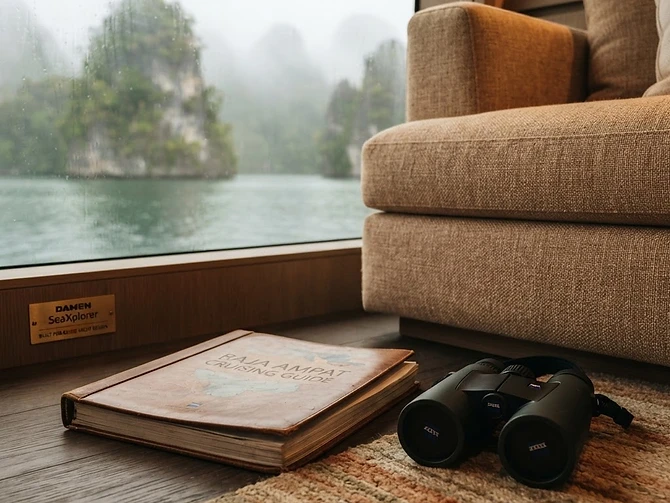
Earlier that evening, while we were still anchored off the karst formations, I had stepped onto the aft deck to retrieve a discarded pair of binoculars. The contrast was startling: the sudden hit of the humid air, the sound of water lapping against the hull, and the distant, lonely cry of a sea bird. Returning inside, the transition into the climate-controlled stillness felt like crossing a physical border between two worlds. I poured a glass of chilled water, the condensation blooming against the glass, and found a quiet comfort in the fact that, regardless of the storm clouds gathering over the horizon, the vessel remained an unwavering constant.
We have learned that true comfort at sea is not found in superficial ornamentation, but in the integrity of the envelope. As the captain signals the morning watch to weigh anchor for the southern reaches of Komodo, the interior remains a fixed point of domestic order, a sanctuary of climate and calm held steady against the wild, swirling currents of the open sea.






