

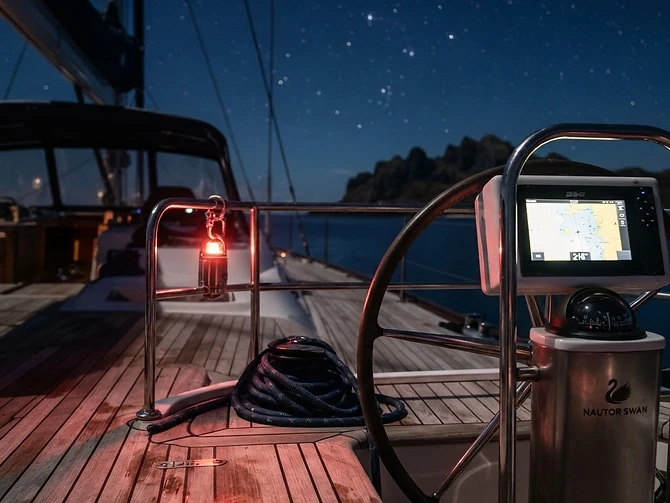
When we weighed anchor off the limestone cliffs of Sawa-i-Lau, the setting sun had already surrendered the horizon to a deep, bruised violet. Our passage north toward the northernmost reaches of the Yasawa Islands was intended to be a slow transit, a deliberate navigation through the night to capture the first light over the reefs. Aboard a Nautor’s Swan 98, the motion is singular; she doesn't fight the swell so much as she breathes with it, the hull moving through the water with the grace of a predator. There is a profound sense of security in the craftsmanship of a Finnish-built yacht when the nearest land is a jagged, unlit silhouette and the depths beneath the keel plunge into the thousands of fathoms.
The Quietude of the Midnight Watch
Steering by the faint glow of the navigation monitors, the world narrows to the illuminated binnacle and the occasional sweep of the radar. There is a specific, tactile intimacy to the night watch that the daylight hours strip away. The hum of the engine is a muted vibration beneath the feet, punctuated only by the rhythmic slap of salt water against the teak toe-rail. As we cleared the headland, the Southern Cross became a piercing fixture in the dark, guiding our trajectory as surely as the digital charts. It is in these hours that the luxury of life aboard reveals its true texture: not in the fine leathers of the saloon or the plush upholstery, but in the profound silence shared between the watch-stander and the sea. Here, the vessel is not merely a mode of transport but a sanctuary of focus, where the chaotic noise of the modern world is replaced by the steady, hypnotic cadence of the swell.
Rituals of the Galley and the Deck
Life aboard, even during an overnight crossing, maintains a necessary, graceful cadence of care. Around 02:00, the galley team had left a thermos of locally sourced ginger tea and a plate of sliced fresh papaya and finger limes—a sharp, acidic, and vibrant contrast to the heavy, humid air of the Pacific night. We sat on the aft deck, sheltered from the breeze, watching the wake dissolve into brilliant, flickering bioluminescent sparks that trailed behind us like liquid stardust. The transition from the exertion of sail-trimming to the stillness of a midnight meal is where the yachting rhythm truly settles. There is a singular wellness in this detachment, a complete shedding of the onshore frantic pace in favor of the ship's steady, reassuring heartbeat.
The deckhand, a seasoned Fijian mariner who has navigated these reefs for over a decade, leaned over the rail and remarked that the water sounds different near the submerged limestone shelves of the Yasawas; it produces a deeper, resonant gurgle that acts as an auditory warning of a shallowing bottom, long before the sonar even registers the shift.
As dawn began to bleed into the eastern sky, turning the dark, monolithic ocean into a vast sheet of hammered copper, the distant, craggy peaks of the northern islands emerged slowly from the morning mist. We tightened the sheets, the carbon fiber mast groaning softly under the renewed tension as the yacht caught the first breath of the trade winds. The watch-keeping had concluded, but the passage—that fluid, uninterrupted connection between port and open water—remained, a testament to the quiet elegance of finding one’s way through the dark. As the sun crested the horizon, the Yasawa Passage opened before us, a gateway of cerulean water that made every quiet, challenging hour of the night feel like a necessary tribute to the sea.






