
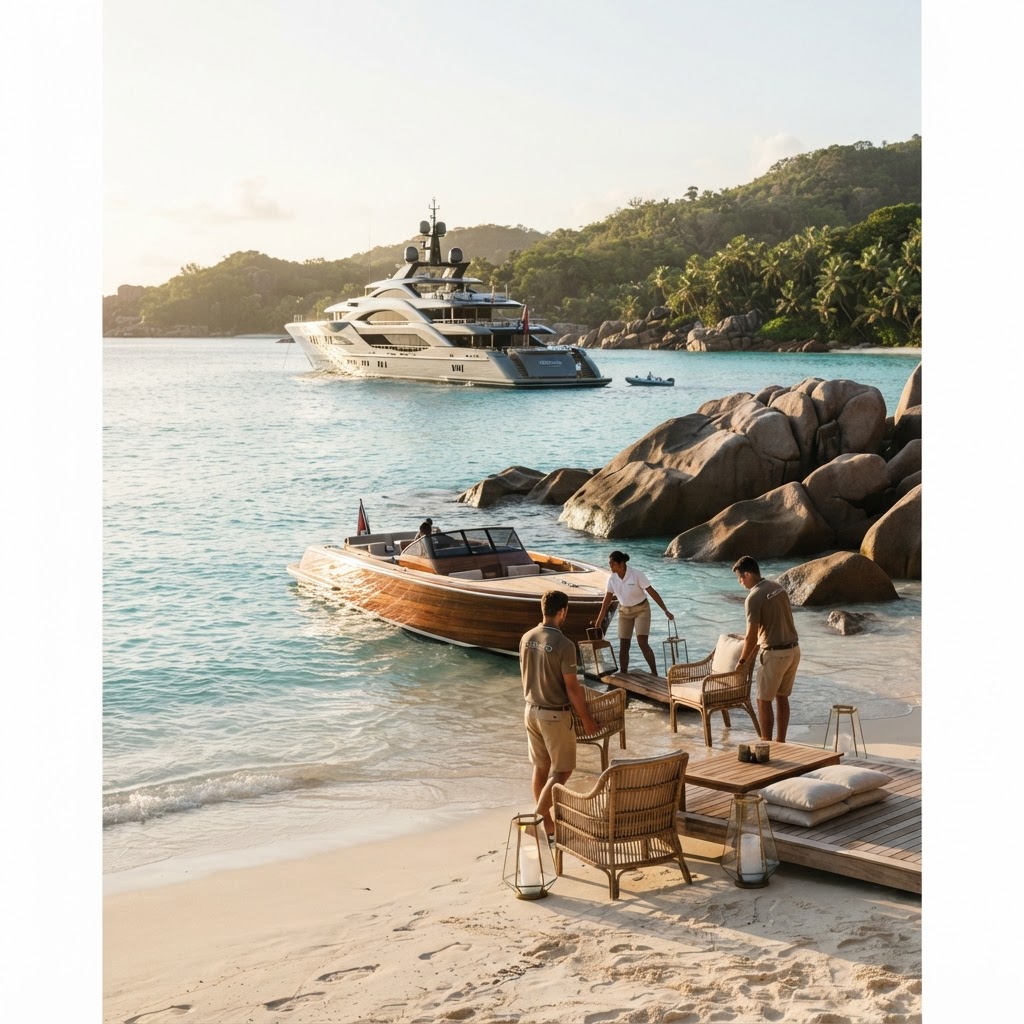
When the heavy anchor chain finally settles into the silty, translucent floor off the western coast of La Digue, the transition from the structured precision of shipboard life to the profound island stillness begins. We had been navigating the Seychelles' inner islands for over a week aboard a 90-meter Oceanco, a vessel that commands the Indian Ocean with an imposing, linear grace. Yet, as the sun began its steady, bruised-gold descent toward the horizon, the focus shifted entirely from the bridge and navigation arrays to the shoreline. The objective was a beach dinner—not merely as a service performed by the crew, but as a deliberate, thoughtful engagement with the fragile ecology of this granite-strewn paradise.
The Logistics of Silent Stewardship
Sustainability in the Seychelles is not a mere marketing posture; it is an absolute necessity dictated by the ancient granite outcrops and the intensely sensitive coral reefs that define the seabed. Our crew began the transition long before the tender ever touched the sand. Every piece of equipment, from the bespoke, recycled-wood folding tables to the soft, battery-powered ambient lanterns, was vetted for its zero-footprint capability. There were no plastic runners, no gasoline-powered generators to intrude upon the rhythmic swell of the Indian Ocean, and no trace left behind to mark our presence. Watching the deckhands carefully hoist the modular equipment, one realizes that the true pinnacle of modern yachting luxury is the ability to disappear completely into a pristine landscape without leaving so much as a whisper of one's passage behind.
Dining at the Edge of the Tide
As the light turned a deep, metallic purple, the ephemeral beach club took shape beneath the low, sweeping canopy of takamaka trees. The ritual of the evening centered entirely on the gentle, inevitable rhythm of the incoming tide. Chef presented a menu focused on locally sourced red snapper, grilled over a smokeless hearth, accompanied by fresh hearts of palm and a simple emulsion of lime and sea salt—flavors prepared with a restraint that allowed the saline air itself to do the heavy lifting. We sat in the cool, powdery sand, the sound of the water lapping against the shore providing the only soundtrack. It was a stark, intentional departure from the polished mahogany and climate-controlled perfection of the yacht’s formal saloon, yet it felt far more in harmony with the vessel’s fundamental identity as a true seafaring craft. To dine with one's feet firmly planted in the coral sand while the yacht anchored silently in the distance is to finally understand the quiet, heavy stewardship required of those who choose to spend their lives on the water.
The Departure and the Echo of Silence
By the time the last chilled glass was cleared, the night sky over the Indian Ocean had deepened into a vast, star-heavy canopy, with the Southern Cross glowing with startling clarity above the masthead. The clean-up was performed with a surgical, disciplined efficiency that mirrors the high professional standard of an Oceanco deck crew. Every piece of linen, every ceramic plate, and every remnant of the evening’s festivities was accounted for, packed, and transported back to the mother ship. As we motored back to the yacht in the dark, the shoreline returned to its natural, undisturbed state, the moonlight illuminating the smooth, untouched sand. We climbed back aboard the ship not just refreshed by the meal, but deeply mindful that the most elegant rituals are those that allow the sea to remain exactly as it was found, existing in a state of grace long after we have weighed anchor and disappeared over the horizon.






