
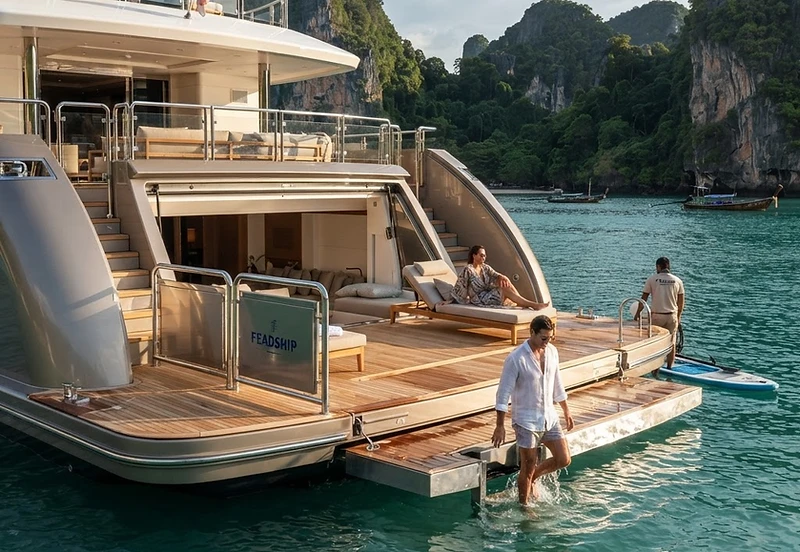
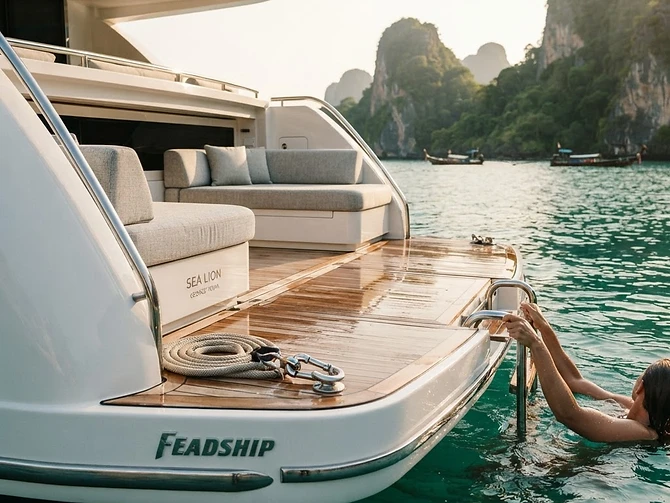
When the 60-meter Feadship dropped anchor off the eastern shore of Koh Yao Yai, the morning mist was still clinging to the limestone karsts of Phang Nga Bay like a phantom shroud. From the bridge, the water appeared as a solid sheet of hammered silver, indifferent to our arrival, yet profoundly still. But it was the stern of the vessel that commanded the true transformation of space. As the hydraulic transom folded outward with a soft, mechanical sigh, it did not merely open a storage hold; it lowered a teak-clad terrace directly onto the Andaman Sea, effectively resetting the yacht’s domestic foundation at water level. This is where the vessel breathes, and for those of us on board, it is where the voyage finally takes hold.
The Architecture of the Transition
In traditional naval design, the transom served as a rigid barrier—a robust vertical plane intended to deflect following seas and protect the internal volume of the hull. Today, the modern beach club functions as a deliberate, fluid architectural envelope, bridging the gap between the climate-controlled serenity of the interior and the saline, unpredictable reality of the bay. The integration of high-threshold glass doors and retractable platforms creates a seamless promenade that feels less like a boat deck and more like a minimalist villa built over a tide pool. Standing on the teak slats, which were still slick with the morning’s heavy condensation, one can hear the gentle, rhythmic lap of water against the hull—a visceral, hollow sound that is entirely absent from the elevated decks above. It is a spatial paradox: you are on a massive, steel-hulled machine, yet your feet are only inches removed from the sea's surface.
Anchored in the Andaman Light
By mid-afternoon, the beach club had become the gravitational center of our orbit. We watched as the crew deployed the tenders, the mechanical motion of the winches muffled by the faint, distant hum of local longtail boats passing toward the pier at Loh Paret. The experience of sitting on the low-slung, weather-resistant sofas is transformative; the horizon line shifts, and the sheer, imposing scale of the Feadship’s hull becomes a mere backdrop. The focus narrows to the interplay of light on the water, which shifts from opaque emerald to a translucent, crystalline turquoise. We shared a bowl of fresh pomelo and lime, the sharp, acidic citrus cutting through the thick, humid air of the bay. There is a specific kind of domestic stillness found here, a realization that the yacht’s complex structure is merely a vessel for the environment it chooses to inhabit. In this quiet, unhurried space, time ceases to be measured by the ship’s clock and begins to mirror the slow, tidal pulse of the archipelago.
As the sun began to dip behind the jagged crags of the mainland, casting long, bruised-purple shadows across the water, the architectural intent of the beach club became crystalline. It is a threshold space, designed not for transit, but for arrival. Whether anchored here in the sheltered, quiet reaches of the Thai islands or berthed in a bustling, social marina, the modern superyacht remains an exercise in bringing the shore to the sea. The beach club remains the most honest room on board, a place where the artificial barrier between sophisticated naval engineering and the raw, shifting topography of the coast finally dissolves, leaving us simply to drift.






