
The Geometry of a Midnight Crossing
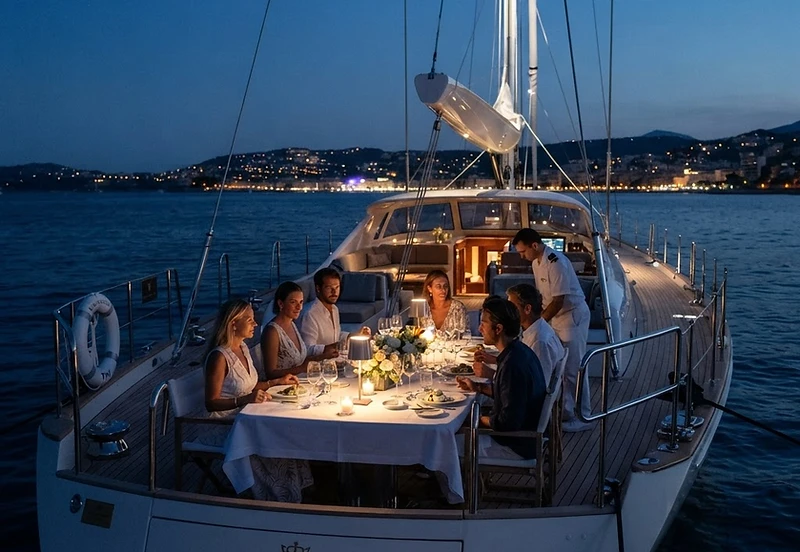
There is a specific, fleeting alchemy that occurs when a vessel as substantial as a 50-meter Royal Huisman transitions from the frantic energy of a midday arrival to the hushed, intentional stillness of a late-night passage. We were clearing the headland of Cap Ferrat, the engine’s low vibration oscillating against the hull, as the coastline of the Côte d’Azur dissolved into a constellation of amber and white flickers. The bridge had long since handed off the navigation to the autopilot, and the crew had pivoted, as they do, from the mechanics of the sea to the choreography of the table.
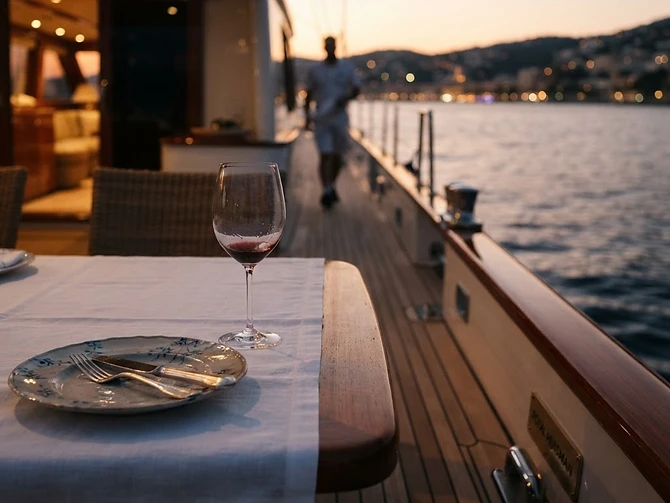
To dine aboard while underway is to accept that the ship is a living, breathing participant in the conversation. As we turned toward the Ligurian border, the slight swell of the Mediterranean dictated a delicate, slow-motion balance—the silverware catching the dim ambient light, the linen napery crisp against the warm teak. The Captain’s table is not merely a place for food; it is the command center of the social life aboard, where the formality of the service acts as a necessary anchor against the vast, dark emptiness of the water outside.
Rituals of the Galley and the Watch
Life aboard a vessel of this pedigree is defined by the seamless transition between the technical and the social. Our chef, having spent the afternoon sourcing heirloom tomatoes and salted anchovies from the markets near Antibes, prepared a sea bass crudo that arrived with the precision of a celestial navigation chart. There is a profound intimacy in eating well while the ship works to slice through the black water. We spoke, naturally, of the currents near Port Hercules and the shifting sandbars we might encounter on our approach to the Gulf of La Spezia, our voices low to avoid disrupting the bridge’s quiet vigilance.
The motion of the hull, rolling gently through the Ligurian swell, transforms a simple dinner into an act of sustained focus.
The rhythm of the charter is a paradox: it is entirely structured, yet wholly liberated from the tick of a clock. Between courses, one finds oneself observing the horizon, watching for the sweep of a distant lighthouse or the bioluminescent wake trailing from our stabilizers. This is the true luxury of the yachting life—not the porcelain or the wine, but the ability to exist within a perfectly curated ecosystem while being physically untethered from the shore. The stewardess, moving with a practiced, light-footed grace that accounted for the ship’s subtle list, cleared the plates with a silent efficiency that felt, in its own way, like a naval maneuver.
The Quiet Ingress
As the night deepened, the conversation shifted toward the morning’s destination: the hidden coves tucked behind the jagged, limestone cliffs of the Ligurian coast. We were not merely crossing water; we were traversing the border between the polished, high-gloss world of the French Riviera and the wilder, vertical drama of the Italian shore. The captain mentioned the difficulty of anchoring near Portofino this time of year, his tone pragmatic and devoid of pretension, grounding us in the reality of the trade. It was a reminder that for all the elegance of the setting, we were essentially guests of the sea, riding upon a complex piece of engineering designed to conquer it.
By the time the coffee was served, the coast of Italy was a dark silhouette against the stars. We were no longer guests and hosts, but a collective entity moving in sync with the hull, the wind, and the deep, unseen currents of the Mediterranean. When we finally retired to the aft deck, the smell of salt spray mingled with the lingering scent of espresso, a final sensory note before the night watch took hold and the ship continued its silent, steady march toward the dawn.






