
The Convergence of Deep Water
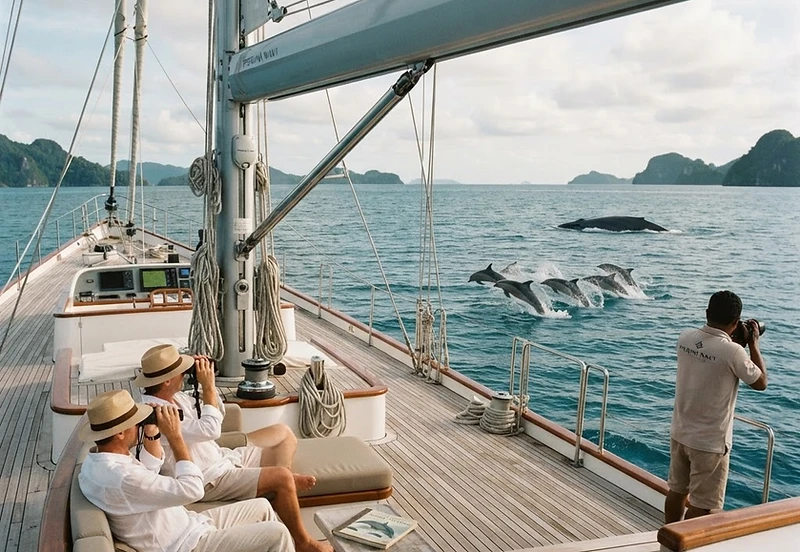
The dawn over the Dampier Strait does not break with a roar; it arrives as a soft, pearlescent lifting of the mist, revealing the jagged, emerald-crowned limestone karst of Raja Ampat. We were anchored in the sheltered lee of Mansuar Island, the 56-meter Perini Navi swinging gently on her chain. The air smelled of damp earth and crushed coral, a sensory reminder that the vast, liquid wilderness of the Indonesian archipelago is never more than a few hundred yards away from the comforts of the yacht’s aft deck. Our objective for the morning was simple: to track the passage of migratory whales traversing the deep channels between the Pacific and Indian Oceans, a journey that demands as much patience from the crew as it does from the guests.
Standing on the bridge, the captain adjusted our course toward the deeper shelf where the cool, nutrient-rich currents collide. There is a specific cadence to a Perini Navi under sail in these waters. The tension on the hydraulic winches, the precise snap of the mizzen sheet, and the subtle, vibrating hum of the hull through the water define the morning far more than any digital readout. We navigated the narrow gaps between the pinnacles with a practiced ease, the yacht’s draft requiring a deep-water confidence that only comes from intimate knowledge of these charts.
The Rituals of the Passage
Life aboard, while we waited for the tell-tale spout of a blue whale, took on a rhythmic, restorative quality. Mid-morning was marked by the stewards setting the teak table on the main deck, not with the frantic pace of a turn-around, but with the quiet ceremony that defines a long-range cruise. We dined on fresh papaya, grilled local snapper with a light chili sambal, and chilled young coconut, consumed while eyes remained scanned toward the horizon. This is the inherent luxury of the yachting life: the ability to exist in a state of suspended animation, where the focus is entirely on the environment, yet every human comfort is perfectly, unobtrusively maintained.
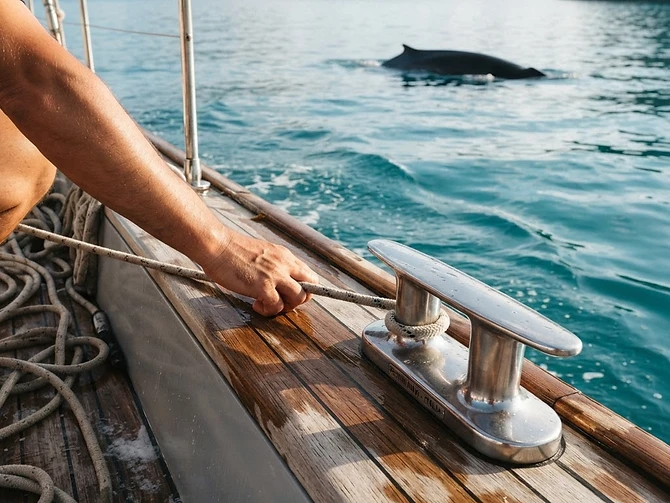
We did not see the whales until early afternoon. When the breach finally occurred—a massive, silver-grey arc against the dark, cobalt water—the yacht slowed its headway to a drift. We watched from the flybridge, the engine rumble silenced, listening only to the slap of the swell against the hull. The crew’s movements were as fluid and synchronized as the whale’s own arc, a dance of professional discretion that allowed us to witness the creature without ever interrupting its migration.
Anchored in the Silence
By the time we returned to the shelter of the Waigeo coast for the evening, the sun had turned the limestone cliffs to a burnt, bruised ochre. We settled into our anchorage, the anchor chain rattling out with a heavy, final sound that signaled the close of the day. As the deck lights flickered on, casting a warm, golden glow against the dark water, the transition from the day’s adventure to the evening’s stillness felt seamless.
The dinner service that followed—a quiet affair of roasted vegetables from the Sorong markets and local sea bass—was secondary to the atmosphere. We sat on the aft deck, watching the bioluminescence flicker in the boat’s wake, talking in hushed tones about the size of the pod. The yacht, once a vessel of exploration, had become our private, floating sanctuary in the middle of a remote sea. There was no need for grandiosity; the luxury was simply in the presence of the water, the security of the steel, and the simple, lived-in joy of a day spent entirely within the blue.
As the moon rose over the Dampier Strait, the wind dropped to a whisper, leaving us in a perfect, glassy silence. We stayed on deck until the stars crowded the sky, the yacht reflecting the celestial architecture above, our presence in these waters feeling both infinitesimal and profoundly privileged.






