
The Anatomy of an Adriatic Passage
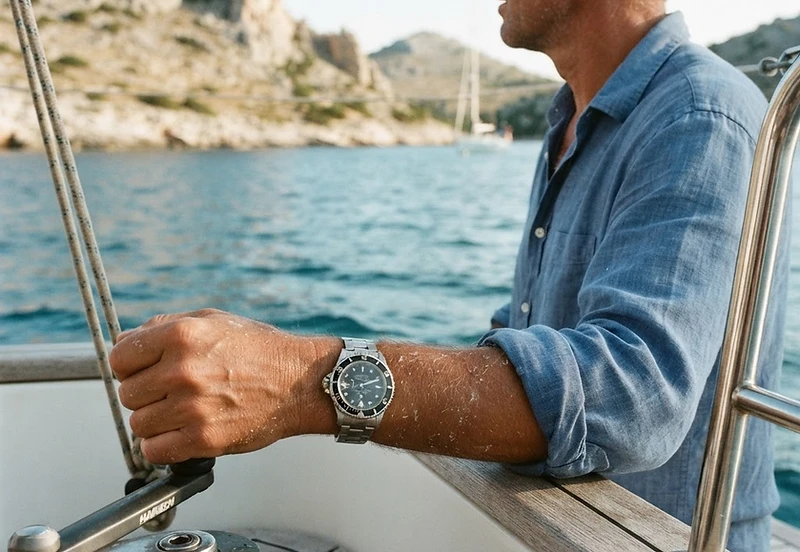
The dawn off the Kornati islands does not break with a roar; it arrives as a slow, pale infusion of light against the jagged, limestone teeth of the archipelago. We were anchored in a secluded cove near Levrnaka, our Nautor’s Swan swinging gently on a scope that felt too short for the depth but perfect for the stillness. On deck, the air tasted of dry scrub, wild sage, and the inevitable, lingering salt of the Dalmatian coast. As I pulled a line tight to adjust the fender, the morning light caught my wrist—or rather, the steel of the dive watch secured there. It is a tool that has survived more transit time than I care to admit, its bezel now softened by years of immersion, the sharp, factory-fresh edges worn into a smooth, grey topography that maps every reef I have charted.
The Geometry of Wear
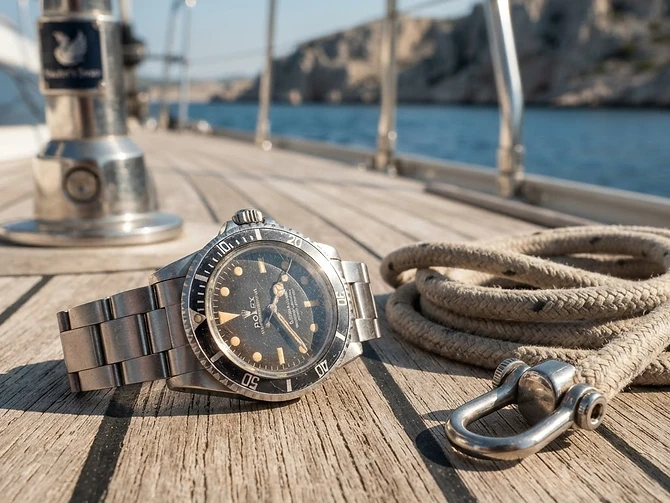
There is a particular honesty to a watch that has spent its life aboard a vessel. It is not merely an accessory; it is a structural element of the passage. My own, a vintage Rolex Submariner, bears the scars of a decade spent navigating the transition from the bustling quays of Marina Mandalina to the remote, wind-scoured bays of the Kornati National Park. The aluminum insert of the bezel, once a deep, ink-black, has faded to a ghostly, slate-grey, an effect the locals might compare to the bleached bones of a wreck. The sapphire crystal is etched with minute, radial scratches—the quiet debris of winching heavy Harken blocks and the abrasive, persistent touch of sand from the hidden beaches near Telašćica. These are not flaws. They are an archive of miles.
Tactile Navigation and the Evening Ritual
In the late afternoon, as we prepared to weigh anchor and push toward the lights of Šibenik, the watch became the focal point of the transition. There is a tactile ritual in turning the bezel to track the approach, a physical engagement with time that a touchscreen simply cannot replicate. We sat in the cockpit, the teak decks still warm from the sun, sharing a plate of fresh octopus salad and local olive oil, the engine hum vibrating through the hull. I watched the captain adjust his own timepiece, a worn Omega Seamaster with a dial that had aged into a rich, tropical brown. He noticed my gaze and tapped the crystal. We didn't need to speak; we both understood that the watch was the constant in a life defined by shifting tides. It was the weight of the voyage on the wrist, a metal anchor for the fleeting minutes of a Mediterranean summer.
As the sun dipped behind the western headlands, turning the water into hammered copper, I looked down one last time at the dial. It was becoming harder to read in the fading light, the luminous paint long ago surrendered to the sun. But I knew the position of the hands by heart. Like the vessel herself, the watch had earned its patina through steady, salt-crusted labor. It had moved from the polished showroom to the rough, rewarding reality of the sea, and in that transition, it had finally become something of true value: an instrument that belonged to the wind and the water.






