

The Geometry of the Morning Watch
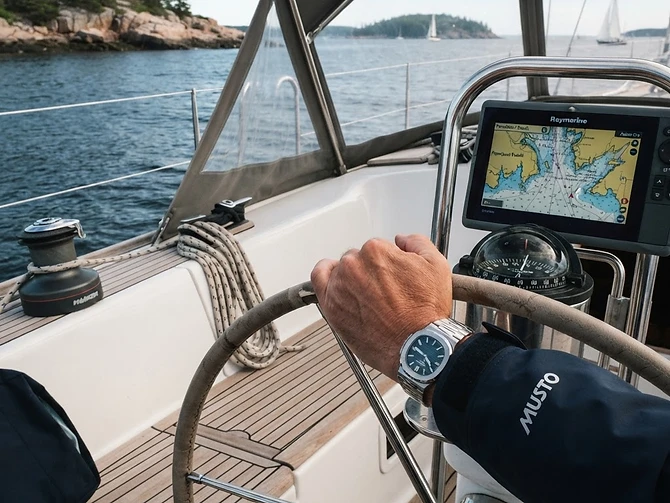
The dawn air in North Haven, Maine, carries a crystalline sharpness—a chill that bites through even the heaviest wool, native to the deep, cold waters of the Gulf of Maine. Aboard the Nautor’s Swan 78, the morning routine begins not with the dissonance of digital alarms, but with the tactile, deliberate resistance of a mechanical bezel being set. Out here, where granite headlands emerge from the morning mist like the hulls of ancient, submerged giants, the bridge becomes a theatre of profound, quiet focus. As we prepared to weigh anchor and thread our way through the narrow veins of the Fox Islands Thoroughfare, the helmsman’s attention was split between the shifting, spruce-cloaked silhouettes of the islands and the rhythmic sweeping of his Patek Philippe Nautilus. The steel casing, chilled by the damp, briny air, felt like a structural component of the yacht itself. There is an undeniable, grounding symmetry in using a purely mechanical instrument to navigate waters that have resisted the reach of the modern world for centuries, where the ebb and flow of the tide remain the only masters.
Tactical Seconds in the Thoroughfare
Steering a vessel of this displacement through the tight, unforgiving channels that define the Maine coast requires a patient, intuitive touch—a rhythmic navigation that often feels at odds with the frantic, flashing immediacy of standard glass-bridge plotters. As the current began to surge against our beam, flooding north toward the bay’s throat, the helm transmitted every nuance of the water’s weight, alive and insistent underhand. We were making for a protected, nameless cove near Stonington, a stretch of coast notorious for its chaotic tidal rips and the hidden, jagged shoals that keep local captains perpetually sharp. It is in these moments—where the depth sounder chirps a warning and the wind shifts violently in the lee of the spruce-topped cliffs—that the watch ascends from a mere accessory to an essential, auxiliary tool of navigation. Keeping a precise GMT track allowed us to calculate our arrival at the lobster shacks of Vinalhaven with sufficient accuracy to avoid the worst of the afternoon chop near the lead buoys. In the vast, shifting expanse of the Atlantic, the watch serves as a mechanical anchor, a reminder that every degree of heading and every passing second carries a consequence, a weight that demands respect.
An Evening at the Mooring
By the time we successfully secured the buoy off the coast of Camden, the sun was casting long, amber-hued light across the weathered, salt-pitted hulls of the local fishing fleet. We retreated to the aft deck, the teak planks beneath our feet still radiating the day’s absorbed warmth, while the scent of butter-poached scallops and Atlantic sea salt drifted invitingly from the galley. Our conversation naturally drifted back to the transit—the way the Swan handled the short, steep swell near the lighthouse, the visual markers we had verified in the thick morning fog. On the wrist, the watch, now warmed by the skin, caught the final, fading glow of the Maine dusk. It had weathered the salt spray, the constant tension of the helm, and the unpredictable, rolling movement of the deck, acting as a tireless, ticking companion to the wild, metamorphic landscape of the coast. As the constellations began to define themselves above the dark silhouette of the Camden Hills, the silence of the anchorage felt absolute, punctuated only by the distant, melancholic toll of a bell buoy and the unwavering, mechanical assurance of time passing in the dark.






