
The Geometry of the Outer Reef
The transition from the deep, bruising cobalt of the open Pacific to the pale, milky turquoise of the Fakarava lagoon is a physical event as much as a visual one. Standing on the teak foredeck of our 45-meter Perini Navi, the change in the water’s density is palpable against the hull, a distinct softening of the vessel’s vibration as we thread the Garuae Pass. The current here—a muscular, insistent force that dictates every movement of the local fleet—pulls at the keel with a heavy, rhythmic grip that demands the helmsman’s absolute attention. We have come to these remote reaches of the Tuamotu Archipelago not to race, but to experience the profound stillness that exists behind the protection of the jagged barrier reef. As the anchor drops and the chain settles into the sand, the constant, low-frequency roar of the surf on the outer atoll walls becomes a familiar hum—a permanent background to life on board that makes every conversation feel intimate, wrapped in the vast silence of the South Pacific.
The Logistics of Remote Sustenance
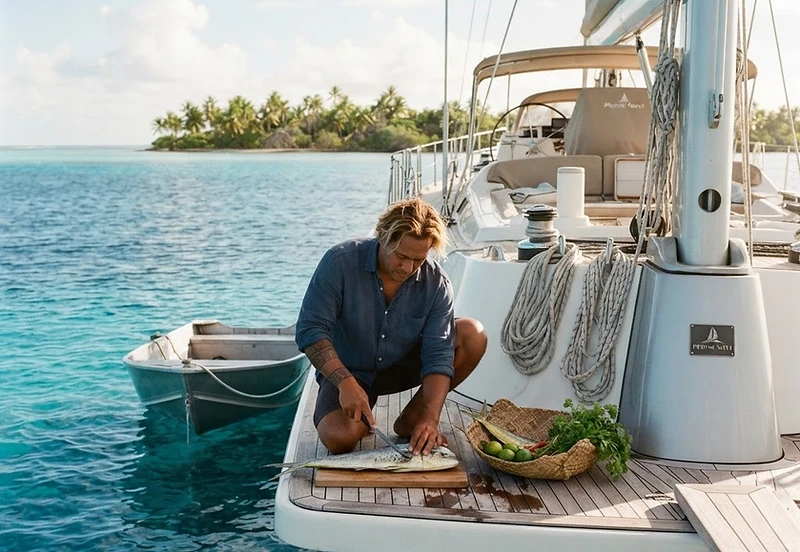
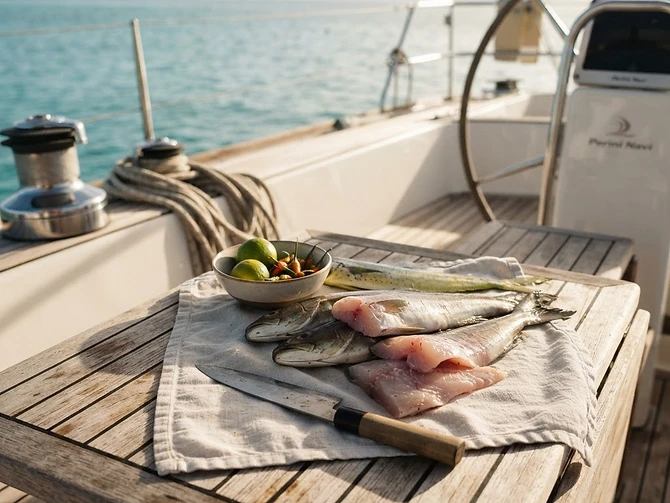
Life aboard a vessel of this pedigree, when stripped of the immediate proximity to the well-stocked provisioners of Falmouth Harbour or the bustling quays of St. Barths, transforms into a rigorous study in deliberate curation. Here, the challenge of the galley is not access, but a deep, meditative respect for our isolation. Our chef, Julian, works within the strict reality of our distance from civilization: crates of papayas gathered from a local grower near the village of Rotoava, fresh wahoo pulled from the pass just moments before the tide turned, and the essential stores held within the chilled hold. The evening ritual is never about excess; it is about the startling clarity of the ingredients. We dine on the aft deck as the sun dips below the silhouette of the coconut palms, the taste of the lime-cured wahoo mirroring the sharp, metallic tang of the salt-thickened air. There is a quiet, profound honesty in eating what the geography provides, a recurring reminder that on a vessel of this scale, one is a temporary guest of the ecosystem rather than a conqueror of it.
The Aftermath of a Salt-Stained Day
As the light fails, the true scale of the Pacific asserts itself. The absolute lack of light pollution turns the southern sky into an overwhelming, heavy archive of stars, visible in a way that makes the glowing, synthetic blue of the navigation suite’s monitors feel almost pedestrian, a ghost of a world left behind. We sit in the cockpit, the teak deck beneath our feet still radiating the stored heat of the day, watching the mast lights of a distant, unnamed sailing yacht flicker near the reef’s precarious edge. It is in these rare, distilled moments—when the mechanical hum of the generators is finally silenced, the sails are furled into the booms with practiced precision, and the only sound is the rhythmic, gentle slap of water against the transom—that the true utility of the charter reveals itself. We are suspended in a pocket of time, held securely in place by a single length of chain and the unwavering geometry of the atoll. Tomorrow, the trade winds will inevitably dictate our next departure, but tonight, the horizon is ours alone, anchored in the dark, breathing sea.






