
The Threshold of the Tasman
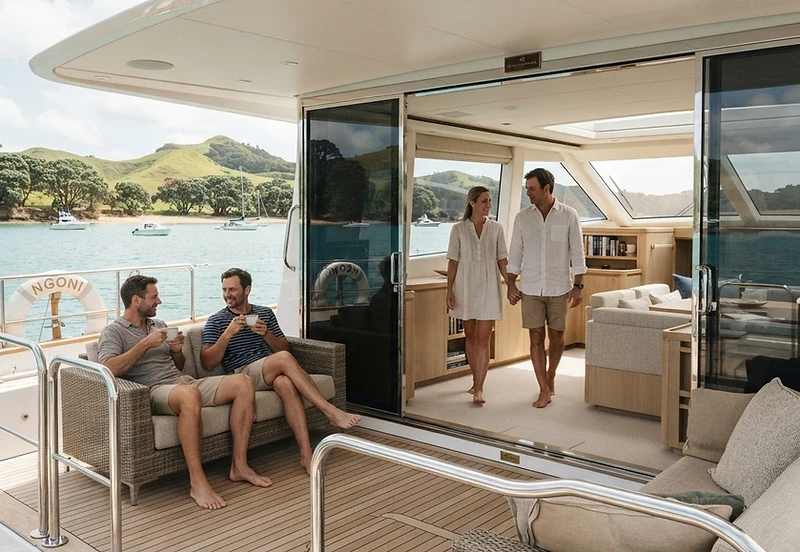
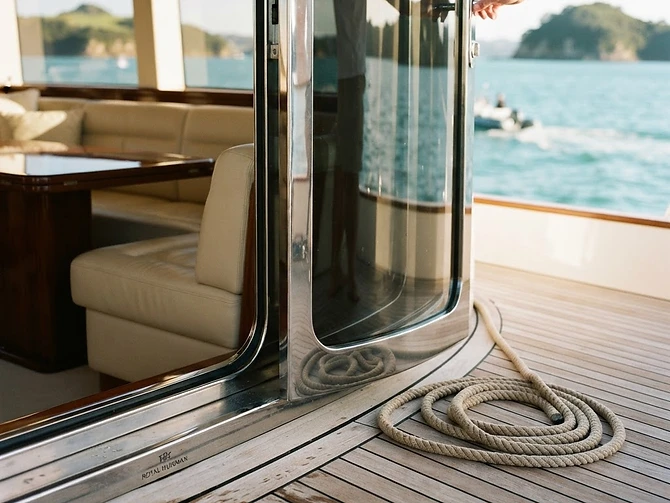
The morning off Urupukapuka Island arrived with a crispness that only the southern latitudes seem to command. We had anchored in the lee of the headland overnight, the Royal Huisman sloop swaying with a rhythmic, predictable grace that felt like an extension of the tide itself. As I stepped from the main aft deck—where the scent of damp teak and the faint, briny tang of the Tasman Sea still clung to the brightwork—the transition into the sky lounge felt less like crossing a doorframe and more like moving through a distinct change in state. The space is a masterwork of interior architecture, refined by the team at Andrew Winch, where the boundary between the vessel’s nautical utility and the intimate comfort of a private home is rendered nearly invisible. The glass doors had been pushed fully into their pockets, and the air moved freely, carrying the distant, melancholic call of a black-backed gull navigating the thermal currents of the Bay of Islands.
Architectural Continuity at Sea
To treat a superyacht as a house afloat is often a design cliché, but here, the logic is deeply structural. The sky lounge functions as the central, social spine of the vessel’s geography. Just as the great modernist villas perched along the Auckland coastline—those glass-and-steel cantilevered structures that look out over the Hauraki Gulf—use their expansive fenestration to frame the shifting horizon, this room uses its volume to domesticate the inherent wildness of the South Pacific. The joinery, meticulously crafted from bleached oak and matte-finished eucalyptus, mirrors the muted, shifting hues of the sandbanks exposed at low tide near Russell. Standing there with a cup of strong, black coffee roasted in a small batch in the town of Russell, I watched the captain check the wind direction on the bridge display just forward of our position. The integration of the sophisticated navigation systems into the forward bulkhead is seamless, allowing the vessel’s technical operation to feel as routine and domestic as the act of preparing breakfast in a residential kitchen. It is an architecture that demands nothing of the occupant, offering only a steady, calm perspective on the moving sea.
The Weight of the Horizon
The true utility of this space lies in its deliberate lack of friction. In the early afternoon, as we prepared to weigh anchor and make way toward the Cavalli Islands, the transition back to the deck was effortless. The sky lounge allows one to observe the muscular machinery of a sailing yacht—the precise tightening of the shrouds, the rhythmic flutter of the headsail as it catches the breeze—from a position of domestic stillness. There is no jarring, sudden shift from the elements to the interior; instead, the architecture acts as a sensory filter, softening the intensity of the southern light while preserving the absolute, biting clarity of the vista. As the sun began to dip behind the jagged, dark silhouette of the Northland mainland, the lounge caught the final, honeyed glow, throwing long, geometric shadows across the limestone-colored upholstery. In that quiet hour, with the low, steady vibration of the engine barely humming through the soles of my feet, the boat ceased to be a machine. It became, for that single, suspended moment, a sanctuary perfectly poised between the deep, dark weight of the ocean and the infinite, pale arc of the sky.
The wind picked up, veering slightly toward the east, and the Royal Huisman began her pivot. The sky lounge, now bathed in a slate-grey twilight, remained as steady as the land we had left behind, a final, glowing box of warmth against the approaching tide.






