
The Weight of the Watch
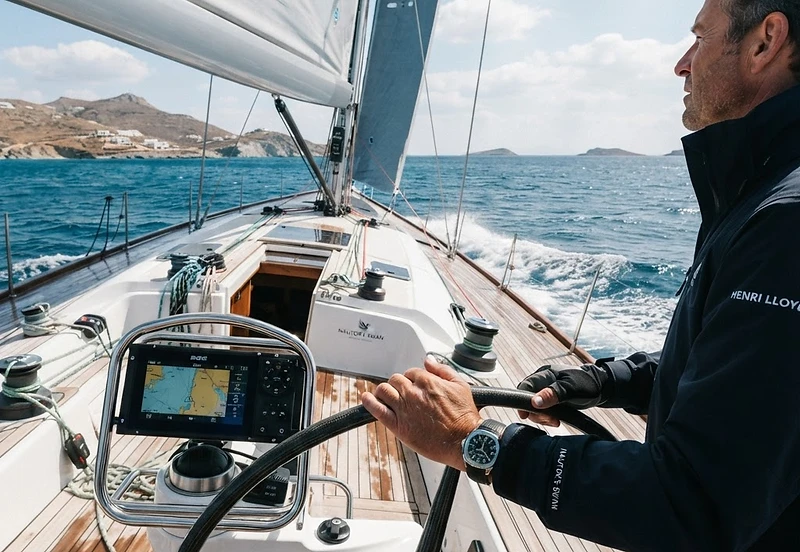
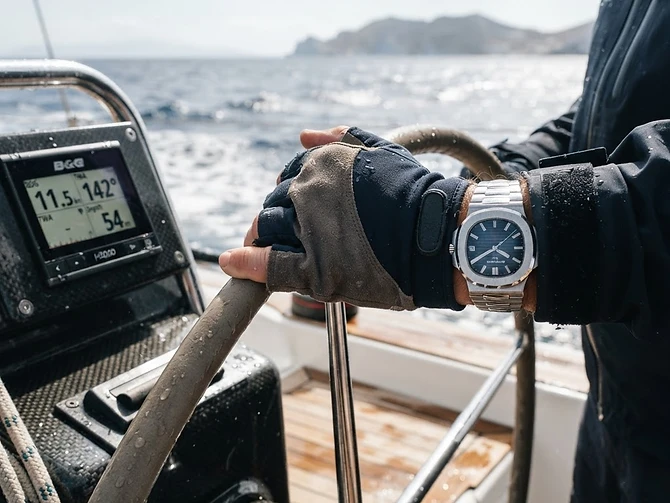
The Meltemi arrived as it often does in the Cyclades: a sudden, assertive cooling of the air that transformed the Aegean from a calm, turquoise sheet into a restless, cobalt expanse of white-crested ridges. We were aboard a Nautor’s Swan 98, her teak decks holding the persistent warmth of the mid-morning sun, though the rigging had begun to hum a sharp, metallic tune. Standing at the helm, the captain adjusted his grip on the twin carbon-fiber wheels, his eyes scanning the horizon between the jagged, sun-bleached silhouettes of Sikinos and Folegandros. On his wrist, a Patek Philippe Nautilus—its stainless steel case faintly scoured by years of salt spray—served as the silent, mechanical arbiter of our trajectory. It is a peculiar intimacy, the way a well-calibrated timepiece becomes a physical extension of the helmsman during a long, white-knuckled beat to windward, mirroring the structural integrity of the hull itself.
Precision in the Passage
Navigation in these waters requires a synthesis of ancient, sensory instinct and rigid modern calibration. While the Swan’s integrated B&G navigation suite provides a high-resolution digital map of every shoal, reef, and submerged rock, the true pulse of the vessel is kept by the chronograph strapped to the captain’s arm. We were pushing hard toward the anchorage at Karavostasis, the harbor masters’ VHF calls sounding faint and distant against the persistent whistling of the wind through the spreaders. The captain tapped the sapphire crystal of his watch, checking the offset for the approaching ship-time as we calculated the final transit through the narrow, rocky channels. It is not merely a tool for marking the hours; it is a weight of accountability. When the gusts swell to thirty knots and the boat heels deep into the churning dark water, the rhythmic, high-frequency tick of the escapement provides a strange, grounding stability. It reminds the deck crew that behind the immediate, spray-filled chaos of the sea, there remains an immutable, human-engineered order.
The Quiet Harbor
We finally rounded the headland, the violent, rhythmic pitching of the open sea subsiding into the protective, stillness of the bay. The anchor deployed with a deep, resonant splash, the galvanised chain rattling through the hawsepipe before biting firmly into the sandy bottom. We took the tender to the stone quay, walking up the steep, winding path to the Chora of Folegandros for a dinner of local matsata pasta dressed in tomato sauce and a glass of chilled, crisp Assyrtiko at a small taverna perched on the cliff’s edge. As the sun dipped behind the volcanic peaks, casting long, bruised violet shadows across the surface of the Aegean, the captain unbuckled his watch, setting it carefully on the weathered wooden table. It sat there, a circular island of microscopic engineering amidst the remnants of the meal—the crust of bread, the empty carafe, the salt-crusted napkin. Its hands marked the steady passage of a day well-spent. The sea had finally quieted, the wind was dying into a whisper, and for a moment, the only motion that mattered was the heartbeat of the spring contained within the steel casing, tethering us still to the vast, indifferent horizon.
As the moon rose to illuminate the white-washed walls of the village, the watch remained a silent witness—a reminder that while the sea demands our total presence, it is the rhythm we bring to it that defines the voyage.






