
The Anchor’s Geometry off Fernandina
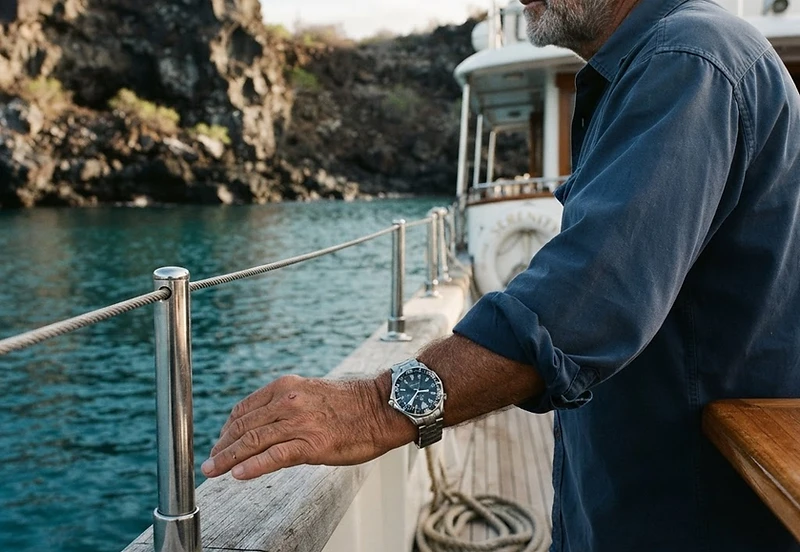
The dawn off Fernandina Island possesses a crystalline clarity that feels as though it predates human navigation. We were riding at anchor on a custom 50-meter Feadship, her teak decks holding the chill of the Humboldt Current before the equatorial sun began its rapid, vertical climb. There is a specific silence in the Galápagos, broken only by the sharp, guttural bark of a bull sea lion or the rhythmic, percussive slap of water against the hull. Standing on the aft deck, I watched the captain adjust his navigation settings, his movements measured and practiced from years of bridge duty. On his wrist, a steel dive watch—a piece he had worn through two decades of Atlantic crossings and heavy Pacific swells—caught the first sharp, horizontal rays of light. The aluminum bezel, once a crisp, inky black, had long since transitioned to a ghosted, matte charcoal, a transformation wrought by thousands of hours in salt-laden air and aggressive ultraviolet exposure.
The Anatomy of a Salt-Etched Passage
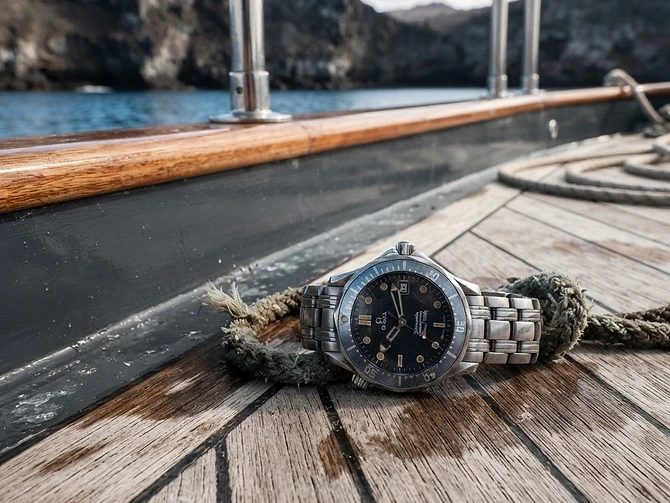
In the yachting world, we obsess over the ledger of maintenance—the meticulous application of varnish on teak capping rails, the endless polishing of stainless steel fairleads, and the preservation of flawless Awlgrip finishes. Yet, there is a separate, more intimate ledger kept by the gear we actually inhabit. That watch, a vintage Omega Seamaster, told the story of the vessel’s passage better than any captain’s log. The patina on the tritium markers was not merely aging; it was the biological clock of a life spent off-shore. I sat with the captain over a bitter, black coffee, the steam curling into the cool morning air as we discussed the day’s planned dive at Punta Espinosa. He rubbed his thumb over the scratched hesalite crystal, an unconscious gesture of tactile intimacy. He mentioned that in the mid-nineties, while refitting a Nautor’s Swan in the old yards of Antibes, he had acquired the piece from a retiring skipper who had logged more miles in the Roaring Forties than most see in a professional lifetime. The watch carried the DNA of those voyages: the light-damaged lume, the salt-etched casing, and a bezel that no longer clicked with factory-fresh tension, but turned with a soft, buttery smoothness honed by grit and time.
The Quiet Archive of the Deep
By midday, the heat became heavy and absolute, and we lowered the tender to scout the primeval volcanic shoreline. The black basalt rocks of Fernandina offer a stark, tectonic backdrop to the sleek, white, sculptural lines of a modern yacht. As we moved across the channel, the watch caught the aggressive glare off the Pacific, reflecting a dull, non-reflective glow that blended perfectly with the volcanic dust and the sea-spray. It served as a reminder that the finest tools do not stay pristine; they become collaborators in our experiences. We dined that evening at a small, wind-swept landing near Puerto Villamil, sharing fresh catch and cold beer—the kind of meal that tastes earned after an hour of free-diving in the cold, nutrient-rich currents that define this archipelago. The watch sat on the weathered wooden table, its faded face a small, ticking map of twenty years at sea. It did not track the artificial time of boardrooms or arrival terminals; it kept the time of tides, of anchor watches, and of the slow, inevitable drift of the horizon.
As we returned to the yacht under a canopy of stars that seemed to vibrate with tropical intensity, the silence of the anchorage reclaimed us. The watch, now darkened by the night, retreated into the shadows of the cockpit, becoming one with the vessel’s own quiet mechanical pulse. It remained a steadfast, unobtrusive companion, marking the seconds until we would weigh anchor at first light to find, once more, that the value of our time lies not in its sharpness, but in how deeply we have allowed the sea to weather us into our most essential forms.






