
The Anchor at Fernandina
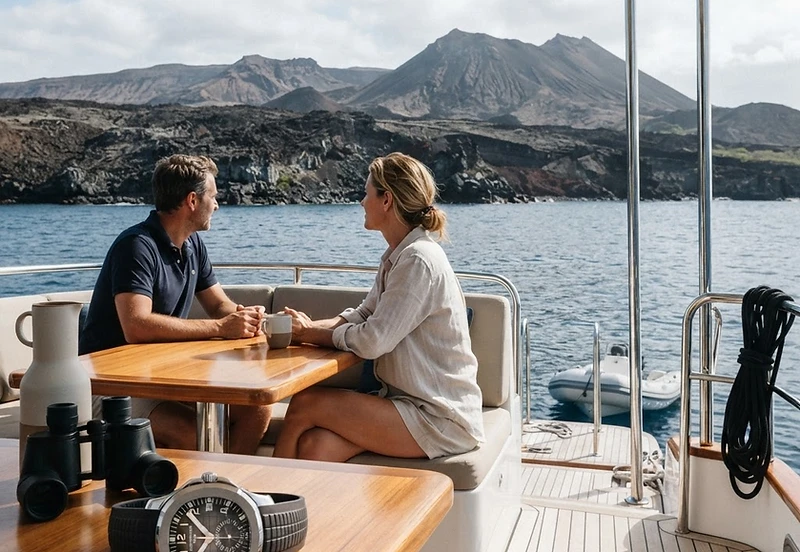
The dawn off Fernandina Island does not break so much as it bruises the horizon, a deep, indigo light bleeding into the charcoal silhouettes of the volcanic slopes. Aboard our Royal Huisman, the only sound is the rhythmic, metallic slap of halyards against the mast—a heartbeat that feels entirely detached from the mainland’s frantic pace. We are anchored in the shadow of the caldera, the water dark and dense as obsidian, cooling the hull from the equatorial sun that will soon sharpen the shadows into needles. It is late February of a leap year, a day tucked into the calendar like a secret compartment in a deck-saloon table, and the stillness is absolute.
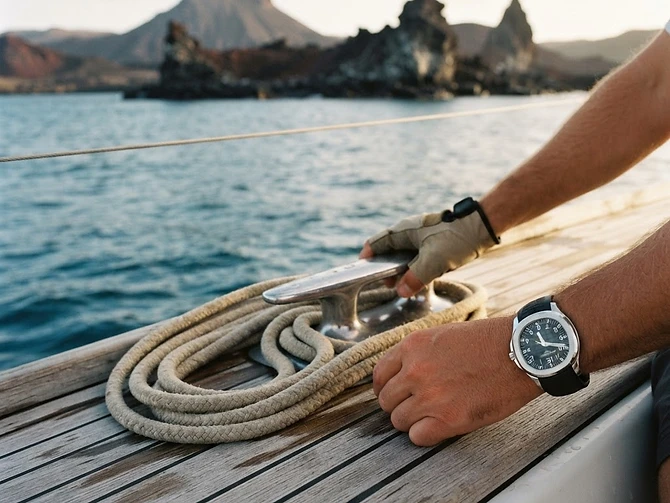
I sat on the aft deck with a cup of strong, black coffee sourced from the highlands of Santa Cruz, watching the Patek Philippe on my wrist. It is a perpetual calendar, a machine of such exquisite, miniature complexity that it has, for three years, accounted for the erratic dance of the earth around the sun without my intervention. On the dial, the small, circular aperture indicating the year had finally clicked over. There is a profound, quiet satisfaction in watching a mechanical object acknowledge an extra day, a twenty-four-hour gift we rarely stop to quantify. On the water, however, that extra day feels different. It is not a bureaucratic adjustment; it is an invitation to remain at anchor for one more tide, to watch the blue-footed boobies dive into the current, and to ignore the pressure of the horizon.
Mechanical Rhythms and Marine Time
In the yachting world, time is usually a matter of transit—ETA, fuel burn, the shifting of wind angles. We live by the GPS, by the digital flicker of the chart plotter, and by the relentless ticking of the engine room’s demands. Yet, there is a counter-culture to this, found in the way we maintain the varnish or in the slow, mechanical sweep of a high-complication watch. The watch does not need a satellite link to know that today, the 29th, exists. It possesses an internal memory, a logic forged from brass and steel that mimics the celestial mechanics keeping our boat tethered to this specific, remote coordinate.
Later that afternoon, we took the tender toward the shoreline of Punta Espinoza. The smell of the sea here is distinct—a mix of cold, nutrient-rich Humboldt current and the dry, mineral scent of ancient lava. As we drifted, the captain—a man who has spent two decades navigating these archipelagos—remarked on the tide. "The leap day," he noted, cutting the outboard, "is just the ocean's way of reminding us that the math is never quite perfect. Nature always demands a correction." He checked his own watch, a rugged, salt-etched diver’s piece, and nodded toward the reef. We were not moving, but we were observing, which is the highest form of travel.
Back on board, the sun dipped behind the jagged peaks of the island, turning the water into a sheet of hammered copper. We toasted the end of the leap day with a glass of cool, crisp Chardonnay from a small, biodynamic producer in the Chilean Casablanca Valley, its minerality echoing the basalt-heavy environment. The watch on my wrist, having successfully negotiated the transition, hummed with its steady, unwavering pulse, indifferent to the fact that tomorrow would reset the cycle. We didn't weigh anchor. We simply let the tide pull us a few degrees to the west, content to drift in the narrow, beautiful margin of an extra day.
As the moon rose, casting a pale, silver path across the Fernandina shelf, the silence of the anchorage felt complete. It is the privilege of the sea to offer these pockets of time, allowing us to step outside the linear march of progress. We are, for now, nowhere and everywhere, held fast by the anchor and the gears, watching the stars wheel overhead until the light returns to reveal the shore once more.






