
The Weight of the Watch Room
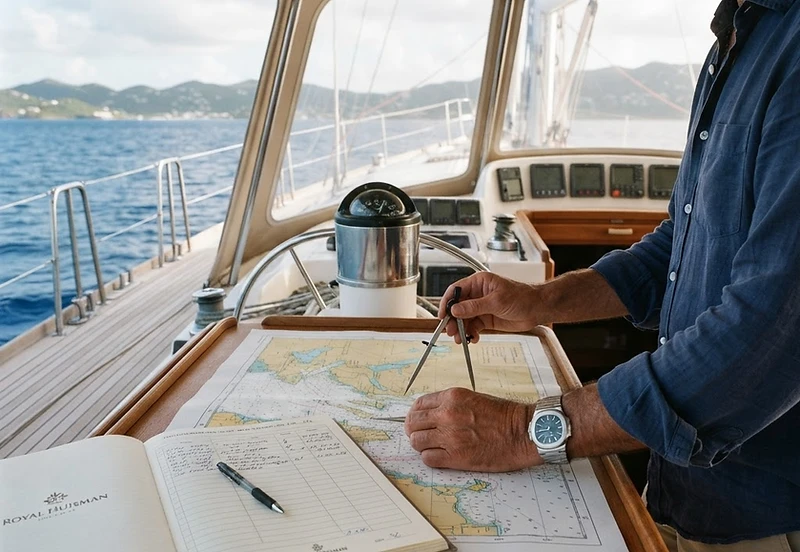
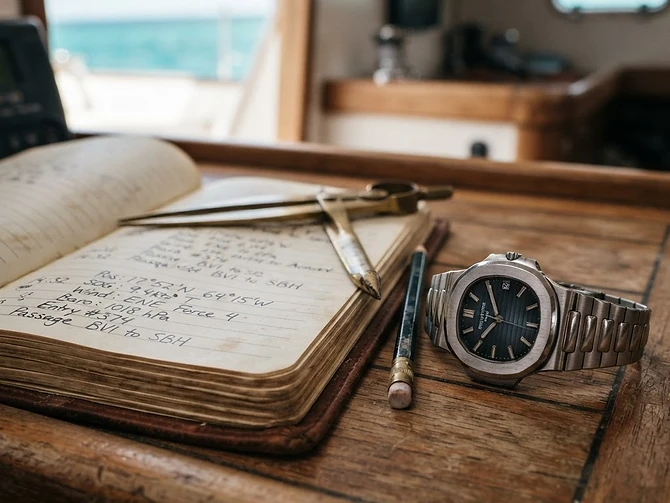
The dawn off North Sound, Virgin Gorda, has a particular clarity that makes the teak decks of a Royal Huisman ketch appear to glow like bleached bone. I sat on the aft deck with a cup of black coffee, the Caribbean trade winds already teasing the halyards into a low, rhythmic hum. Beside me, resting on the mahogany companionway hatch, was the ship’s logbook—a leather-bound record of every heading, knot, and swell encountered since we cleared the Solent. Tucked into the crease of the day's entry was a 1950s Patek Philippe reference 1463, its stainless steel case bearing the microscopic pitting of fifty years spent in and around the spray of the Atlantic. There is a curious symmetry to these two objects: the logbook records the physical passage of the vessel through the world, while the chronograph measures the relentless, indifferent progression of the hours that make those miles possible.
Tactical Seconds in the Gustavia Approach
By mid-afternoon, we were running on a broad reach toward St-Barthélemy, the spinnaker pulling hard against the tension of the winches. Navigating the approaches to Gustavia requires a shift in temperament; the water changes from deep, sapphire indigo to the brilliant, translucent turquoise of the shallows near Shell Beach. I adjusted the pusher on the Patek to time our transit against the local landmarks. Every adjustment of the helm, every minor deviation to catch a cleaner gust, was logged with a quick note in the book—a shorthand of survival and navigation. To look at the watch is not merely to check the time; it is to consult a mechanical witness. The patina on its dial, a soft, honeyed cream, speaks to the same ultraviolet exposure that has weathered the canvas of our sails. When we finally dropped anchor off the cliffs of Colombier, the silence that fell over the deck was profound, punctuated only by the soft click of the chronograph being reset—a final, satisfying punctuation mark to a passage defined by the twin disciplines of logging the position and tracking the time.
The Quiet Archive of the Anchorage
As the sun dipped behind the hills of St-Barth, casting long, bruised shadows over the masts anchored in the harbour, the day’s work concluded. The logbook was closed, the final entry noting the barometric pressure and the exact time of arrival, recorded with the same precision I had used to measure our approach. There is no sentimentality in this maintenance, only the recognition that a journey is composed of fragments—the tension of a line, the salt crusting on a bezel, the ink drying on a page. We went ashore for a late supper at Bonito, the lights of the superyachts shimmering on the water like spilled sequins. Walking back to the tender, I felt the weight of the watch on my wrist and the memory of the logbook’s rough paper under my thumb. We are merely the stewards of these records, holding our small, measured moments against the vast, unwritten indifference of the sea.






