
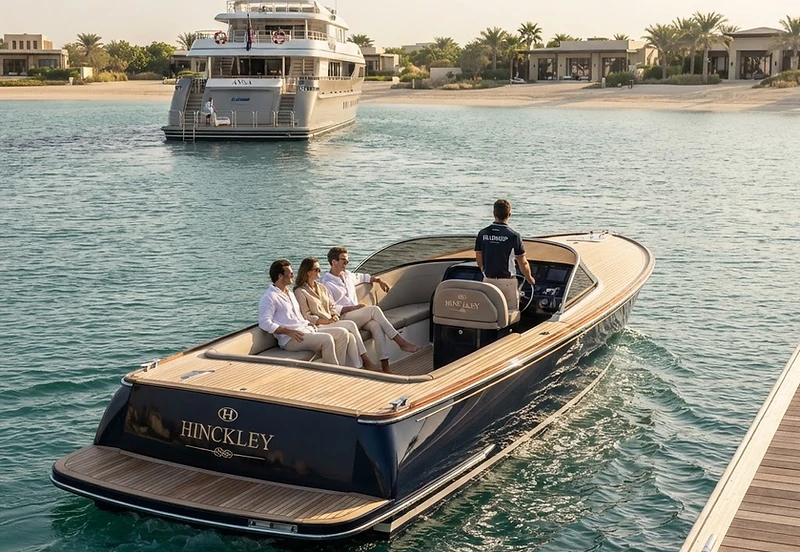
The 65-meter Feadship lay motionless off the coast of Abu Dhabi, her hull reflecting the bruised purple of a fading desert sky. On deck, the air was still, held in a state of suspended anticipation. We had spent the day tracking the slight variations in the Gulf’s tide, but as the heat began to bleed from the water, the evening’s mandate became clear: a transition from the mechanical precision of the yacht’s systems to the grounding intimacy of a coastal dinner. The crew prepared the tender, a custom Hinckley with the low, purposeful profile that cuts the chop of these shallow waters with surgical intent.
The Threshold of the Shallows
Descending the passerelle, the change in scale is immediate. On the yacht, we exist within a bubble of engineering excellence, surrounded by the constant, low-frequency hum of generators and the climate-controlled stillness of the interior. Once seated in the tender, that distance between ocean and sky collapses. As the captain eased the throttles forward, the white spray of the wake acted as a phosphorescent anchor against the gathering darkness. We were threading a needle through the shoals, the chart plotter glowing a soft, insistent blue in the cockpit. There is a distinct, visceral quality to these transits; you feel the depth beneath you change, the water moving from the deep, opaque teal of the channel to the translucent, lighter shade that signals the proximity of the barrier islands.
We were headed for Zaya Nurai, a brief fifteen-minute run that feels like crossing a meridian. The olfactory landscape changed rapidly: first the sharp, metallic tang of the yacht's engine exhaust, then the cooling salt of the open Gulf, and finally, as we neared the private jetty, the dry, baked scent of sand and distant jasmine. It is a sensory sequence that rewards the patient; the yachting life is often defined by the destinations we claim, but it is the physical act of getting there—the vibration of the hull against the swell, the spray on the glass—that creates the true boundary between the voyage and the arrival.
The Ritual of the Table
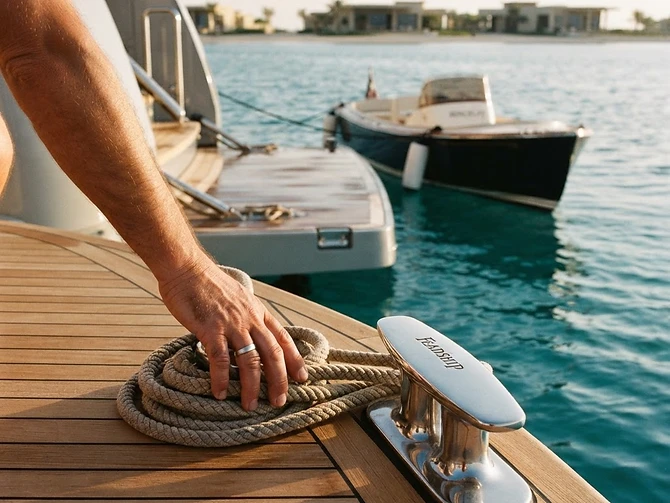
Upon pulling alongside the wooden pier, the shift from motion to stillness is profound. The tender’s engine cut, leaving only the rhythmic, hollow sound of water lapping against the pilings. We stepped off the boat, leaving the maritime rig behind for the informal pace of the shoreline. Dinner here is not merely a meal; it is a continuation of the day’s rhythm, a moment to digest the miles covered and the horizons charted. We sat under the low-slung, cedar-lined ceiling of a beach-front table, the floorboards still holding the day’s heat against our feet.
The service at the island is quiet, reflective of the local temperament—unobtrusive and impeccably timed. We spoke of the passage from the northern islands, the way the current had pulled against us near the breakwater, and the small, technical challenges of maintaining the vessel's position in such shifting tidal zones. The meal—a slow succession of local catch, charred with citrus and sea salt—felt appropriate to the setting. There was no rush, no sense of the clock. We were in a space designed to pause, a necessary counterbalance to the constant navigation required to keep a vessel of our displacement operational and secure.
As the conversation waned, we walked back to the jetty. The moon had risen, casting a long, silver splinter of light across the Gulf. The tender was waiting, its bow gently rising and falling with the tide. We climbed back in, the leather seats still holding the cool night air, and pushed off. The return journey felt shorter, a swift cutting of the darkness back to the illuminated stern of our home at sea. We climbed back onto the main deck, the yacht’s lights a welcoming beacon against the vast, empty expanse of the Gulf, and stood for a moment at the rail, watching the faint trail of our wake settle into the black, glassy water.






