
The Clearing of the Shallows
The dawn air off Key West carries a specific, metallic tang—a sharp distillation of drying turtle grass and the faint, sweet scent of cold-start diesel engines stirring in Garrison Bight. Stepping onto the aft deck of the Hinckley Talaria 55, the morning is hushed, save for the rhythmic, hollow slap of chop against the hull. We cast off with the outgoing tide, the island’s familiar silhouette rapidly retreating into a low, blurred smudge against the horizon. The passage to the Dry Tortugas is less a transit and more an intentional shift in gravity; we are moving from the manicured, social docks of the Florida Keys toward the stark, bleached expanse of the Gulf of Mexico. As the depth sounder transitions from the shallow, tea-colored flats into the deep, bruised indigo of the Gulf channel, the Talaria finds its stride. The vessel settles into a steady, confident plane, the JetStick controls offering a surgical precision that allows us to slice through the Gulf’s short, notorious chop with a grace that only refined naval engineering—and a well-balanced hull—can provide.
The Geometry of the Anchorage
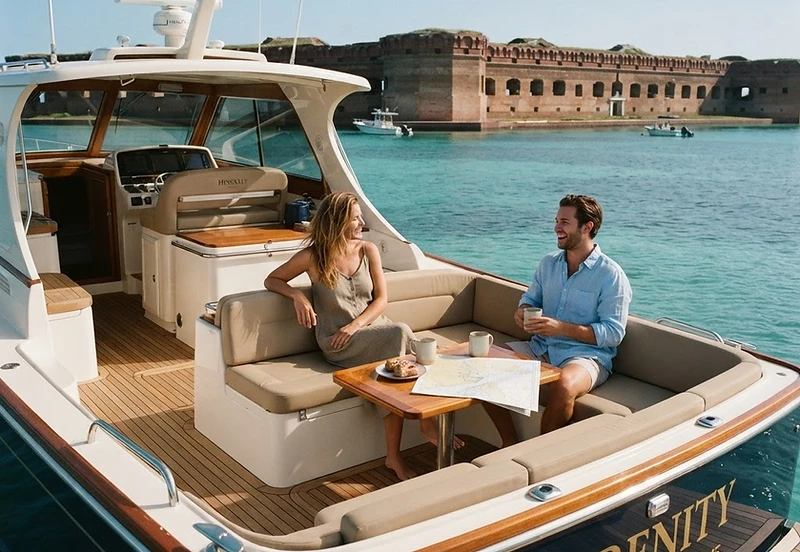
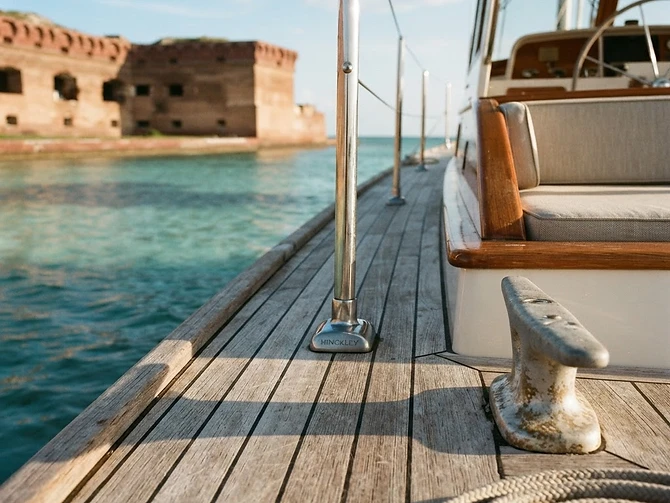
By early afternoon, the monolithic brick bastions of Fort Jefferson emerge from the haze like a mirage forged of clay and long-forgotten maritime history. Navigating the surrounding shoals demands a total suspension of distraction; the water flickers from a deep, inscrutable navy to an electric, translucent turquoise that hides shifting sandbars beneath an optical illusion of depth. We drop anchor in the lee of Garden Key, the galvanized chain rattling through the hawsepipe with a violent, mechanical finality that punctuates the absolute silence of the archipelago. Life aboard undergoes a sudden, radical metamorphosis. The focus shifts from the demands of navigation to the deliberate choreography of the anchorage: the meticulous deployment of the tender, the precise adjustment of the sunshade, and the transition into a state of profound, saltwater-induced stillness. The heat of the afternoon is managed with the whisper-quiet efficiency of the ship’s climate system, yet the pull of the water is impossible to resist; one does not simply watch this environment, one must be submerged within it.
Rituals of the Turning Tide
As the sun begins its long, gold-drenched descent, the rhythm of the boat settles into the essential cadence of the nightly cycle. We gather on the teak deck for a meal that celebrates the honesty of the region: local stone crab served simply with a sharp, citrus-forward dressing and a chilled infusion of basil and mint pulled from the galley’s small, self-sustaining window garden. There is a primitive clarity to dining under the vast, unpolluted canopy of the Gulf, where the only artificial light is the steady, rhythmic sweep of the Loggerhead Key lighthouse. We speak in lowered tones, our voices carried away by the cooling breeze. The frantic obligations of the mainland—the digital tether, the relentless push of the modern calendar—feel like remnants of a distant, irrelevant world, surrendered entirely to the current. Under the heavy, uncaring brilliance of a thousand stars, the ship swings slowly at anchor, tethered to the crumbling history of the fort and the endless, indifferent depth of the sea, the only sound the persistent, soothing murmur of water against the transom.






