

The Obsidian Surface of the Rebak Strait
The Andaman Sea in the early hours has a consistency that defies standard fluid dynamics; it is less a body of water and more a pane of polished obsidian, holding the jagged, inverted reflection of the limestone crags that define the Langkawi archipelago. Aboard our vessel, a classic Nautor's Swan that has spent years chasing the monsoon, the transition from the deep, cool dark of the aft cabin to the expansive reach of the teak deck is a deliberate act of shedding. The air is heavy, perfumed with the damp, earthy musk of the nearby mangroves of Pulau Rebak, a sharp, vegetal contrast to the saline bite of the morning breeze. Before the sun clears the distant headlands of the Malaysian mainland, the silence is total, broken only by the rhythmic, hollow tap of a loose halyard against the mast—a metallic heartbeat for a vessel held fast to its ground tackle.
The Ascent of Heat and Alignment
Life aboard a performance sailing yacht demands a peculiar sort of physical calibration, a constant adjustment to the vessel’s subtle movements. We begin not with the navigation station or the chart plotter, but with the body. A plunge into the cool, dark water off the transom swim platform provides the necessary awakening; the Andaman salt is dense, buoyant, and leaves a fine, crystalline film on the skin that feels like a protective layer against the encroaching humidity. Following this, the transition into the onboard sauna—a compact, cedar-lined volume tucked into the aft bulkhead—is a study in thermal extremes. As the heat rises, the world outside becomes a blur of saturated light and deep shadow, the boundary between the teak decking and the limestone teeth of the islands beginning to shimmer in the heat haze. Emergence from this heat serves as the prelude to the morning movement. On the foredeck, clear of the running rigging and the clutter of the headsail, the mat unfurls against the grain of the silvered timber. Each posture is an attempt to map the body to the vessel’s slight, gentle pitch against the anchor chain. It is here that one notices the fine, lived-in details of the craft: the tension of the shroud, the way the teak has aged into a muted slate under equatorial sun, and the low, steady hum of the refrigeration compressor deep within the hull—the mechanical lullaby of a life spent at sea.
The Ritual of the Return
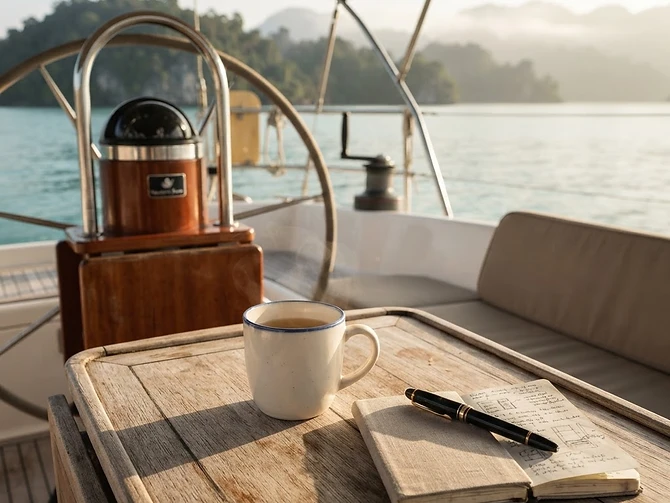
By the time the sun begins to bite, the anchorage has changed. Local longtail boats, their engines a distant, sputtering percussion, emerge from the inlets, and the morning's stillness gives way to the kinetic movement of the trade. We stow the mat and move to the cockpit for the first tea of the day, looking out toward the hazy, rising silhouette of the Langkawi massif. There is a profound honesty in this routine; it is not about luxury as a commodity, but about the luxury of time and the precision of place. As we ready the lines and check the wind over the bow, the memory of the morning's swim remains, a lingering, cool weight in the blood. The anchor winch engages, a low, mechanical growl that signals the end of the vigil. We turn the bow toward the open passage, the sea already beginning to wrinkle under the first true breeze of the day, and set our heading for the horizon where the blue deepens into the vast, uncharted reach of the Mergui.
The anchor clears the surface, shedding the dark mud of the strait, and for a moment, the ship hangs perfectly still between the depth of the sea and the clarity of the morning sky.






