
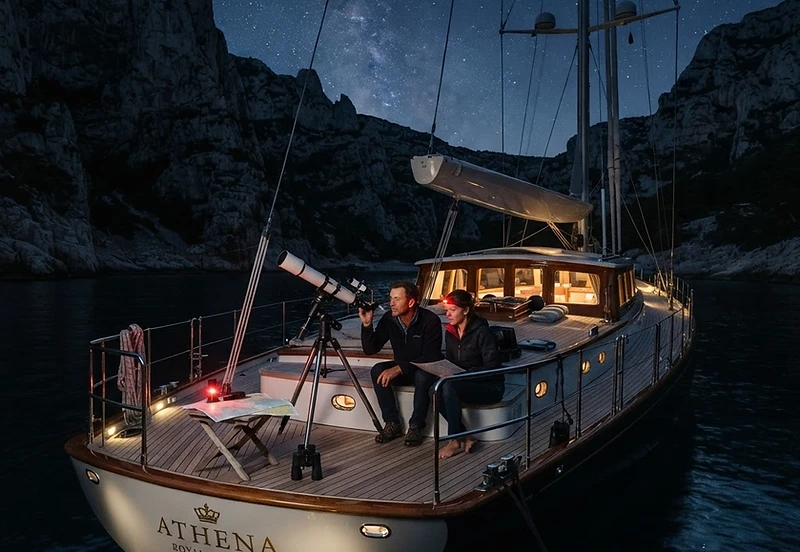
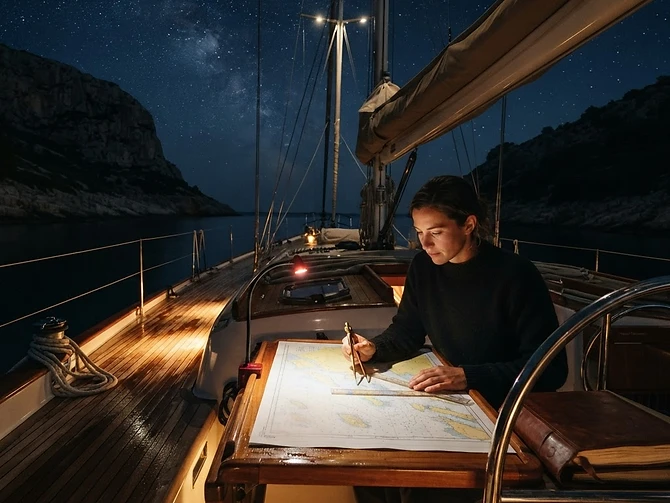
The anchor chain settled into the limestone substrate of the Kornati with a familiar, metallic groan that resonated through the hull of the Athena, a sixty-meter Royal Huisman ketch whose sheerline seemed to trace the very horizon of the Adriatic. By late afternoon, the heat had retreated from the deck, leaving behind the scent of sun-warmed teak and the faint, briny tang of the surrounding Karst islands. Here, in the heart of the Kornati National Park, the modern world feels less like a distant memory and more like an irrelevance. We were tucked into a quiet cove near Lavsa, where the landscape is a parched, lunar geometry of jagged stone, entirely stripped of the encroaching hum of the mainland ports.
The Ritual of the Evening Watch
Life aboard is defined by a series of quiet, deliberate movements. As the sun dipped below the jagged silhouette of the Levrnaka headland, the crew began the transition from the functional intensity of the afternoon sail to the stillness of the evening. There is a specific cadence to the deck team as they stow the gear, a focused precision that leaves the aft deck pristine, ready for the evening’s primary indulgence. Tonight, the dining arrangement was moved to the open deck, where the table—dressed in crisp, white linen—became the singular focal point of our small, floating universe. Dinner was a modest affair, eschewing the ornate for the authentic: fresh Adriatic sea bass, simply grilled over charcoal, accompanied by local chard and young potatoes sourced from a small grower on Murter. There was no rush; the rhythm was dictated entirely by the slow descent of the light and the gentle, rhythmic lap of water against the hull.
Celestial Navigation in the Kornati Deep
As the last amber glow vanished, the true character of this anchorage revealed itself. With the yacht’s exterior lighting dimmed to a soft amber glow, the sky over the Kornati transformed into a dense, sparkling tapestry. Away from the light pollution of Zadar or Šibenik, the Milky Way appeared with a clarity that felt startling, almost tactile. We retreated to the top deck, lying back on the oversized cushions to watch the constellations wheel over the masthead. There is a profound humility in star-gazing from the middle of the sea; one feels the scale of the vessel, not as a monument of engineering, but as a tiny, buoyant speck tethered to the pulse of the planet. I recall the steward leaning in, silently setting down a glass of cold, crisp Pošip, his movements barely audible against the ambient soft whistle of the wind through the rigging. We spoke little, the conversation yielding to the sheer, quiet force of the sky above, a reminder that the most essential luxury of a voyage is not found in the cabin below, but in the unobstructed view of the infinite.
As the night deepened, the constellation of Scorpio traced its arc toward the southern horizon, mirrored in the dark, glass-like expanse of the water. The anchor light burned steadily, a solitary, warm beacon in a vast and ancient darkness. By midnight, the boat had settled into a complete, expectant silence, the only sound the periodic, rhythmic creak of a block against the spreader, a soft percussion that served as the heartbeat of our night at sea.






