
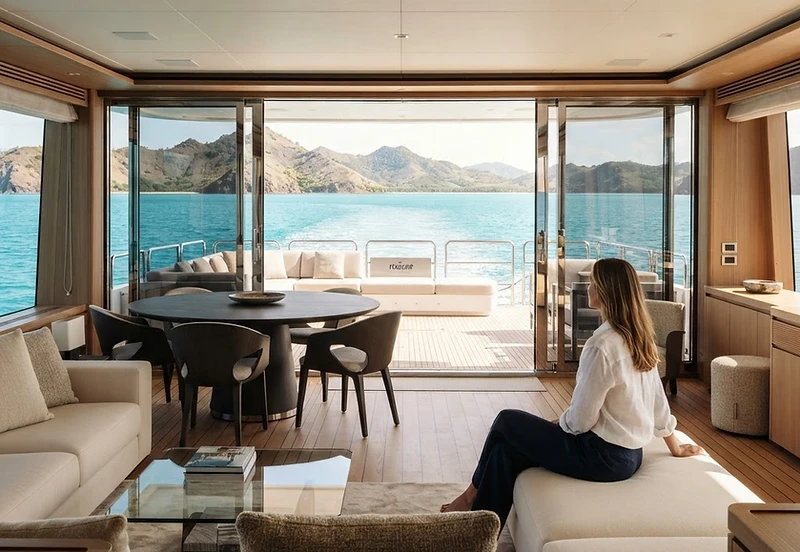
The morning light in the Yasawa Islands does not merely illuminate; it interrogates. As we lay at anchor off the northern tip of Naviti, the water shifted from a deep, bruised indigo to a translucent, electric turquoise that seemed to vibrate against the white hull of the 65-meter Feadship. Standing in the main saloon, the traditional boundary between the vessel’s interior and the jagged volcanic horizon outside felt entirely porous. This spatial recalibration is the signature of Remi Tessier, whose work here eschews the high-gloss artifice common to superyacht interiors in favour of a tactile, architectural honesty that mirrors the austere beauty of the Fijian archipelago.
The Pavilion of the Open Sea
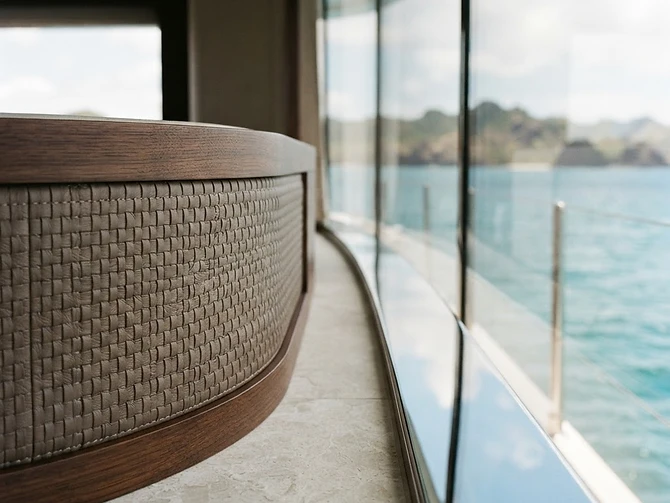
Tessier has approached the main saloon not as a confined cabin, but as a floating pavilion. The floor-to-ceiling glass panels are not merely windows; they function as primary structural apertures that define the room's proportions against the sheer scale of the South Pacific. Inside, the joinery—a muted, matte-finished sycamore—echoes the pale, crushed-coral sands of the nearby Blue Lagoon, while the low-slung, custom-upholstered sofas provide a grounding weight, mimicking the deliberate solidity of a modernist villa anchored to a limestone clifftop. There is no clutter, no attempt to compete with the dramatic basalt spires rising from the jungle on the shoreline. Instead, the interior architecture serves solely to frame the passage of a solitary local drua canoe, turning the simple, rhythmic movement of the tide into a deliberate aesthetic event. Every line leads the eye outward; the boat is not an escape from the environment, but a viewing platform for it.
Tactile Quietude in the Yasawa Reach
Life aboard, when the southeasterly trade winds inevitably stiffen, necessitates a shift in pace. We retreated to the saloon as the sky darkened over Sawa-i-Lau, the sudden, heavy tropical squall drumming a percussive, metallic rhythm against the aluminium superstructure. It is in these moments of forced seclusion that the quiet brilliance of Tessier’s layout becomes absolute. The transition from the teak-decked aft cockpit—where we had been sharing a breakfast of fresh papaya, lime, and local honey—to the interior is entirely seamless, a masterful blurring of thresholds. The air inside felt cool, structured, and scented faintly of dried sea salt and the organic, earthy grain of the timber.
The beauty of this space lies in its deliberate restraint; it acknowledges the inherent volatility of the Pacific while offering a fixed point of absolute, architectural calm.
Watching the rain cloud dissipate to reveal a razor-sharp, violet sunset, I realized that Tessier had managed to translate the structural poise of a permanent residence into the mercurial, shifting environment of a long-range cruiser. The saloon felt less like a room on a boat and more like a private observatory—an elevated, sheltered piece of architecture that grants its inhabitants the luxury of witnessing the wildness of Fiji without ever being subject to it. As the deck crew prepared the windlass and the anchor chain rattled, signalling our slow departure toward the Mamanuca group, the saloon remained a steady, quiet vessel within a vessel, holding its own form with complete indifference to the turning world outside.
By dusk, the transition from the boat’s interior light to the cooling blue of the twilight was barely perceptible. We remained in the saloon as the coastline began to smudge into the encroaching shadows, the vessel cutting a silent, narrow wake through the channel. The luxury here was not found in soft goods or gilded fixtures, but in the rare, unyielding stillness of a space that allowed the vastness of the Pacific to exist, undisturbed, at our very feet.






