
The Meeting of Limestone and Hull
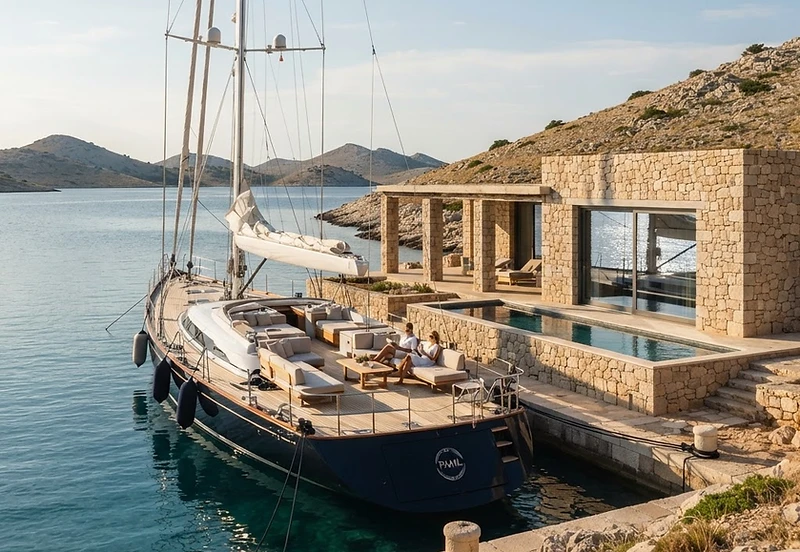
The dawn in the Kornati archipelago is not announced by light, but by the retreat of the dark—a velvet, pre-nautical blue that compresses the horizon into a single, sharp edge. I stood on the aft deck of the 45-meter Perini Navi as she sat motionless, her aluminum masts piercing the still air like upright needles. We had ghosted into the bay the previous evening, the engines cut well offshore, relying on the dying momentum of the tide to nudge us against the custom-built quay. This was not a commercial berth, but a calculated architectural intervention: a long, low ribbon of white Brač stone that extended from the shoreline like a pier hewn from the very geology of the islands.
As the sun began to heat the teak, the air carried the scent of cold salt mixed with the faint, sun-baked aroma of Mediterranean scrub—wild sage and rosemary clinging to the karst crags above. The pavilion, conceived by architects sensitive to the local vernacular, sat flush with the water’s edge. It was constructed not to command the cove, but to act as a bridge between the vessel’s complex engineering and the indifferent, rugged permanence of the archipelago. The stone had been hand-tooled to match the exact elevation of our rub-rail, allowing for a seamless transition; one could step directly from the vessel’s caprail onto the floor of an open-air living space that functioned as a terrestrial echo of our main deck salon.
Reflections on the Waterline
Life aboard a yacht of this pedigree is often defined by the barrier between the guest and the elements; you observe the sea through thick, reinforced glass. Yet, in this pavilion, the logic of the yacht was mirrored in reverse. The architectural plan was entirely open, mimicking the flow of the Perini’s wide decks, with heavy oak sliding panels that replicated the precise joinery found in our master cabin. At mid-morning, I sat with the captain, Luka, drinking nothing more than chilled mineral water. We watched the sea state refract against the undersides of the pavilion’s eaves, a flickering, liquid dance of light that made the structure feel as though it were drifting, untethered, just as the yacht did on her anchor chain.
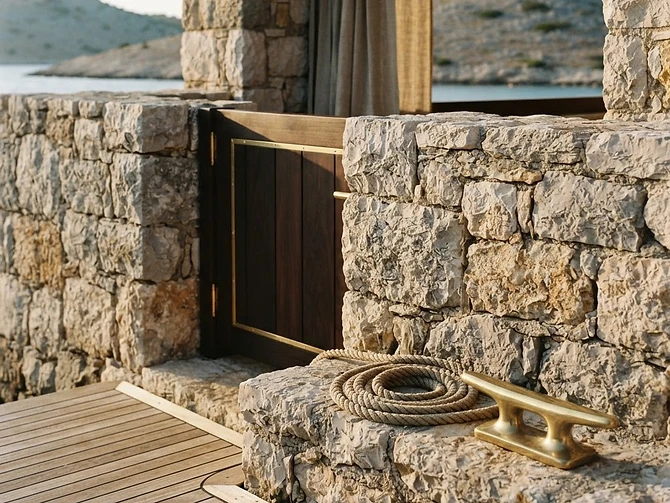
Integrating the shore with the ship is a fragile pursuit, easily marred by excessive glass or aggressive modernism. Here, the architects had resisted the urge to impose. By using the same rough-hewn stone for the quay as the surrounding cliffs, they ensured the berth appeared as if it had been weathered by the Adriatic itself. It was a space that dictated a specific rhythm: morning swims in the cool, clear shallows, long hours spent inspecting the rigging while leaning against the tempered limestone, and the quiet, repetitive ritual of polishing the stainless steel fittings as the sun hit its zenith.
By late afternoon, the heat became a physical presence, pressing the air down onto the water until the surface mirrored the dull, textured sheen of hammered pewter. We slackened the spring lines, the movement of the hull against the fenders producing that soft, rhythmic thrum—the familiar heartbeat of my twenty years at sea. There was no chaotic marina energy here, no drone of commercial machinery. Only the sharp, lonesome cry of a gull and the slow, inevitable negotiation of the tide against the masonry. As the light pulled toward the amber of evening, I looked back at the quay one last time, watching the shadow of the main mast creep across the stone floor, tethering the architecture to the passing day, and to the vessel that would, eventually, slip away into the deeper blue.






