
The Vertical Horizon of the Kangerlussuaq
There is no sensation quite like the morning descent into the Kangerlussuaq, where the towering basalt cliffs rise like dormant sentinels from the indigo water. As we brought our 30-meter flybridge motor yacht to a halt, the anchor chain rattled a sharp, metallic staccato against the absolute stillness of the fjord. Here, the scale is humbling. The vessel, a triumph of naval architecture defined by sweeping sightlines and expansive glazing, felt momentarily small—a drifting splinter of polished steel cradled by a landscape that has remained indifferent to the passage of eras. The air in the Arctic Circle does not merely blow; it cleanses, carrying the sharp, flinty salinity of distant icebergs and the deep, mineral scent of crushed stone.
The Galley’s Arctic Provision
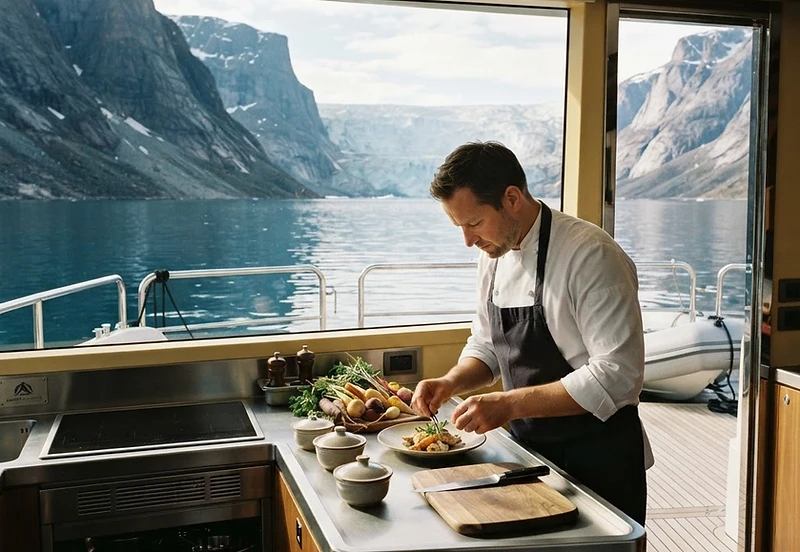
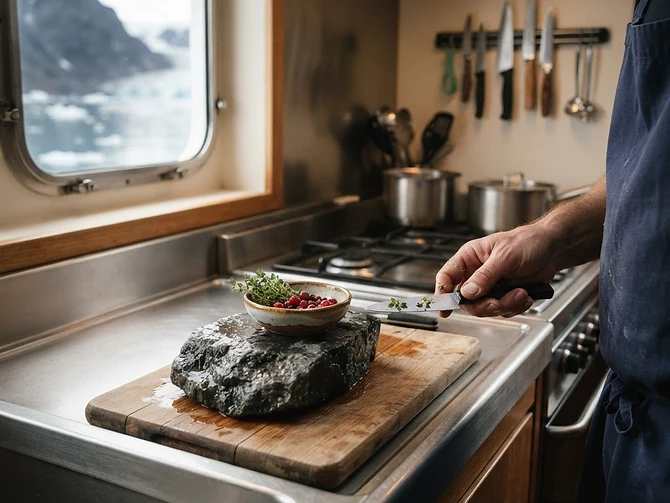
Life aboard, governed by a sun that barely brushes the horizon, finds its pulse within the galley. Our chef, having spent the previous evening exchanging stories with hunters in the small settlement of Sisimiut, returned at first light with a haul that defied the austerity of the terrain. We gathered on the aft deck, wrapped in heavy Icelandic wool, to sample the bounty of these frigid waters. We were served a refined kalaallit igaat—a Greenlandic fish stew—prepared with the firm, pearlescent fillets of native Atlantic cod, slowly simmered with wild crowberries and a pinch of hand-harvested sea salt. The meal was a masterclass in terroir, a direct dialogue between the harsh, unforgiving geography and the curated warmth of the yacht. We paired the catch with a reduction of local arctic thyme, an aromatic that clung to the palate with the persistence of the polar summer.
The Geometry of the Afternoon Watch
As the afternoon light sharpened into that peculiar, liquid gold characteristic of the high north, the flybridge became our sanctuary. To sit at the helm while the yacht holds its station against a gentle tidal pull is to understand the true resonance of seafaring: the mastery of space. We spent the hours tracing the coastline, observing the patterns of drift ice as they mirrored the towering cumulus above. There is no urgency in these waters, only the low, steady vibration of the generators and the soft, rhythmic lap of water against the hull. Below, the saloon, finished in muted, pale oak and brushed nickel, offered a deliberate, elegant contrast to the raw, jagged granite of the shore. It is in these quiet transitions—the movement from the wind-scoured bridge to the sanctuary of the interior—that one begins to measure time not by mechanisms, but by the slow, inevitable shifting of the ice shelves.
A Final Descent into Stillness
As twilight deepened into the bruised violets of the arctic night, the final engine note fell away, leaving us in a profound, ringing silence. The fjord, now a perfect black mirror, held the silhouette of our vessel as if suspended in obsidian. From the rail, one could trace the jagged line where the mountains met the stars, a celestial geometry that rendered every terrestrial concern irrelevant. We lingered for a final moment, watching the faint, ethereal green flicker of the aurora beginning its slow, spectral dance above the glaciers, the entire world distilled into the cold, clean clarity of the Greenlandic reach.






