
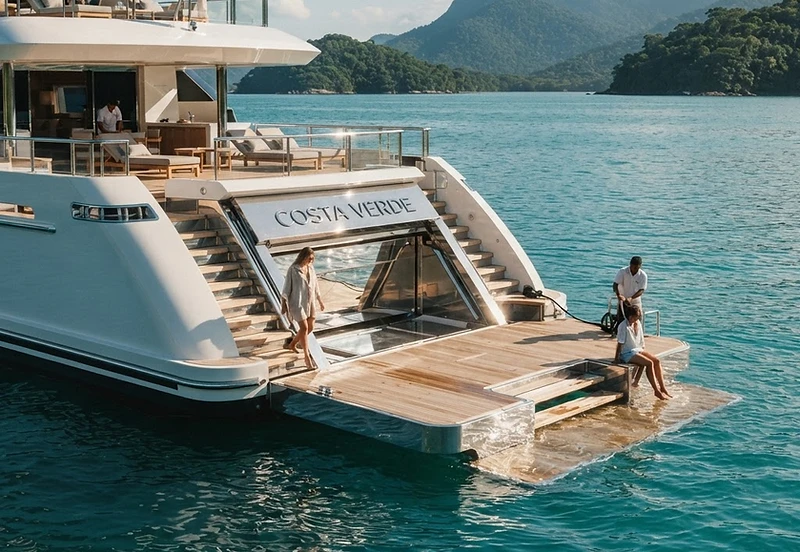
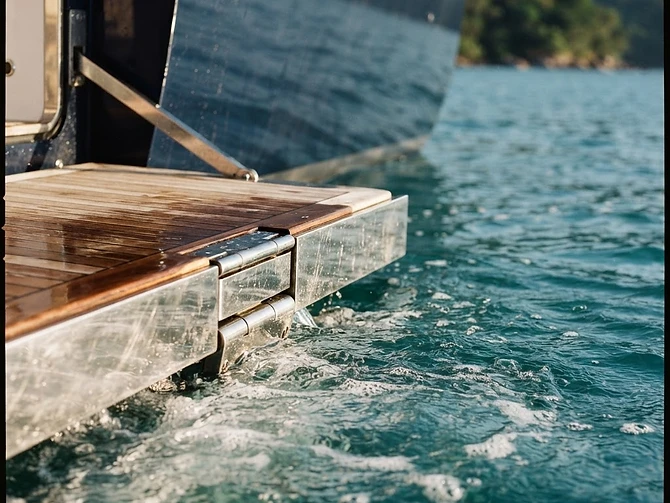
The morning mist was still clinging to the granite peaks of Ilha Grande when we dropped the hook in the sheltered turquoise of Saco do Céu. The water here is unnervingly clear, reflecting the dense Atlantic rainforest that tumbles directly into the sea. Aboard a 50-metre vessel, the transition from the high-gloss aesthetic of the aft deck to the water’s edge is where the true architectural ingenuity lies. As the hydraulic transom of the yacht lowered, it didn't merely open a garage; it unfolded a cantilevered pavilion, a stage set for the singular alchemy of the Costa Verde.
The Geometry of the Tides
Designing a beach club for a vessel navigating the unpredictable swells of the South Atlantic requires a precision akin to high-end residential architecture, yet it must operate under the constant duress of salt, humidity, and kinetic energy. When the beach club doors of our vessel—a craft defined by its clean, modernist lines—dropped into the horizontal position, the deck became an extension of the surrounding seabed. Naval architects understand that this space is not an amenity; it is a structural bridge between the interior salon and the ocean. The transition of teak planks, polished and sanded to a silken finish, created a seamless plane that erased the boundary between the vessel and the water.
We watched the crew set up the seating: low-profile, weather-treated furniture that echoed the brutalist shapes of the coastal rock formations nearby. The architecture here is ephemeral, existing only when the yacht is at anchor and the hydraulic systems are engaged. It is a reminder that on the water, the most permanent structures are often the ones that are designed to disappear into the horizon the moment the wind shifts.
The Living Shoreline
By midday, the heat intensified, and the beach club became our private island. We shared a lunch of fresh pupunha palm heart and grilled snapper sourced from a local fisherman’s skiff that had pulled alongside—the scent of charred fish and warm salt spray lingering in the humid air. The design of the space allowed for a natural, unforced flow; one could slide directly from the cool teak into the crystalline shallows of Saco do Céu. Unlike a villa anchored to the mud and stone, this floating architecture responded to every current. You could feel the subtle, rhythmic shift of the hull beneath your feet, a gentle, pulsing reminder that the building you occupied was fundamentally untethered.
This is the secret of the modern superyacht: the realization that the true luxury is not the internal volume of the vessel, but the ability to inhabit the threshold. As the sun began to dip behind the peaks, casting long, bruised shadows across the bay, the beach club felt less like a piece of engineering and more like a sanctuary. We packed away the cushions and secured the hatches, the massive hydraulic arms humming as they retracted the platform, sealing the hull shut against the coming night.
The yacht, now once again a clean, monolithic silhouette on the water, began to swing on its chain, turning its nose toward the mouth of the bay. I stood on the aft deck, watching the wake dissipate into the darkening water, leaving behind nothing but the faint, rhythmic sound of the tide lapping against the hull as the stars began to pin themselves against the deep, verdant sky.






