
The Geometry of the Anchorage
The morning had been spent in the lee of the Dongjiao Coconut Grove, our 40-meter motor yacht swinging gently on a scope that accounted for the shifting, unpredictable currents of the Qiongzhou Strait. From the bridge, the view was a continuous study in verdant palms pressing against the tide line, their fronds stuttering in a localized thermal breeze. There is a specific, heavy stillness that descends when the main engines are silenced, leaving only the slap of water against the hull and the distant, sharp cry of seabirds navigating the coastal thermals. By late afternoon, the decision to head ashore was less a matter of supply than a desire to reconcile the vessel’s contained, climate-controlled comfort with the chaotic, sun-drenched energy of the Hainan coast.
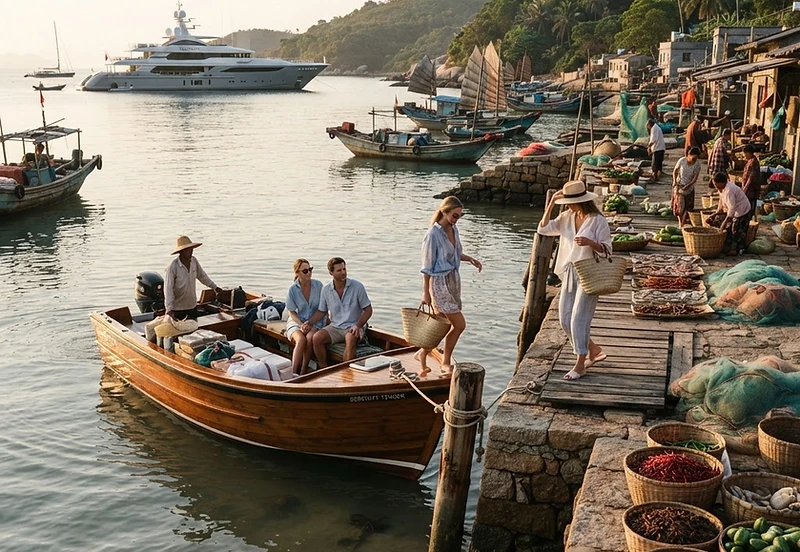
We lowered the tender, the familiar whine of the winch echoing against the gelcoat. Boarding is a ritual of timing; as the yacht rises on a minor swell, one must gauge the precise second to commit weight to the rubber gunwale. Once clear of the mothership’s shadow, the open cockpit of the tender offered a visceral, kinetic contrast to the deck. The spray, dense with the minerals of these shallow tropical waters, stung the skin as we threaded our way through a gauntlet of local fishing sampans—vessels worn by years of salt and toil, their hulls bearing the distinct, jagged scars of a thousand low-tide returns.
The Culinary Pulse of the Coast
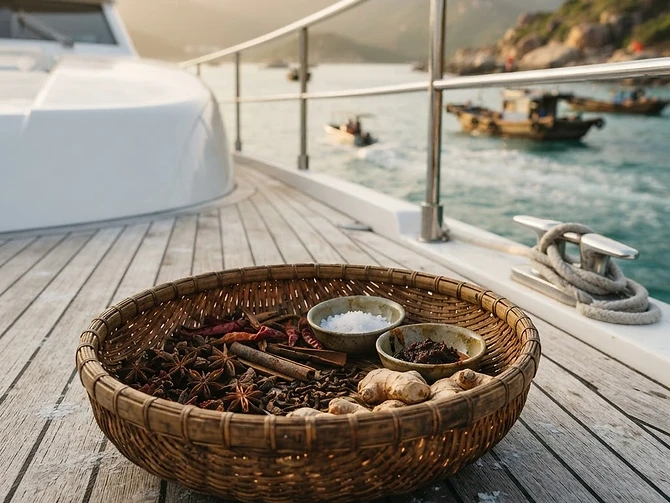
Making fast at the Wenchang wharf requires a navigator’s intuition, as the timber piers are constantly reshuffled by the bustling, flat-bottomed craft of local fishermen. We stepped onto the worn wood, the air instantly thickening with the scent of ginger, star anise, and the distinct, wood-fired char of open ovens. Our destination, a modest, open-air establishment favored by those who know these latitudes, is defined by a commitment to the province’s immediate harvest. Here, the menu is dictated entirely by what the coastal flats and the nearby groves provide.
We were served the traditional Wenchang chicken, poached in a clear broth infused with local coconut water and galangal, the meat yielding and redolent of the island’s unique terroir. Alongside it came a plate of razor clams, gathered from the tidal flats only an hour before our arrival, sautéed briefly with slivers of pungent garlic and a calculated splash of Shaoxing wine. The meal was rounded out by a simple, vivid preparation of morning glory, tossed in a fermented soybean paste that balanced earthy depth with a sharp, saline brightness. This is a cuisine that rejects ornamentation, relying instead on the intense, focused integrity of the raw ingredients—a culinary tradition that mirrors the functional honesty of a well-maintained engine room.
The Return to the Dark Horizon
The transit back to the anchorage under the emerging stars felt like navigating through heavy ink. As our tender’s navigation lights cut a narrow, oscillating path through the black water, the silhouette of our yacht appeared as a floating constellation, its deck lights casting a warm, amber glow onto the surface of the South China Sea. The hum of the outboard eventually faded into the rhythmic wash of the waves against the transom, a sound that serves as the final, absolute anchor for any seafaring soul.
Climbing back aboard, we left the lingering heat of the spice-laden port behind, settling into the familiar, hushed atmosphere of the aft deck. The transition from the chaotic, sensory-rich shore back to the controlled, saline elegance of the yacht provided the evening’s final, quiet symmetry. Looking out toward the distant, flickering lights of the mainland, the taste of ginger still lingering, we were reminded that the true privilege of this life is not the proximity to the shore, but the absolute liberty to depart it precisely when the tide dictates.






