
The Anchor’s Geometry in the Lee of the Rubicón
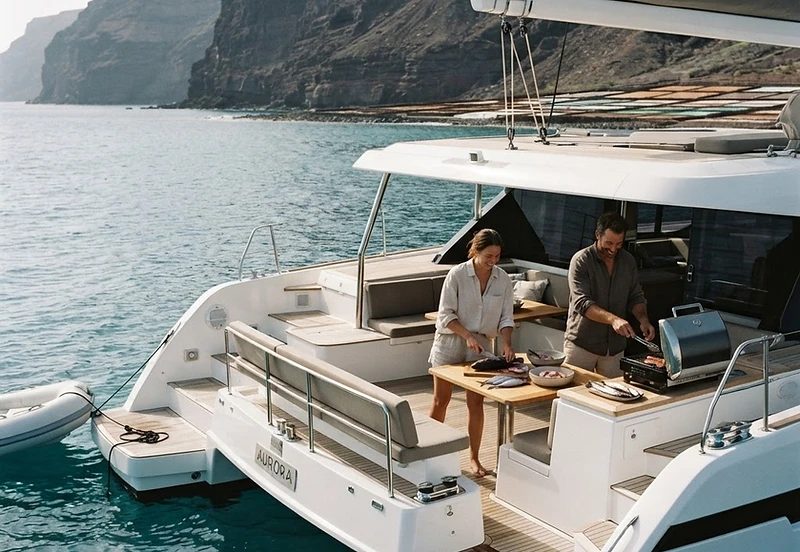
The morning light in the Canary Islands possesses a particular, crystalline quality, a sharp, unvarnished intensity that renders the volcanic landscape of Lanzarote into high-contrast geometry. Tucked into the protected waters near Marina Rubicón, the aft cockpit of our catamaran—a vessel designed with the open-flow ergonomics that define contemporary multihull life—functions less as a deck and more as a floating terrace. Here, the threshold between the bleached teak of the cockpit and the vast, cerulean expanse of the Atlantic dissolves entirely. We are anchored in the deep lee of the island, shielded from the relentless north-easterly trades, where the distant, rhythmic clatter of halyards against alloy mast-steps is the only cadence that persists.
Life aboard a catamaran in these latitudes is governed by the sun and the tidal swell. As the day warms, the cockpit becomes the social heart of the vessel. The architecture of the space, with its integrated seating and seamless physical connection to the saloon, mandates a slower, more deliberate pace. One is perpetually conscious of the sea; it is encoded in the salt-caked stainless steel, the undulating light patterns refracted through the saloon glass, and the subtle, rhythmic pitch of the hulls as local fishing pangas navigate the anchorage on their trajectory to the dawn markets.
The Culinary Pulse of the Volcanic Shore
In the Canary Islands, the ocean provides more than mere transit; it dictates the rhythm of the table. We maintain a strict discipline of regional sourcing, ensuring that the galley remains an extension of the island's arid, mineral-rich soil. Our chef, an advocate for the local pantry, frequently pilots the tender toward Playa Blanca at first light. He returns with crates of papas antiguas—those small, gnarled potatoes that hold the distinct, earthy minerality of the volcanic terrain—and pristine, silver-skinned sama roquera, or dentex, landed by local crews just hours prior.
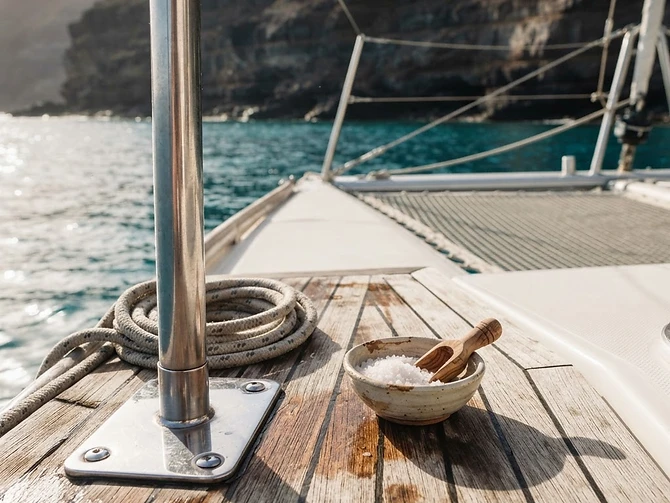
Dining in the aft cockpit is a ritual of elemental clarity. We sear the sama over white-hot charcoal, basting the fillets with a reduction of traditional mojo verde, where the sharp, herbal bite of green coriander and raw garlic punctures the rich, buttery flake of the fish. There is a profound, grounding connection in consuming a catch pulled from the very currents that hold our anchor chain. When we venture ashore, we nudge the tender onto the volcanic grit near local establishments where the focus remains exclusively on the integrity of the harvest. The meal is rarely about artifice; it is about the brine-soaked purity of lapas—limpets—seared on a heavy steel plate and seasoned only with a squeeze of lime and coarse, grey sea salt harvested from the nearby Janubio salt pans.
The Tether of the Tide
There is an inherent honesty to this life that defies the usual noise of the coast. As evening descends, the trade winds invariably abate, leaving the anchorage in a state of near-perfect suspension. The jagged silhouette of the Los Ajaches headland resolves into a singular black line against a darkening, indigo sky, and the yacht settles into the slow, gentle movement of the Atlantic tide. We sit in the cockpit, the air cooling against our skin, the faint, lingering salinity of the day still present, watching our masthead light flicker to life against the sprawl of the Milky Way. It is in these final hours—when the navigation is logged, the sails are tightly furled, and the galley stands quiet—that the true utility of the catamaran reveals itself: not merely as a machine for traversing the ocean, but as a private, floating island, anchored precisely where the deep blue meets the basalt edge of the world.






