The Chain’s Final Note
The anchor chain surged through the hawsepipe with a metallic rattle that, in the stillness of Velfjord, sounded like a closing door. As the Nautor's Swan 98 shed her momentum and swung to face the incoming tide, the vibration of the engine—a companion for six hours of steady progress through the Vestfjorden—dissipated into the sudden, expansive silence of the Helgeland coast. Here, the Norwegian light does not concede to night so much as it retreats into a permanent, bruising violet. The jagged peaks of the Sju Søstre range rose like ink-stained monoliths against a sky that refused to fully darken, casting long, mournful shadows across the black water. Standing in the cockpit, the air felt crisp, carrying the sharp, iron-scent of cold granite and the subterranean musk of damp moss, a sensory reminder that we were far beyond the reach of the temperate cruising lanes.
The Shoreline Anchor
Our position was dictated by the topography, yet it felt curated by the residence perched upon the headland. Designed by the architects at Snøhetta, the structure was a meditation on the marriage of land and sea. It was a low-slung composition of raw, local schist and expansive panes of structural glass, cantilevered over a jagged rocky shelf with such precision that it seemed to hover, poised like a vessel awaiting the tide. The terrace, hewn directly into the dark, striated bedrock, bled seamlessly into the water’s edge. Below the house, at a private pontoon, a polished mahogany motor launch bobbed in rhythmic syncopation with our own hull. The house did not loom over the water; it acted as a shoreline mirror to the yacht. As the evening deepened, the warm, amber glow from the floor-to-ceiling windows of the residence played across the swells, creating a terrestrial hearth that felt as steady and intentional as our own navigation instruments.
The Sanctuary of Varnish and Vellum
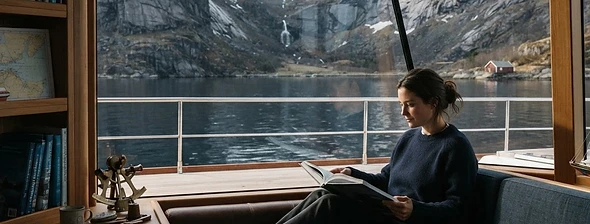
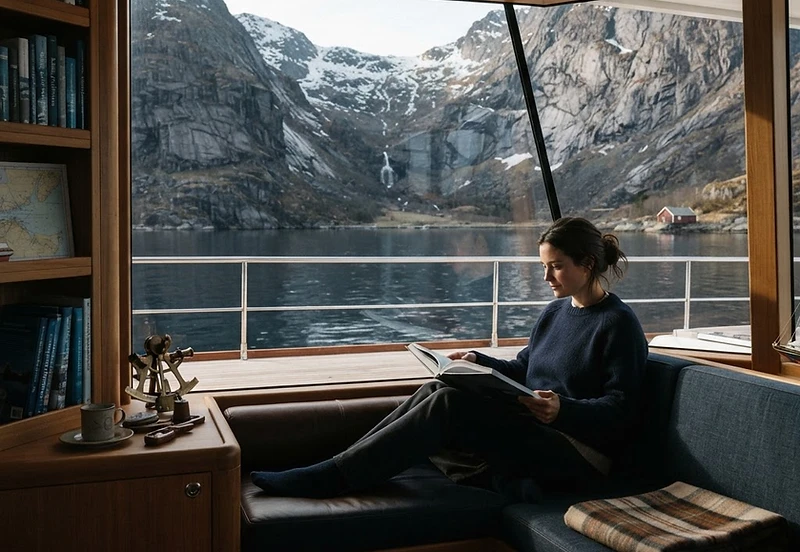
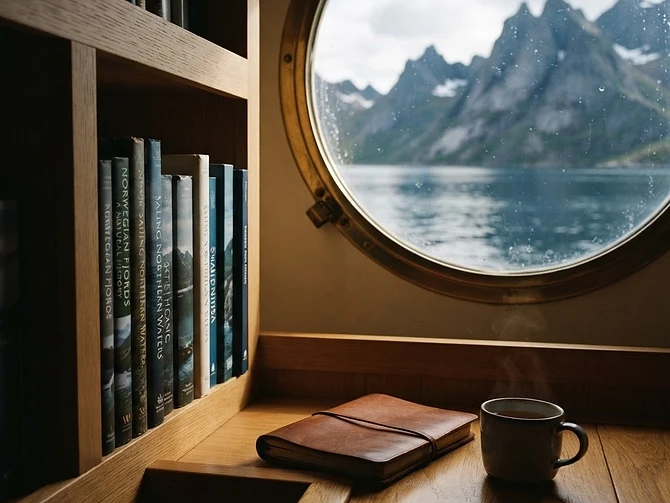
Below decks, the environment transitioned from the raw, sub-arctic wind to the temperate hold of the library saloon. While the Swan’s exterior is engineered for the violent caprices of the North Sea, the interior is an exercise in tactile density and quiet. The cabinetry, finished in hand-rubbed teak, held the day’s residual warmth, feeling solid and reassuring under the fingertips. Books on 19th-century hydrography and accounts of Norse maritime history lined the recessed shelves, their spines soft with the salt-etched wear of a dozen previous voyages. We spent the remainder of the evening in this golden capsule, listening to the slap of the water against the topsides—a rhythmic, hollow sound that no playback can replicate. A simple supper of cured Arctic char, seasoned only with sea salt and fresh dill, sat upon the gimballed table, the flavors bright and clean against the somber backdrop of the fjord. There is a singular, unhurried cadence to a long evening at anchor in these latitudes; the world outside is so immense that the act of reading, of maintaining a small corner of order, becomes a profound human reclamation. As the final sliver of twilight retreated behind the mountains, the boundary between the quietude of our cabin and the formidable, granite-bound shore dissolved into a singular, dark serenity.