
The Geometry of the Pacific Quiet
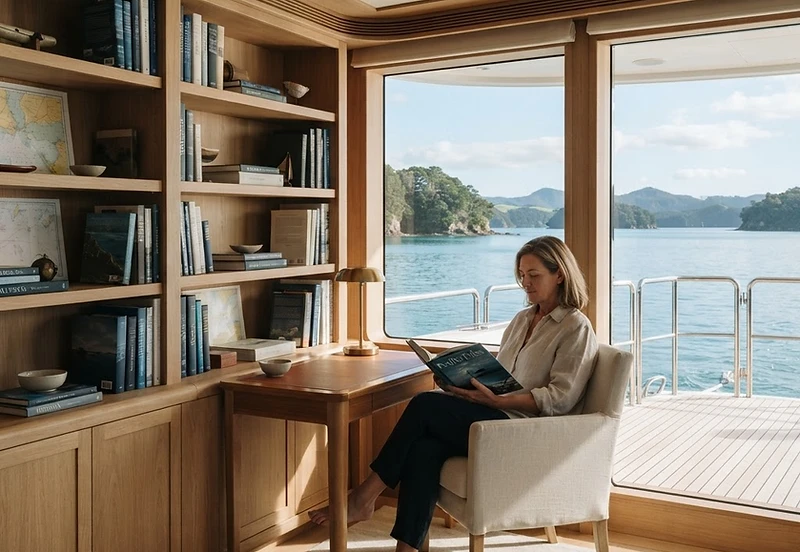
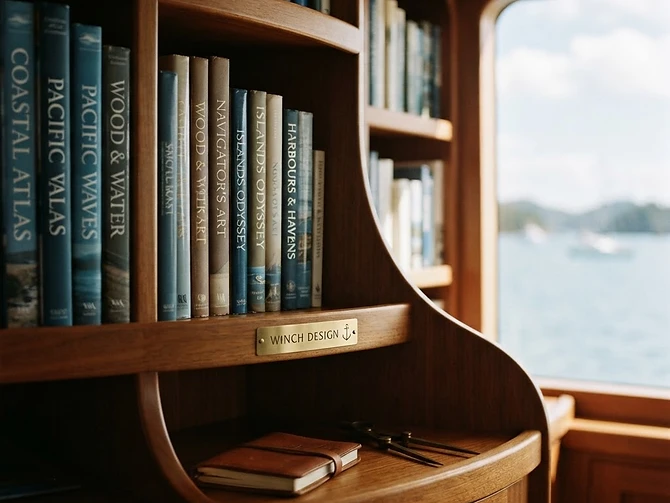
The dawn in the Bay of Islands does not break so much as it exhales. From the aft deck of the Athena, the water in Urupukapuka Bay was the colour of hammered pewter, undisturbed by anything save the occasional rhythmic slap of a tender against the swim platform. I retreated inside, passing through the primary saloon, to the owner's study—a space that feels less like a room and more like a carefully calibrated instrument of repose. The interior, executed by the studio of Winch Design, relies on a restrained palette of limed oak and deep, marine-grade cedar that seems to absorb the hum of the ship’s electrical systems, leaving only the silence of the anchorage.
There is a specific architecture to being at sea that mirrors the construction of the finest waterfront villas in the nearby townships of Russell and Paihia. Much like the cantilevered beach houses that cling to the volcanic cliffs of the Cape Brett peninsula, this study is positioned to exploit the horizon. The windows are oversized, frameless panes of tempered glass that suggest no barrier at all between the mahogany-lined shelves and the gnarled pōhutukawa trees reaching out from the shore. The room is structured to feel like a static extension of the coast, a terrestrial villa that happens to possess a draft of six metres.
Tactility and the Anchored Mind
Life aboard a long-range vessel is often defined by the noise of maintenance—the mechanical whine of a winch or the distant, steady pulse of a generator—but in the library, those sounds are relegated to the periphery. I spent the morning tracking the progress of a local fishing charter boat as it cut a white scar through the morning mist, heading toward the deeper, more turbulent waters near the Nine Pin rock. It was a visceral reminder of the dual existence of the vessel: a machine for traversing the Pacific and a home that must hold its own against the weight of the horizon.
The joinery here is exacting, echoing the clean lines found in the most disciplined modernist residences in Auckland’s Herne Bay. Every drawer pull is recessed, every shelf is secured with hidden magnetic latches to withstand a rolling swell, and the navigation desk is positioned such that one can monitor the depth sounder while contemplating a paper chart of the Hauraki Gulf. There is no performative grandiosity here; the luxury is found in the stillness of the grain, the scent of oiled timber mixing with the faint, persistent salt air that drifts in whenever the seals are bypassed. To sit here is to understand the yacht not as a platform for transit, but as a deliberate architectural choice to live within the weather.
The Final Descent of Light
As the afternoon wore on, the wind shifted, swinging from the south and bringing with it the bracing, herbaceous scent of wet stone and native fern from the mainland. I watched from the leather-clad desk as the tide pulled away from the exposed sandbars near Otehei Bay, revealing a mosaic of calcified shells and dark, tangled kelp. It is a strange, grounding privilege to observe the world through the lens of a library that can be relocated at the whim of the captain. The architecture of the yacht is finally revealed not in the polish of its hull, but in the peace it affords the reader. Before the light failed completely, I closed a copy of a local marine guide, the paper heavy and cool under my hand, and listened to the anchor chain groan against the bow roller—a small, metallic heartbeat in the darkening expanse of the bay.






