
The Anatomy of Stillness
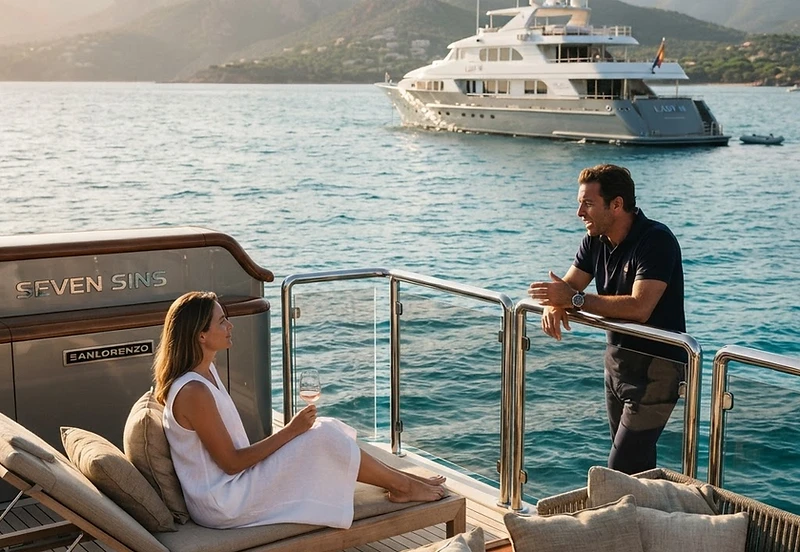
The motor yacht does not merely occupy space; it commandingly negotiates it. Positioned a mile off the coast of Saint-Tropez in the shimmering expanse of the Bay of Pampelonne, the vessel rests upon the water with an almost architectural density, its steel hull absorbing the relentless afternoon glare of the Cote d’Azur. There is no urgency here, only the measured oscillation of a craft tethered to the seabed, responding to the gentle, rhythmic pulse of the Mediterranean currents. While the distant shoreline of Pampelonne hums with the frantic, sun-drenched energy of the season—the faint, rhythmic bass of beach clubs carried on the mistral—the deck of this vessel operates as a discrete, private jurisdiction of silence, salt, and cooling shade.
I remember precisely the quality of the light at three in the afternoon, when the glare off the water becomes so absolute that it threatens to dissolve the horizon line entirely. Leaning against the polished stainless steel of the caprail, I watched the deck crew finalize the placement of the oversized linen cushions on the aft deck, their movements practiced and ghost-like. A glass of mineral water sat on the teak table, the condensation tracing a slow, uneven path down the side of the crystal, marking the only movement in an otherwise perfectly static scene. In this moment, the yacht felt less like a machine and more like a sensory filter, stripping away the noise of the French Riviera to leave only the essential geometry of sea and sky.
The Geometry of Repose
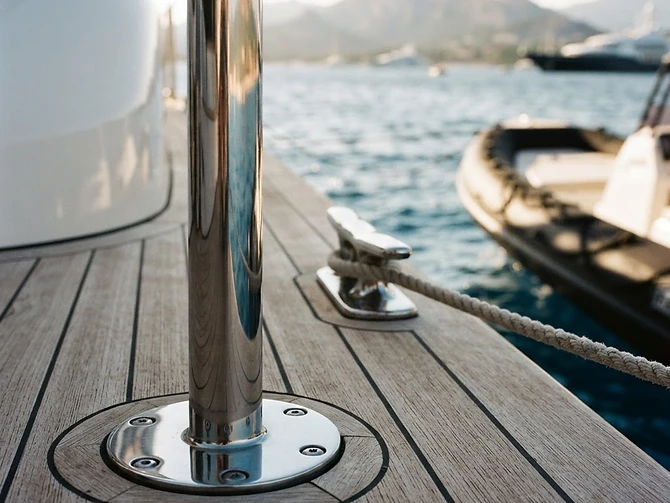
On board, the spatial logic is defined by an exacting minimalism. The clean, parallel lines of the teak decking draw the eye toward the distant Esterel mountains, unencumbered by the clutter of typical nautical artifice. One observes the play of light against the expansive glass of the superstructure, where the boundaries between the interior salons and the exterior environment appear to dissolve entirely. The architecture of the yacht serves to curate the intersection of shadow, wind, and the relentless, blinding blue of the horizon.
To rest at anchor is to participate in a larger, slower conversation with the elements, stripping away the friction of the voyage in favor of the clarity of the destination.
Later, as a light lunch was served—a simple plate of grilled sea bass caught by a local fisherman and finished with nothing more than lemon, olive oil, and sea salt—the conversation remained hushed. It is a peculiar luxury to eat in the middle of such an exposed bay, yet feel entirely insulated. The yacht functions as a floating extension of the most refined villa, a steel platform engineered not for speed, but for the deliberate suspension of time. The captain’s voice came over the internal comms, a low-frequency murmur acknowledging a slight shift in the wind, a reminder that even in stillness, the vessel is in a constant, delicate dialogue with the seabed.
The Weight of the Horizon
As the afternoon wanes, the vessel’s shadow stretches across the seafloor, a dark, cooling presence in the clear, sandy shallows of Pampelonne. It is a reminder that even the most opulent transport serves ultimately to facilitate an encounter with the immense. As the sun begins its long, gold-tinted slide toward the mountains, the yacht remains perfectly oriented, a steady, gleaming monolith amidst the fluid instability of the bay. There is an unmistakable nobility in this suspension—a state of grace achieved only when the engines are cut and the world is allowed to simply flow, uninterrupted, around the keel.
Evening arrives with a subtle change in pressure, the wind shifting from land to sea. The yacht settles further into its moorings, the slight, rhythmic creak of the lines against the fairleads the only audible testament to its massive displacement. The air turns slightly cooler, carrying the scent of pine from the coast, and the water around the stern turns a deep, bruised indigo. Tomorrow, the vessel may weigh anchor to pursue new coordinates toward the Iles d’Hyeres, but for now, it remains a centerpiece of the landscape, a definition of repose that feels both eternal and entirely fleeting.






